


Read this article in 中文 Français Deutsch Italiano Português Español
Interview: Kari Aulasmaa, CEO of Renta Group
02 November 2026
Renta Group celebrated the 10th anniversary of its founding in September, so it was a good moment to speak to the company’s founding CEO, Kari Aulasmaa, about progress so far and plans for the future.
The Finland-based company is already operating at yearly revenues in the €650 to €700 million range and is active in eight countries: Finland since 2016, Sweden and Norway (both 2018), Poland (2019), Denmark (2021) and the three Baltic States (2022).
Aulasmaa, who has more than 30 years’ experience of the rental industry including senior roles at Havator and Ramirent, spoke online to Murray Pollok from Renta’s head office in Vantaa, Finland.
It’s pretty extraordinary, isn’t it, what’s been achieved at Renta in 10 years?
Kari Aulasmaa: In a way. But you know, it was well planned from the beginning. We’ve been executing the same plan all the time.
It was not really a precise and detailed plan, but the big picture was very clear about what we would like to create and what kind of company we were building. Naturally we had some targets regarding the size of the company, but not really market share targets.
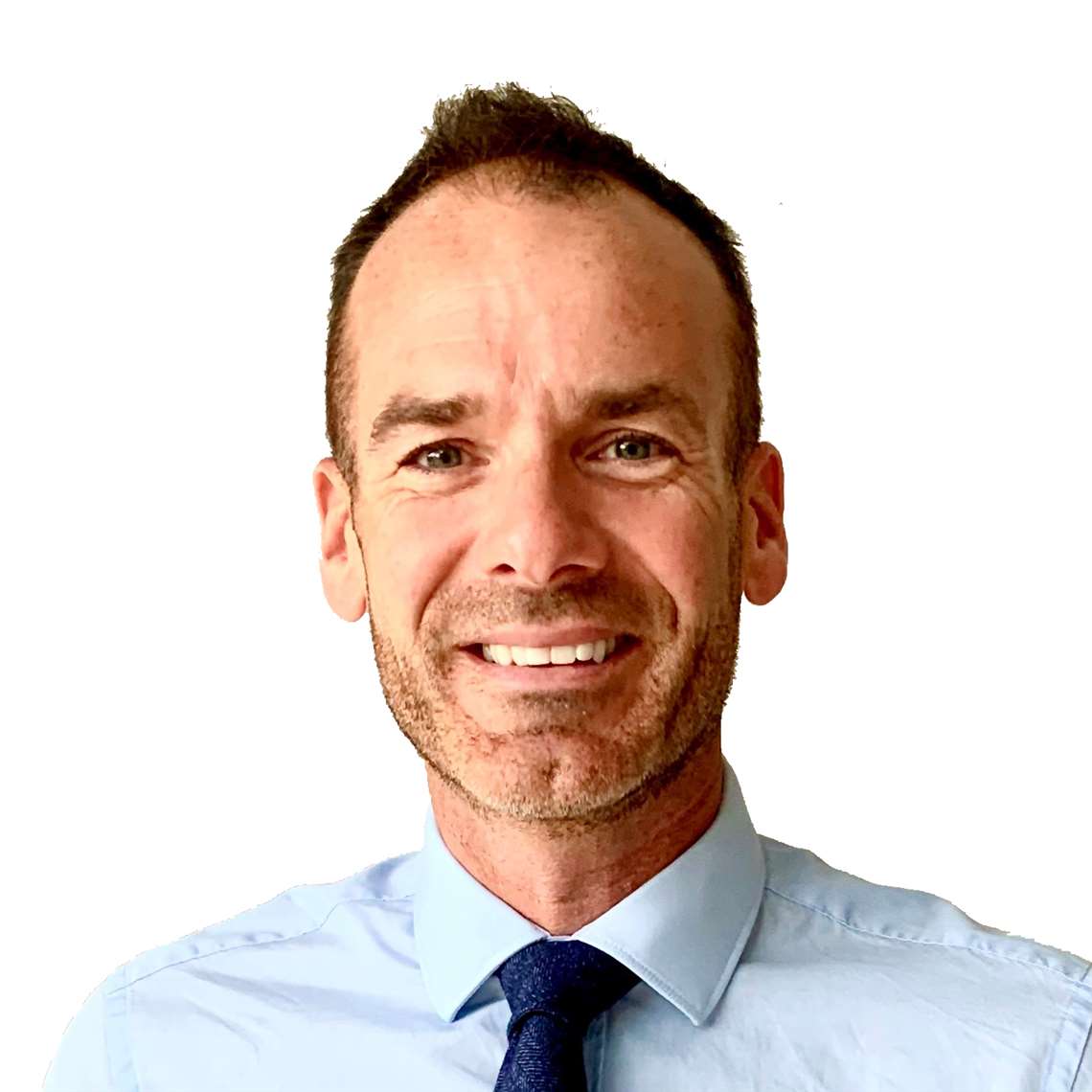
 Kari Aulasmaa, CEO of Finland-based Renta Group. (Image: Renta Group)
Market shares are something that you earn if you are good enough. It’s rather the outcome than the target itself, but naturally we know where we are.
In the beginning, the first four or five years, everything happened much faster than we expected. The market was favorable and I think we were a little bit lucky as well. Then, of course, there were years that you couldn’t really anticipate – the pandemic, the last three years, where we’ve been in a very deep downturn in the Nordics.
In terms of the revenue target, are you where you expected to be with €600 million revenue last year?
In run rate it is already above €650 million, approximately €700 million, so more or less where we expected to be.
You were all experienced rental people and you had a plan, but that scale in 10 years, it’s not usual, is it?
Well, if we look at rental sector specifically, I don’t know if anyone else has done it before in the way we did, but is it something special? We saw the market, we saw what was needed, and I think we read all the things in the right way, and it happened as we planned.
It’s often asked if we have taken market shares from others, but it’s not just a gaining game. We have managed to create new markets as well.
I quite often use Finland as an example, because in a way it’s been quite an advanced market, but rental penetration was always clearly behind Sweden. It was some 10, 12% behind, always. And I have had a very strong opinion and the only reason for that is that there are more high-quality rental companies and rental services available in Sweden, and Norway as well.
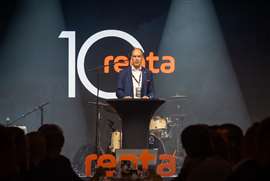 Kari Aulasmaa speaking at Renta's 10-year celebration in September 2026. (Image: Renta Group)
And what happened when Renta made an entry in Finland, in three years rental penetration jumped 12% and we were equal with Sweden. And only because suddenly there was one more good alternative for customers and less reason to own anything. It’s good for everyone if there is a strong rental sector with multiple different players.
And from the beginning we called ourselves a modern rental company. For us it means that we do things a bit differently. We realized that digitalization is here and now - it’s not coming in 10 or 20 years. So, in our strategy, digitalization and innovation was built in from the beginning, and in a way we have become a kind of front runner in terms of that.
What makes us very different is our local business model. I think our local business model is very different. Branch managers, local sales managers - we are as good as they are with their local customers. This is not the kind of business you can manage from a distance. They know their customers, what they need, and that’s why we allocate a lot of decision making power down to the local level. Decision making should play very close to the customer.
You mentioned that the last three years have been very difficult. Is the Nordic region definitely out of that phase?
Yes and no. Part of the market is really recovering, booming, and partly it’s still very badly down. I think the market structure has changed quite dramatically during the past three years. It’s mainly new residential construction which has taken most of the hits, and it’s been a real collapse. In the Nordics, levels are maybe 50 to 60% lower than three or four years ago. That’s a quite dramatic drop.
Maybe even more serious has been that renovation has been down at the same time. I think I’ve been in the rental business some 32 years and I have never seen it before that all four Nordic countries are following exactly the same trend, with such a deep drop all at the same time.
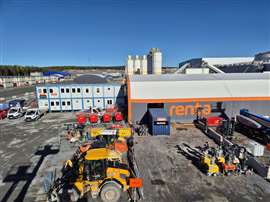 One of Renta’s 203 branch locations. (Image: Renta Group)
On the other hand, a couple of other construction sub-sectors have been doing very well. Infrastructure construction has been even booming in Scandinavia. We have had quite a good situation with industrial investments, many of those projects are related to the green transition, which is important topic in Nordic countries. In the Nordics, that’s still taken seriously.
[Before the downturn] our exposure to residential was around 15%, and now it’s 8 or 9%. So that’s a big change. At the same time, infrastructure construction and industrial projects, today that’s approximately half of our revenue.
And of course, the geopolitical situation is what it is. Finland and Sweden have recently joined NATO and we have a bit more than 2,000 kilometer border with countries like Russia and Belarus. So, I guess it’s not any secret that we are preparing ourselves and that means a lot of military related investments - building new roads and bridges to transfer forces or heavy tanks.
That helped offset the decline, because your revenues grew.
Yes. If you take past three years, our average growth has been approximately 15% a year. It’s partly through M&A, but we have grown organically as well. The organic growth rate has been around 6% in the past three years.
What is your approach to specialist rental? You have pump rentals in the Baltics and in Poland, anything else planned?
We have expanded pumps already to Finland and we are operating projects in Sweden and our ambition naturally is that pump rental operates wherever we are.
I would split our fleet and operation into two parts. We are in a way a generalist, which means that we have a very good footprint and rental network in all the countries where we are present. That’s always the ultimate target. Wherever we are, we want to become a nationwide provider with good coverage and network.
In addition to that, we see four different specialty categories. You mentioned the pumps, or water management as we call it, then we have tunnelling, which is very specialist and not so traditional for rental companies. If you are building lots of tunnels in Norway or wherever it requires totally different kinds of equipment, drilling machines, specialty lifts.

Then we have a very large scaffolding and weather protection operation. That’s an important product category for industrial projects and industrial maintenance shutdowns, but also renovation projects.
And the fourth, which is not always considered as a specialty category, we have a very sizable site module business.
These represent approximately a quarter of the business. It’s growing and I expect that to grow in the future.
Why wouldn’t you have power, for example, for data centres. Do you see that business expanding?
First of all, guess how many times I have been asked that question. In the Nordics, the electric grid is everywhere and electricity is cheap. So, compared to other areas globally, the power market is not so big. That’s the reason why we don’t consider it as a specialty sector.
Naturally, we have a lot of generators and I mentioned power management, which is actually becoming maybe the next specialty sector. It’s much more than power generators, it’s managing power and energy overall. That’s a total concept where generators play a certain role.
What about the data centre opportunity?
We are serving many data centre customers already. It’s not new. And actually, Finland especially has become a kind of promised land for data centres. The grid is everywhere, electricity is cheap, and in addition to all that, it’s cold here, so you don’t need to cool down your data centres. Even more, when it’s cold, the data centre is generating heat that can be used in district heating.
And these projects are mainly in Finland?
Yes, more in Finland than anywhere else. I think all in all, we have counted approximately 40 different ongoing projects at the moment in our operational area. Each project is a minimum three years, regardless of what size of data centre it is.
But it’s very easy to see that in next four or five years it will be a very important sector, maybe even the next 10 years. And when I said that there are 40 projects ongoing, there are plans for another 40. So that’s a big customer sector already now and will be even more important.
In those projects are you always the sole provider or sometimes working alongside competitor rental companies?
Yeah, there are all these variants, and in some cases it depends on the customer. Of course, the big companies behind the data centres, they don’t build anything themselves…in many cases, they want to have one partner who is ready to solve whatever they face. And in these companies, they are in new geographies, they don’t know anything about how things work in these countries. So, they really appreciate it if someone is willing and capable to solve their needs.
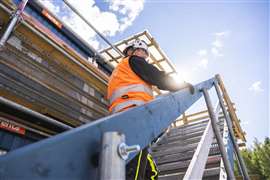 Site modules are an important element of Renta’s data centre projects. (Image: Renta Group)
Typically, it starts from the site modules - each data centre requires hundreds of site module units – and the site areas are very large. They take a lot of fences to isolate those areas and a lot of traffic and safety equipment. And naturally, construction always requires energy and now we come to power and it’s not based on generators as much as maybe in UK.
These data centre customers are very demanding. They have their own quality standards and sustainability requirements and are very careful with those. So, as a customer, they are more demanding.
Are they profitable contracts?
We don’t usually disclose those numbers on a project or customer basis, but they have high requirements and high standards and are ready to pay for those as well.
M&A has been a big part of your growth. How do you see that going forward?
Yes, I think in 10 years we have done 43 acquisitions. So Denmark [Nordjysk Lift in March this year] was number 43. But it maybe gives a picture that we are just buying and building, but that’s not the whole truth. Organic growth has played a very important role as well. If I look at our network of 203 depos today, approximately half was acquired and the other half is greenfield starts.
I’ve always said that we don’t have any specific M&A strategy. Our ultimate goal is always to build up a nationwide operation, including network and certain product categories. And we have always two alternatives: either you buy something or you establish something yourself. And it’s case by case, what makes sense.
Is there scope for a transformative acquisition in your territories at the moment?
Naturally we are looking for more transformational acquisitions. We have done a couple of those. I mentioned 43, and naturally most of those are quite moderate sized companies where you just build your network step by step, with four, five or 10 depots.
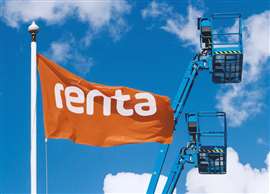 Aerial platforms are a core product in Renta’s fleet, but not treated as a specialist division. (Image: Renta Group)
Of course, you could imagine that if you have acquired 43 companies, you could ask what’s left. We are a true nationwide provider with certain white spots, but that’s not so much the case in existing markets anymore, and I think we’ve been very open that we are not limited to staying in the Nordics or Northern Europe. So, we do our homework all the time and when it’s time, we will be very ready to expand to new geographies as well.
Where is the priority? Germany and Benelux would be the obvious next places to go?
Yes, and you could add UK to the list as well. If you look at situation from our point of view, we cannot go North. Nowadays, we cannot go East, so what’s left? If we look at our eight countries today, that’s approximately 17% or 18% of the European rental market.
Then if you look at the three areas - Germany, Benelux, UK - that’s more than half of the European rental market. If you look at these countries and penetration potentials and things like that, it makes these big European markets very attractive actually.
I think Benelux is still running behind the Nordics overall in penetration. On the other hand, if you look at Germany and UK, they are extremely fragmented as well. I think in both countries there are more than 4,000 rental companies and maybe it would be good market for a clever consolidator with the right digital capabilities and so on. But in Germany, definitely there is also rental penetration potential.
What kind of timescale are you looking at?
It’s always very challenging to estimate that. So far, we have been very focused on our existing markets in Northern Europe because we still recognize the growth avenues here. So, we are not done in our home market yet.
Sooner or later we, we will face a situation when we need to expand elsewhere. And we’ve done our homework. When it’s time, we will be ready.
What about Spain, Italy or Portugal?
Well, of course it would be nice to be there, but there is a certain distance from Nordics to Spain, for instance. It would be a bit strange to be in Spain without being in Germany and other countries between first.
And France?
It’s a certain distance between many countries and markets between. So, from our point of view, it would be an island.
Do you have the financial capacity to make big acquisitions?
We have had so far. We started with a Finnish finished private equity [Intera] and we joined forces with IK Partners, a European private equity house, in 2022. We’ve been lucky in having good controlling owners all the time. Naturally, we have a strong operation, very strong cash flow, so we finance a lot of our operation and acquisitions by our own cashflow.
At some point an IPO would make sense?
We’ve been actually open for all kinds of different paths. It can be our next financial sponsor; it can be an IPO. Renta would be very easy to list, it’s very much IPO-ready. It’s a strong marriage [with IK Partners], but no matter how happy a marriage it is, they will exit one day.
Digitalization is also a priority?
I think the word digitalization is not very good - it means so many things for different people - but in our case, it’s making things easy for our customers and ourselves. It’s all about handling the very large data flows. If your digital fundamentals are in place, then you can transform data into something useful for yourself and your customers. That’s what it’s all about. I would say that our base is very strong. We have a very good telematics coverage - more than 80% of eligible fleet – so the data source is in order.
 Digital technology has been prioritised since the founding of the company. It has around 50,000 users of its customer app. (Photo: Renta Group)
Then we have a customer solution, and we have 50,000 active users of our customer app. And we have the capabilities to transfer data, useful information and reports to our customers.
We have digitized most of our internal processes. If I just mention maintenance for instance, it’s very proactive and that’s where AI, for instance, comes in. Capabilities to prioritize maintenance based on current demand. So, the system tells us what you should fix first.
We have recently reviewed our AI strategy and definitely the most important area where we see lot of potential for the future is our fleet planning. We’ve got tons of fleet-related data every single day, and we can connect that to customer behavior and customer demand.
Would that change the rhythm of your purchasing? More frequent, smaller purchases?
Precisely. That’s what we have done. Of course there is always umbrella planning, but our fleet planning is rather on a monthly or quarterly basis.
We try to plan things together with our suppliers, sometimes successfully and sometimes less successfully, because of world is changing and it’s been quite tough times, but that’s one part of our work, to keep them informed what kind of plans we have.
Finally, you’ve been at the helm now for 10 years and it’s been growth, acquisitions, new initiatives. It must be personally quite exhausting.
Well, when I started this exercise, I realized one thing: how many times in your life as a CEO do you get the opportunity to start something from scratch almost with free hands and to use all the experience you have. What could be more optimal?
It’s been a perfect journey so far and we are not done yet. We want to continue and I want to continue.
Thank you.
CONNECT WITH THE TEAM