



Read this article in 中文 Français Deutsch Italiano Português Español
Infrastructure to carry weak EU construction recovery

06 October 2026
EU construction output is expected to grow by just 0.5% in 2026, with infrastructure investment and a gradual recovery in Germany offsetting continued weakness in building activity, according to ING Research.
 Madrid, Spain - Spain has been one of the bright spots in European consturction in recent years. Image: Adobe Stock
The forecast follows a 1.8% decline in EU construction output in 2024 and growth of 2.3% in 2025. ING said construction has generally lagged wider economic growth in recent years and warned that higher financing costs and geopolitical uncertainty continue to limit momentum.
Building activity, covering residential and non-residential construction, remains particularly weak as high interest rates, construction costs and economic uncertainty make households and businesses more cautious about investing in property.
Infrastructure has performed better, supported by EU funding and spending on energy and digital networks. Specialised construction has also benefited from renovation and sustainability work.
Among Europe’s largest markets, Germany is expected to return to growth in 2026 following five consecutive years of contraction. Construction output in Europe’s biggest market fell by more than 10% between 2020 and 2025, but ING expects housing and infrastructure investment to support a gradual recovery through 2027.
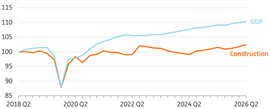 EU construction lags GDP growth. Volumes, Index 2018 Q2 = 100. Image: ING
France faces a weaker outlook. Construction output fell 3.5% in 2025 and continued to decline during the first half of this year. ING forecasts a further 2.5% contraction in 2026.
Spain, meanwhile, is expected to grow by 3% this year as its construction sector continues to recover from a sharp decline between 2019 and 2022. Poland is forecast to remain flat in 2026 before returning to 2% growth in 2027, while Dutch construction output is expected to stabilise this year.
Housing recovery loses momentum
The outlook for residential construction also remains subdued.
EU building permits increased by around 15% between summer 2024 and the end of 2025 but have since broadly stabilised, suggesting the recovery in new housing is losing momentum.
ING pointed to higher interest rates, geopolitical uncertainty and elevated construction costs as factors limiting new development. Housing projects also remain difficult to make commercially viable in markets including France, Germany and Austria, where developers have limited scope to pass higher construction costs on to buyers.
Construction costs themselves are rising only gradually, although energy-intensive products including concrete, cement and bricks face pressure from higher energy prices.
Supply chains are also being affected by low river levels, which reduce the amount of material that barges can transport. In September, 8% of EU construction companies reported production constraints caused by material shortages, up from 5.7% in January.
Infrastructure provides support
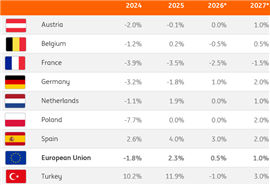 EU construction forecast. Volume output construction sector, % YoY. Image: ING
EU infrastructure output increased 2.2% in 2025, although growth slowed to around 0.4% year-on-year during the first seven months of 2026.
Energy construction remains one of the stronger areas, supported by renewable energy development and expansion of electricity grids. Railway construction is also growing, helped by network renewal and major projects including Rail Baltica and the Lyon–Turin link.
Road construction is under greater pressure. Roads account for around 30% of EU infrastructure output, but ING said local and regional government budget constraints are limiting spending on new construction and maintenance.
ING concluded that Europe’s construction recovery would remain “slow and uneven”, with infrastructure and Germany’s recovery providing much of the support while financing costs and weak housing economics continue to weigh on the sector.
STAY CONNECTED



Receive the information you need when you need it through our world-leading magazines, newsletters and daily briefings.


CONNECT WITH THE TEAM