



Read this article in 中文 Français Deutsch Italiano Português Español
Images | First element for Fehmarnbelt tunnel heads out to sea for immersion

05 May 2026
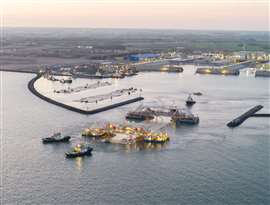 The first of 89 Fehmarnbelt tunnel elements started being transported out to sea on 4 May 2026 (Image: Sund & Bælt)
The first element for what will become the world’s longest immersed tube tunnel, the Fehmarnbelt tunnel between Denmark and Germany, is due to be immersed this week.
The first of the 89 concrete elements that make up the future tunnel is on its way to the immersion point off the coast near Rødbyhavn on the Danish island of Lolland.
The 217-metre-long and 73,500-tonne concrete element left the work harbour of the tunnel factory at 9pm on 4 May 2026.
The element, which contains four tubes that will house the motorway, railway, and a service tube, has been loaded with 4,500 tonnes of ballast concrete to ensure it is heavy enough to sink to the seabed.
The tunnel element will lie in an 18-kilometre-long trench on the seabed from Rødbyhavn to Puttgarden. Before immersion, a bedding layer of gravel has been laid in the tunnel trench to ensure that the element rests in the correct position.
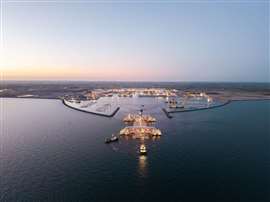 The first of 89 Fehmarnbelt tunnel elements started being transported out to sea on 4 May 2026 (Image: Sund & Bælt)
It is being transported with the help of five tugboats and specially built immersion vessel.
The tunnel element is sealed at both ends and filled with air. However, as the road traffic tubes are heavier than the railway tubes, the element is not naturally balanced.
For this reason, the outer railway tube is fitted with temporary water chambers, which ensure that the element remains completely horizontal during immersion.
Lasse Vester, deputy contract director at Sund & Bælt, said, “This is a very complex manoeuvre, which has never been carried out on this scale before. The elements of the Fehmarnbelt tunnel are both wider, heavier and longer than those used to build the Øresund link, and we will be working in significantly deeper water.”
“It is a major task with very little margin for error. We have to immerse an element that is as long as two football pitches, within just a few millimetres. That places great demands on the equipment and on our contractor, which is why they have been preparing for this task for a long time.”
Transportation and immersion of the element is expected to take several days.
The 18km-long Fehmarnbelt tunnel is expected to cost €7.4 billion (based on 2015 prices), with a planned opening of 2029. A total of 79 standard tunnel elements are each 217m long.
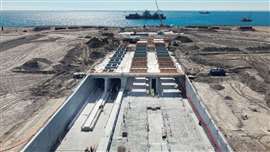 The tunnel portal at Rødbyhavn on the Danish island of Lolland (Image: Sund & Bælt)
STAY CONNECTED



Receive the information you need when you need it through our world-leading magazines, newsletters and daily briefings.



CONNECT WITH THE TEAM