



Read this article in 中文 Français Deutsch Italiano Português Español
Analysis | Why are overseas construction companies buying up US firms?

05 October 2026
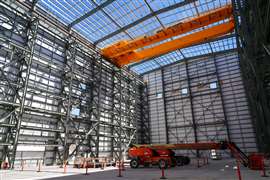 A view inside an under-construction test and fueling facility at TerraPower’s Kemmerer nuclear power plant being built in southwestern Wyoming, USA (Image: USA Today Network via Reuters Connect)
Construction M&A is hot and for overseas buyers, America is proving particularly tempting.
A succession of deals this year has seen foreign groups buying a seat at the table or expanding businesses already there. What makes buying a US contractor more attractive than building one?
Firstly, there has been notable activity by European companies in the US market: France’s Bouygues Construction completed its acquisition of Vannoy Construction in June. The North Carolina contractor generated roughly US$1 billion in revenue in 2025.
Spain’s Acciona followed in July with an agreement to buy 80% of Vertical Earth, a Georgia infrastructure contractor with US$217 million in annual revenue and more than 600 employees. The deal hasn’t reached completion yet but it’s expected by the end of this year.
And then last month (September), French construction giant Vinci’s Soletanche Bachy announced its acquisition of Maryland’s Bradshaw Construction, a microtunnelling specialist with US$30 million in annual revenue.
The transactions span different markets but they illustrate the appeal of acquiring established teams, capabilities and customer relationships.
Buying the ability to grow
For Chicago-based Brad Werner, who leads advisory firm Wipfli’s construction and real estate practice, acquisitions are becoming a core growth strategy.
“For the first time in my two decades in this business, inorganic growth is a key business strategy for a lot of contractors, especially in the upper-middle market,” Werner tells Construction Briefing.
What’s driving it domestically is a burst in the construction of what he describes as “mission-critical infrastructure” like data centres, power plants, and the infrastructure that goes around them.
“What I am seeing with some middle market contractors is if they have caught the wave behind the construction of all of these projects, they’re having trouble keeping up with demand.”
 Brad Werner, Wipfli
Buying a business removes that constraint on being able to recruit quickly enough and that is what is driving domestic M&A activity, he notes.
It’s a similar story for the European groups, where Werner sees particular attractions in the expertise assembled around America’s artificial intelligence infrastructure boom.
“I think it’s about making sure that they’re capturing that wave of AI infrastructure and the capabilities because most of the best skilled talent building these structures are US-based companies. So I think it’s talent more than anything,” Werner says.
Sellers also have reasons to welcome a larger owner. Growth requires capital, management depth and the ability to make acquisitions themselves. Even a successful regional contractor in the US may lack all three.
“It’s usually because they’re getting to a stage of scale where the amount of capital they’re going to have to deploy to get over the next hurdle is just not something they’re willing to do internally as a private company. That’s at least what I see when I talk to private businesses,” says Werner.
“So valuation might move up a timeline, but it’s not usually the compelling why. The why is usually, ‘Alright, we’re going to have to invest, we’re going to have to grow ourselves in new markets or we’re going to have to do M&A and we’re not equipped to do it.’ The truth is you look at a lot of these $300 million to $1bn contractors in the US and they don’t have corporate development teams that can go aggressively do M&A, find firms, and integrate them.”
A different calculation in housing
Japanese housebuilders have also been buying.
Sumitomo Forestry completed its US$4.5 billion acquisition of Tri Pointe Homes in May. Daiwa House’s Stanley Martin acquired United Homes Group for US$221 million in enterprise value that month and Holiday Builders in July.
Werner sees these investments partly as a hedge against mature home markets with fewer growth opportunities. Acquisitions also offer access to the relationships needed to navigate US housing development.
“I think that’s why you’re seeing a ton of Asian money come over to the States to gobble up a lot of these homebuilders is because homebuilding in particular, and to a certain extent, commercial construction, is regionally focused. So it’s better to acquire somebody who’s already got those built-in relationships than it is to try and grow stuff organically. You just can’t build the capability fast enough to gobble the market share even though the demand is there.”
The next big thing in construction M&A?
Meanwhile, Werner expects the next acquisition targets in US construction to be businesses that keep infrastructure working. That could involve companies with cooling, water and maintenance capabilities, attracting investors seeking income beyond individual construction projects.
“I think it’s going to be the ancillary services that’s will have a moment here in the next 24 months,” Werner says. “And if you think about what some of these private equity (PE) groups love, it’s not being focused purely in projects, it’s the maintenance, the water, and the cooling element of that.”
And while it’s unclear whether he intends the pun, he notes that cooling systems in particular could end up becoming a “very hot add-on service”.
Opposition to new data centres could also increase interest in upgrading existing facilities.
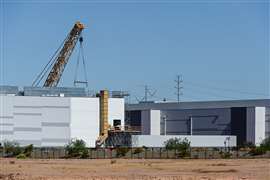 Large data center facility under construction with a lattice boom crane and structural work in progres (Image: Eduardo Barraza via AdobeStock - stock.adobe.com)
“Somebody’s going to figure out what we need to do with retrofitting these buildings if the NIMBY movement that’s going on right now holds,” he notes. If all these new data centres are cancelled, well then what are we doing with all the ones that are already coming online? Who is retrofitting them, who is putting in the cooling systems and the water systems?”
He notes that vertical integration of companies is also “going to be a huge part of that”.
“When I talk to some of these general contractors when they’re thinking about their inorganic growth strategy those are some of the sectors they’re thinking about too,” he adds.
The buyers could change, too. Werner is watching whether private equity can overcome owners’ current preference for selling to another industry operator.
Talking about his own industry, Werner says there was “negativity” around private equity companies’ entry into the space around five years ago and he perceives a similar attitude in construction now.
“PE is like the redheaded stepchild in this, so they (construction companies) have a lot more bias towards going with a bigger strategic player. I’m very interested to see if that changes in the next couple years.”
He notes the sale in June of the project and cost management advisory services firm Cumming Group by New Mountain Capital to Leonard Green & Partners in June this year, having grown the business significantly to revenue of $770 million in 2025.
“I’m curious to see if PE ends up being a much bigger player for some of these than traditional strategic acquirers have been if it can prove the use case on some of this stuff,” he remarks.
A strong market, skills, and the opportunity to pivot
Much has already been said about the state of the US construction market and the fact that certain key sectors - data centres and power chief among them - are providing most of the momentum. If companies - domestic and foreign alike - are bringing out the chequebook, then it’s partly so that they don’t miss out on these “mission-critical” projects but also because acquisitions potentially enrich the buyer with skills and capabilities construction firms need for the future.
And even if the construction of new data centres starts to slow, amid a growing public backlash, then there’s the potential for M&A to continue in other areas as contractors add specialist firms that can maintain, retrofit and upgrade existing facilities.
“I think it’s [M&A in construction] going to continue to trend up and to the right. It’s such a fragmented space and there’s so many good players,” Werner concludes.
“Most folks, if they’re a good operating business in anything tied to infrastructure right now, don’t have a demand problem. They have a capability problem. Do they have enough people to execute it? It’s a scarcity problem which I think just drives a heck of a lot more M&A. You’re going to have a lot more groups actively building out internal capabilities to drive inorganic growth because [otherwise] it’s literally a growth blocker.”
STAY CONNECTED



Receive the information you need when you need it through our world-leading magazines, newsletters and daily briefings.


CONNECT WITH THE TEAM