


Read this article in 中文 Français Deutsch Italiano Português Español
Interview: Hiboo on managing mixed equipment fleets

24 August 2026
Tech firm Hiboo began life focused on equipment tracking for contractors, but has evolved into a fleet management platform for rental companies and contractors. Murray Pollok spoke to Charles Bénard, Hiboo’s co-founder and chief product officer.
French tech business Hiboo began life in 2017 with the goal of helping contractors manage their mixed fleets of equipment, providing the hardware to track machines and the software platform to manage them.
However, Charles Bénard, Hiboo’s chief product officer and one of three co-founders, tells International Rental News they quickly realized that rented equipment should be included as well, which naturally led the business to consider rental companies as potential customers.
 Charles Bénard, a co-founder and chief product officer of Hiboo. (Image: Hiboo)
“At some point we realized that there is a lot of value for plant hire companies to share the data with their end customers and to become a digital partner so that they allow their end customers to unlock some visibility on what is going wrong, what is going right, and make better decisions,” says Bénard, who co-founded the business with his brother Clément, who is the CEO, and a friend, François Jacob, the CFO.
Users of its software now encompass both contractors and rental businesses, more of the former in France and more of the latter in the UK. Its UK rental customers include Flannery Plant Hire, Blackwood Plant Hire and GAP Group.
Ciarán Higgins, who joined Hiboo last year as the company’s representative in the UK, says with UK rental companies it started with the need to provide a digital service to the large tier-one contractors. In the case of Flannery, says Higgins, they are now sharing data with around 300 customers.
“But then as they go through the process, they start to realize, we could actually do a lot with this data that we’re paying for to improve maintenance, billing and all the things that we actually look at internally,” says Higgins, “But they almost have to get that client demand first, and then they’ll actually take a look at it.”
Usage-based maintenance
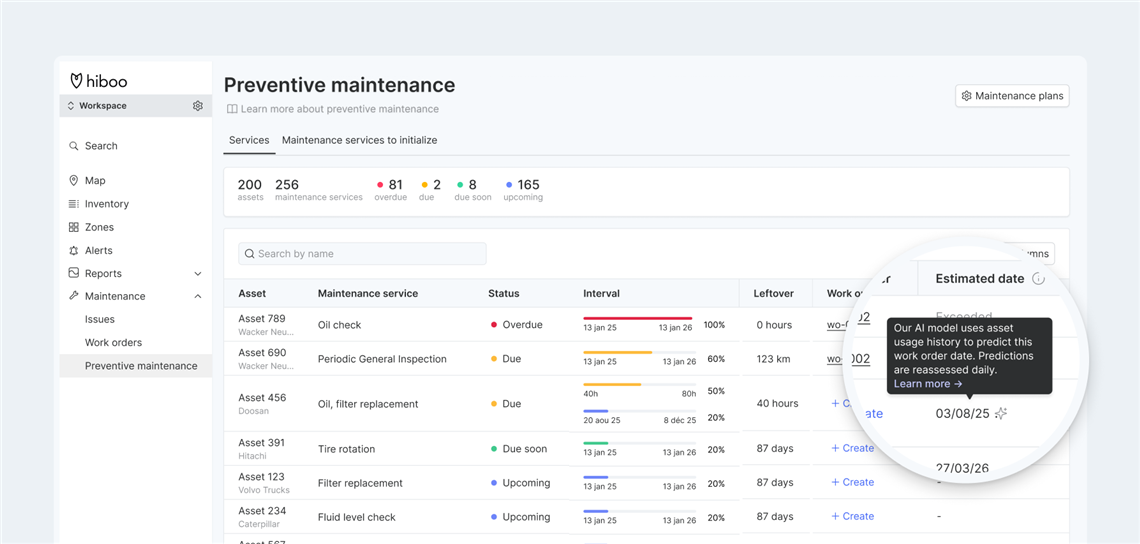
For example, rental firms are use machine data from mixed fleets to shift from a calendar-based maintenance schedule to a usage-based approach; “And there’s no [heavy work] on your end to do it because you already have the data. We have a maintenance module, or they already have a something in their ERP - we can do it either way.”
Earlier this year the company also signed up Glasgow-based GAP Group, one the largest privately-owned rental businesses in the UK.
Bénard says; “One of the first use cases we unlocked at GAP was how to move from a manually updated maintenance system to data-driven maintenance systems. It’s changing everything because the way you retrieve the data is costing less.
“We won’t create another silo because silo data is what is so painful for this market. We live in an era where you should do everything possible to let the data flow. And that’s what we try to do.”
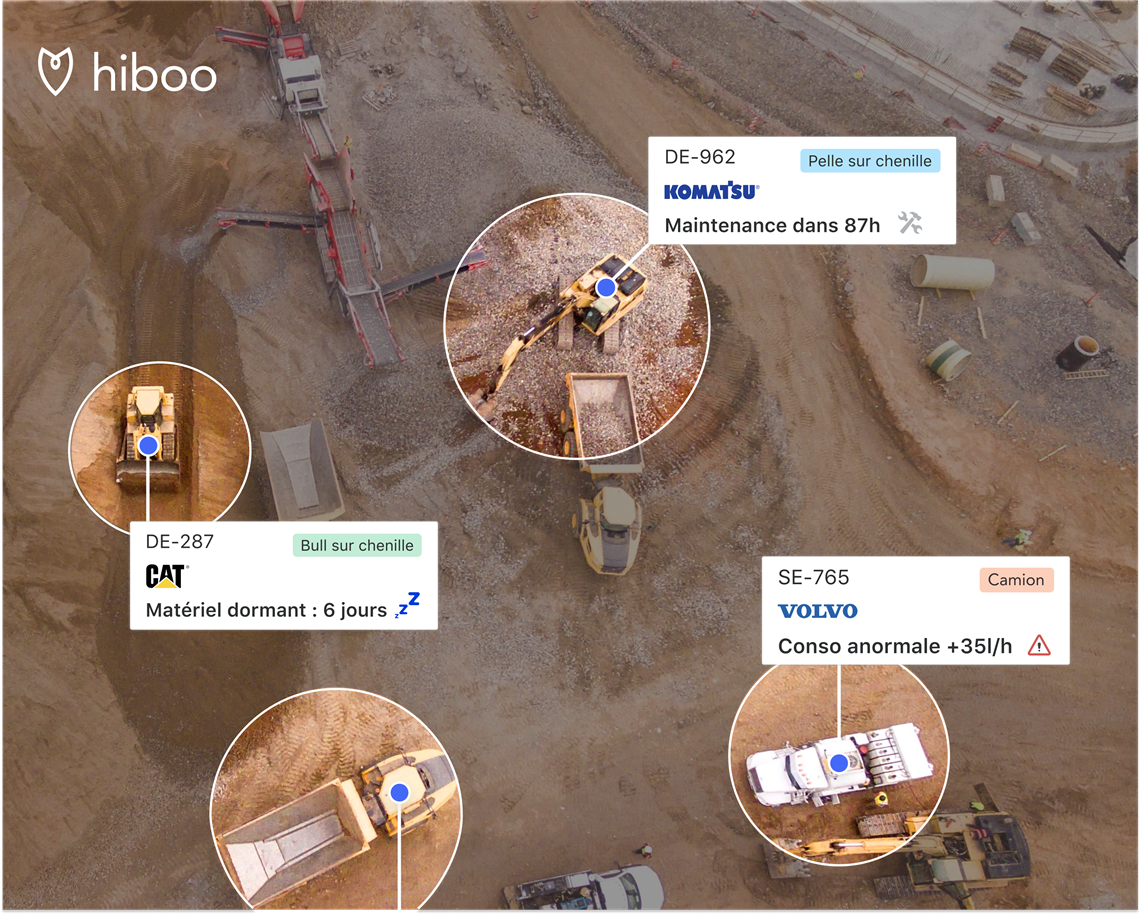
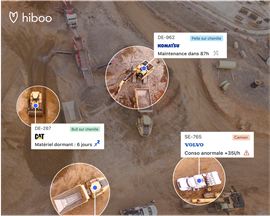 Image showing Hiboo’s platform to monitor mixed-brand fleets. (Image: Hiboo)
The company now has as many as 200,000 assets being analysed by its software, although that includes a significant numbers on trials. Machines feeding data through Hiboo’s systems are based in more 100 countries, thanks in part to its work with global players such as French contractor Colas.
In addition to its rental customers, Hiboo’s technology is being used by Bylor, the joint venture between Bouygues and Laing O’Rourke, on the massive Hinckley Point C nuclear power station.
Higgins says that project has helped it gain work on other major UK sites, such as the Sizewell C nuclear plant and the Lower Thames Crossing tunnel in London.
“The transfer of data between companies across the supply chain is really important on these big projects”, he says.
From hardware to software
If the switch to a broader customer base was an early decision, so was the realization that the early focus on tracking hardware should give way to a greater emphasis on software.
“We are a 100% software company”, says Bénard, “but to be honest the first two and a half years of Hiboo we were trying to build hardware - not the hardware that is connected to the CanBus, but something that would match a connectivity need for powered assets, something you can stick and track.”
The technology worked, and they will still offer that, but fleet managers told them that most machines already had OEM-fitted hardware; “And so we realized that actually there’s a lot of data,” says Bénard, “The problem is not a connectivity problem, it’s how do you retrieve this data? That’s the first problem we try to solve.”
The focus now is doing more than simply aggregating data from multiple sources, but creating a fleet management solution where the data is reaching the operations; “So, how do I optimize maintenance programming based on an automatic understanding of the OEM documentation? How do I forecast when to do my next maintenance, where how do I do my forms, surveys, etc.
“We are here to help with internal [rental] operations, but we are also here to help develop the success of the relationship with your customers, because you are moving from being an equipment supplier to being maybe like a plant advisor, because you’re sharing the data with them.
“We can envision a situation where you advise your end customers to a level that you can price it, because you are allowing them to get the data that was a blind spot for them before.”
Bénard says ‘out of contract’ data is becoming a more common application and, alongside that, data that helps rental companies make fleet procurement decisions.
 Hiboo’s founders, from left: Clément Bénard (CEO), François Jacob (CFO) and Charles Bénard (CPO). (Image: Hiboo/Franck Vogel)
“You are helping them understand the economics behind the question of how am I covering my fixed and viable costs? And related to this is your maintenance activity and your actual usage.
“It’s hard to understand utilisation because if it was not working that day what was the reason? Was it the weather? Was it because there was a fault on the machine?
“One of the upcoming very important features will be this: how do I create a centralised actual usage understanding of my fleet?”
‘Are you sure you need that?’
Ciaran Higgins says there is another layer to this, with data allowing the rental supplier to tell a contractor when a machine is not working enough, or too much; “Are you sure you need all that? Maybe you need more because they’re running 50 or 60 hours a week. Do we need to add more resources here?
“They’re able to have that conversation with their customers based on the data and knowing that, if I look after a major tier one contractors, it will come back to me in the long run in terms of the trust that I can build with them.”
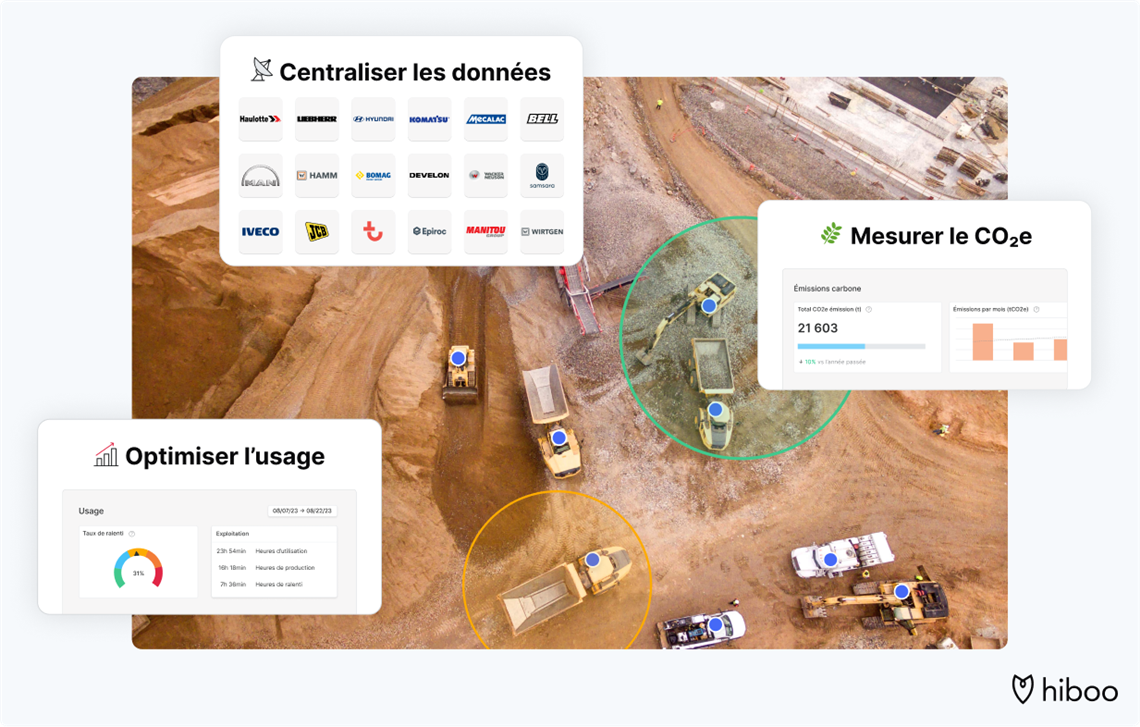
The company’s website includes details of the multiple data sources that its software can accept, from the telematics systems of OEMs, truck manufacturers and even telematics providers. It also shares integrations with other software companies, meaning that Hiboo can feed data into a company’s existing ERP or accounting system.
In addition, it is working with one major construction equipment OEM to be the software interface giving end users a way to integrate data from mixed fleets – a kind of ‘white label’ software approach.
Bénard expands on the integrations possible with its software; “What we want is for the data to be used, so we can serve customers by providing APIs so that it enhances the value within your product. We usually target the main ERP and CMMS maintenance platforms of each country we are operating in. But we did also some integrations with Salesforce, with SAP, Procore, and many more.”
In terms of product development work, there are various things the company is working on, including the use of AI.
“What we believe in is an assisted version of fleet management,” says Bénard, “Within Hiboo, there’s already many points where you have assistance. For example, a machine that enters your inventory will automatically be set up because of AI understanding of what the asset is, and soon it will also provide not only the equipment category, but the documentation as well, the pictures, etc.”
He comes back to preventative maintenance; “By the end of 2026, you won’t anymore have pain of structuring your preventive maintenance. Because we have this universal taxonomy of the equipment for each asset.”
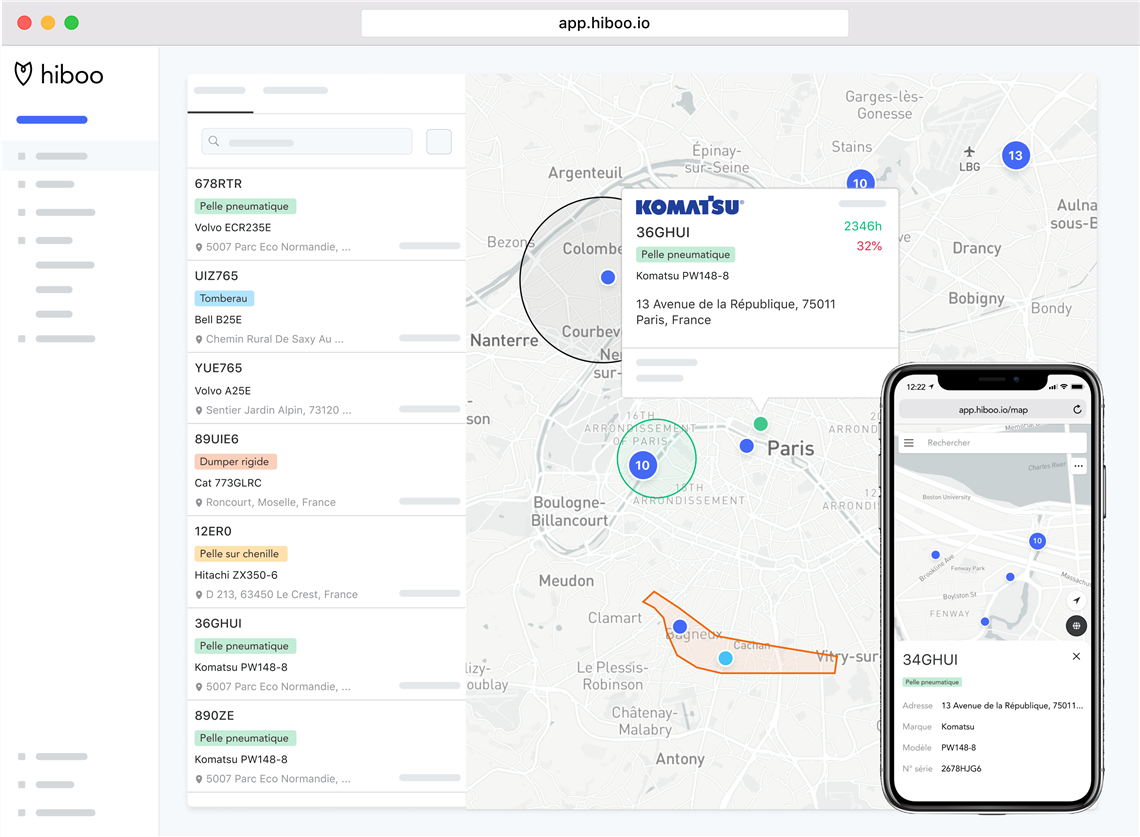
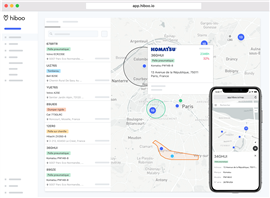 Map showing machine location and data. (Image: Hiboo)
He says Model Context Protocol (MCP) solutions will also allow rental companies to use LLMs such as Gemini, Claude and ChatGPT to analyse data supplied by Hiboo. (Trackunit launched its IrisX MCP earlier this year.)
Help with electrification
The company is now working to help rental companies and contractors manage the electrification of their fleets and sites, and it will soon launch a dedicated electric vehicle module.
“When you are taking the risk to be carbon free at the construction level using electric equipment, it’s a complex logistic,” says Bénard.
“You need to help fleet managers and companies to better understand ‘What is available in my BESS? How can I supply my equipment for the tasks I want to perform tomorrow?’ This is something we are excited about because we’ve been retrieving a lot of data.”
He says there are two phases to the deployment of electric machines. First it’s planning and pre-deployment sizing; “Because there’s grid projects, off-grid, short, long. And the goal is to help them understand what you will need in terms of energy use.
“Then you have charging scheduling and logistics. But where we are currently helping the most is with fleet and asset status - how can you have a one glance picture of the full site picture, where am I needing energy, etc. So, this leads to how do I match usage to capacity?”
He says it will also help equipment owners maintain ‘state of charge’ (SOC) levels on individual machines that won’t compromise a manufacturer’s warranty.
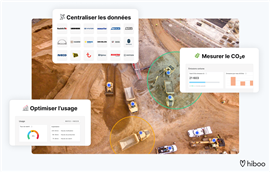 Hiboo will consolidate machine data from multiple brands of equipment. (Image: Hiboo)
Safety-related alerts
If electrification is one recent development, it is also looking at safety-related topics. For example, working with Netherlands company BMair which designs technology to protect machine operators from hazardous dust and gases using cab pressurising systems and air filters.
“We retrieve the data, mix it with the other data we have, and help the fleet manager take better decisions,” explains Bénard, “In many situations, it can be as simple as [detecting] when the filters need to be changed.”
It is also working with its rental customers on human form recognition (HFR) systems, using cameras and AI to detect situations where workers are getting too close to machines on site.
There is certainly a lot going on at the business, something that is reflected it its growth. Bénard says it is expanding at 45% to 50% each year, helped by a €12 million funding round completed at the end of 2023.
“We are still going through some cash because we want to grow, but we are targeting being break even by 2028”, he says. “We are on target for that. We reached the budget last year and we hope to do it again this year.”
A lot has changed since that contractor-led vision of 2017.
STAY CONNECTED



Receive the information you need when you need it through our world-leading magazines, newsletters and daily briefings.
CONNECT WITH THE TEAM