


Read this article in 中文 Français Deutsch Italiano Português Español
Q&A with KPMG’s Martin Seban on the latest ERA Market Report

14 October 2026
The European Rental Association (ERA) publishes its latest annual Market Report on 15 October. We spoke to the lead author, Martin Seban, a director at KPMG Strategy in France, about the key findings.
Looking at the big picture for Europe, the 1.8% compound annual growth rate between 2025 and 2027 is quite modest, isn’t it?
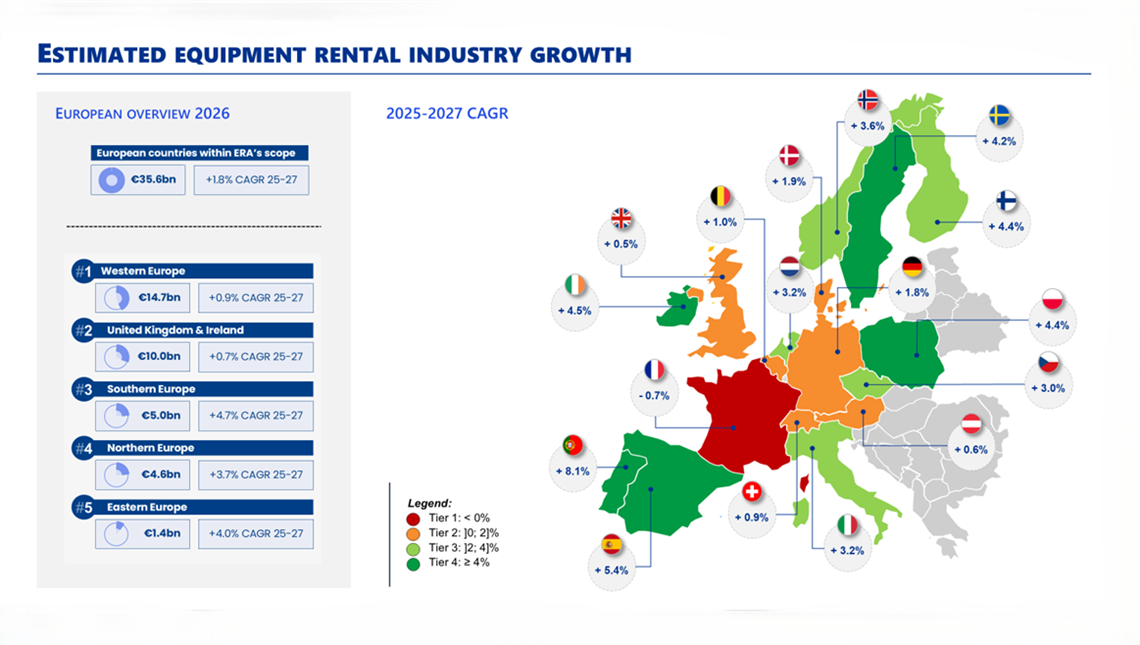
Martin Seban: Correct. When you look at Europe as a group you have many markets which are struggling a lot - France being the top one - but also some markets which are kind of stagnant, and those are major markets. So France, and also the UK and Germany, are suffering a lot or at least not seeing a positive trend.
The story on Germany might be a bit different because they are putting lots of money into the market and projects are starting to materialize. So, we should look on the positive side on Germany. But as a whole, yes, Europe is still fragile. And you can see [in the illustration] the positive news on the Nordics, and the real question is whether it is a technical rebound or real sustainable growth.
 Source: ERA Market Report, 2026.
Putting Denmark to one side, the Nordic countries are all getting out of a cycle of decrease over the past three years. So, it’s positive, but you need to look at the big picture and over the long run they are still behind the level of activity they had three years ago. It’s a rather technical rebound.
France remains an outlier as the worst performing market, with projected -0.7% CAGR from 2025 to 2027. How would you describe the problems facing the rental sector in France?
There are many problems. Residential construction is still lagging behind. Rental exposure on this segment is not super high, so they can manage to live without residential. But in the end, with non-residential, such as public investment, the situation in France is not that good. Foreign investment, local investment is not very high.
The only engine which is working relatively well is energy, grid and renewables-related works, but that cannot drive the whole market.
And overall, the situation in terms of national debt, political leadership - with the election in the coming months - all of that is creating a lack of confidence, which translates into the number and size of projects being undertaken.
And what reasons do we have to believe that it’s going to be better in 2027? The market is suffering – it was suffering a year ago, is suffering this year, and is expected to suffer as well next year.
You and ERA gave an interim report at the Convention in early June. What has changed since then?
Overall, the European picture is broadly unchanged, at around +1.8% growth each year. But there have been real moves underneath. The biggest is Poland: EU-funded infrastructure is finally converting into site activity, and we now see growth of around 4.5% in 2026, versus 2% in June.
 Martin Seban, director, KPMG Strategy. (Image: Photo: Maurice Vinken/kleurstof.eu)
Also Eastern Europe, the second fastest growing region (+4.0% CAGR), which is supported by €137 billion of EU funds.
The Nordics have accelerated, especially Sweden and Finland, based on high-frequency construction and company data. In Germany we have slightly trimmed 2026, because the €500 billion fund is taking longer to convert into projects, but we expect stronger traction from 2027.
If you look at the rental end markets, are there any general themes across the whole of Europe?
Residential is still weak overall, but with early recovery signs. You have only a few countries such as the Republic of Ireland, for instance, where the market is doing quite well. However, in residential you can feel that in some other countries we should be getting to the end of the cycle, and at some point we should see a rebound. That being said, we have been making that point for at least two or three years.
Non-Residential, for all the reasons that we have in Europe - confidence, interest rates, geopolitical impacts - that is not going super-well. Civil engineering will be the only segment in the construction sector which is doing relatively well, and is fueling a large growth for the business. And here, the EU’s NRRP investment programme for Europe is really having a massive impact in many countries, such as Italy, Portugal and Poland.
The renovation market, because consumer spending is not doing very well, is not so strong. So, within construction there is a mixed bag of dynamics.
Outside of construction, it’s even more scattered across the board. You have manufacturing suffering for the same reasons as non-residential, logistics as well, but you have some segments, such as events, which are doing better.
For Europe as a whole, rental is 65% driven by construction-related project and 35% for non-construction related projects.
Are data centres starting to have an impact in Europe?
It’s certainly massive and everyone is talking about it. The question is whether it is being talked about because it’s a new segment and so creating an opportunity that was not existing before, or is it because it’s accounting for a large portion of the business now? I tend to think that it’s the former.
It’s creating a lot of business in some markets and you have some companies that are doing fantastic business on those projects. On top of that, it is typically more profitable than standard construction-related business.
Looking at some individual markets, the Netherlands seems to be performing better than its neighbours.
The market is actually doing relatively well. Residential is not great, but the rest of the underlying drivers are relatively positive. Non-Residential, for instance, as opposed to France, is doing quite well. You still see some private investment.
And on top of that, we see some levers working on the business, in terms of the ability to pass on inflation in pricing, and services that you are now being paid for by the customer such as insurance or transportation.
Spain, Portugal and Italy are performing the best in Europe.
I would say that Spain and Italy they are benefiting ‘full blast’ from the leisure, digital, tourism economy that we can see since the post-Covid rebound. They are also heavily benefiting from the European plan for infrastructure.
And in addition, they are getting new types of customer. In Spain, for instance, the TV and movie segment, the logistics sector, data centres. So, they are gaining traction.
The real question that you have is that now Spain is a +€2 billion rental market, so it is becoming quite big. If you get 5% growth with that size, you are actually changing the profile of your market quite significantly.
In the end, the activity levels [in Spain, Portugal and Italy] are quite good. We do not see an interruption to these developments. At some point they will need to slow down, but we do not see it yet.
What do you see in terms of penetration rates for rental in Europe?
We measure it with three metrics. One is GDP, one is construction output, and the last one - which I think is more important or more interesting - is by rental activity per capita.
The more we diversify the business and go beyond the construction business, the more we cannot measure only against construction outputs. So per capita is really interesting.
The ones which are moving and changing scale are definitely the southern countries. Spain and Italy are moving up and joining the level that you get in France, Germany or the Netherlands. And then you would have the group of the Nordics, who are getting closer to the UK.
Anything else you noticed in preparing this year’s report?
I think over the past few years we have seen the regionalisation of the growth dynamic. You have groupings of countries that are moving in a similar direction. So, the Nordics tend to have this dynamic, but now you have a group of central European countries plus the UK, which are stagnant - Germany, France, Austria, Switzerland.
And you have some kind of a banana shape from Ireland to Southern Europe, which are doing very well. And then the Nordic countries which are trying to get out of the hole they were in.
I would say that for Western Europe, for instance, plus the UK, you have those big legacy rental players in quite mature markets being a bit stagnant and lacking a new engine for growth. That’s a common trend.
In Southern Europe and Ireland, you have the double effect of having an increase in penetration plus underlying drivers which are quite positive.
And in the Nordics, you have a common theme – residential which is still suffering, but with some positive traction in the private space with new spending and data centres and the energy transition. But also in those countries you see a will to invest in public infrastructure. And that includes defense spending on road infrastructure and the like.
I think this regionalisation, the fact that you have groups of countries moving together and a clear map with not so many changes between their dynamics, that’s kind of new and interesting, I would say.
Thank you, Martin.
|
How to get the report The report is free for ERA members and for companies who are members of ERA’s association members (check at https://erarental.org/members/). For non-members, the cost is €1,500. To order a copy, visit www.erarental.org or email: [email protected] |
STAY CONNECTED



Receive the information you need when you need it through our world-leading magazines, newsletters and daily briefings.

CONNECT WITH THE TEAM