



Read this article in 中文 Français Deutsch Italiano Português Español
Europe’s housebuilding recovery will have to wait until 2029

26 October 2026
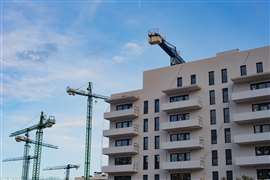 Image: Gusta Cabrera via AdobeStock (stock.adobe.com)
A full recovery in European housebuilding is unlikely before 2029.
That’s according to a new forecast from management consultanct Bain & Company, which has shared its new Building Blocks Construction Indicator with Construction Briefing.
Bain said the European residential construction market is taking off more slowly than anticipated, despite years of structural undersupply.
It said that although European construction stabilised in 2026 with stronger conditions and brighter prospects, it has not yet fully rebounded.
Headwinds, including inflation, geopolitical and macroeconomic uncertainty, and two interest rate increases from the European Central Bank in June and September, that are weighing on the market even as governments spend on infrastructure and GDP is climbing.
In residential construction, Bain said that France, the Nordics, and the Netherlands are recovering, Germany and the UK are in transition, and Italy is an outlier as incentives that spurred demand in previous years are phased out.
“As we forecast in 2025, Europe’s construction market is starting to gain traction, and the weakness of the last several years has abated. But the unlock of accumulated demand is taking off somewhat more slowly than we had hoped,” said Marc Jeker, partner in Bain & Company’s Infrastructure, Construction and Building Products practice.
“The direction of travel remains positive thanks to sustained infrastructure spending and pent-up private sector demand that’s now converting into activity. Government intent is real, and activity indicators are moving in the right direction, contributing to keeping medium-term growth fundamentals intact – anchored by residential new construction, infrastructure momentum, and data centers. So, we continue to see an ongoing revival, absent a further unanticipated macro shock.”
Bain’s analysis found that Europe needs an additional 650,000 dwellings per year for a decade, on top of the 1.6 million built annually today. However, property price-to-income ratios are above 6x in key European markets, which is putting a handbrake on demand.
Jeker said companies would need to plan for a gradual revival, rather than a swift recovery.
Growth by region
Bain set out its forecasts for construction growth across several different regions:
Nordics and the Netherlands
The Nordic countries and the Netherlands are set to enjoy the highest expected growth of key European regions between 2025 and 2026, at 1% to 3% in real terms.
In the Nordics (Norway, Sweden, Finland, Denmark), overall construction activity is also set to increase by a compound annual growth rate (CAGR) of 2% to 4% between 2026 and 2029, with new residential construction leading (4.5% to 6.5%).
Bain said residential construction growth would be supported by government housing targets in Norway (130,000 new homes by 2030) and Sweden (100,000 new homes by 2035), as well as easing mortgage conditions in Finland.
For the Netherlands, Bain projects a growth rate (CAGR) of 1.5% to 3.5%, skewing to new residential construction.
UK
The UK is set to see growth of 1.5% to 3.5% over the period, driven by infrastructure (3% to 5%) and residential renovation (2% to 4%). But new residential construction is forecast to be slow through to 2029 (0% to 2%). Bain said affordability would likely weigh on new construction.
Germany
Construction activity is expected to grow at 2% to 4% CAGR in the medium-term, driven by infrastructure, supported by the €500 billion special infrastructure fund. Bain said residential construction is also expected to grow thanks to pent-up demand, although affordability constraints could weigh on progress here too.
France
France’s residential building sector is expected to enjoy 3% to 5% growth until 2029 but that will be dragged down by limited growth in infrastructure of 0%-1% over the next three years. That means that the country will see only moderate growth as a whole, of around 0.5% to 2.5%.
Italy
Italy will be Europe’s weakest construction market over the period, with growth of 0% to 2%, according to Bain. Infrastructure will be Italy’s strongest segment, with growth of 1% to 3% but that will decelerate as the pipeline of the National Recovery and Resilience Plan (PNRR) thins after the August 2026 deadline, with the deceleration largely offset by residential acceleration, Bain said.
STAY CONNECTED



Receive the information you need when you need it through our world-leading magazines, newsletters and daily briefings.



CONNECT WITH THE TEAM