



Read this article in 中文 Français Deutsch Italiano Português Español
Calculating the true TCO of rental equipment
Partner Content produced by KHL Content Studio
07 October 2026
The rental equipment industry has more power options at its disposal than perhaps ever before.
 The question of TCO is becoming increasingly important to rental companies and equipment end users. Image: Adobe Stock
Battery-electric machines continue to attract attention, particularly in compact equipment and applications where noise or local emissions are important considerations. At the same time, internal combustion engines continue to evolve, while renewable fuels such as HVO, hybrid systems and hydrogen are adding further possibilities to the powertrain mix.
For rental companies, contractors, equipment owners and professional users across Europe, the Middle East and Africa, businesses increasingly need to determine which power solution – or combination of solutions – makes economic and operational sense for their applications.
That makes the total cost of ownership (TCO) discussion increasingly important.
Fuel or electricity consumption is clearly part of the equation, as are maintenance, servicing, equipment uptime and productivity. But acquisition cost alone can give a misleading picture.
For battery-electric equipment, the calculation may also need to include chargers, batteries, available electrical supply and potentially depot or site upgrades. For engine-powered equipment, fuel efficiency, maintenance intervals and serviceability will influence costs over the machine’s working life.
A deeper understanding of TCO can therefore help buyers make decisions based not simply on the initial investment, but on what a machine costs to own, operate and support.
When a shift is not quite a shift…
Philipp Deubel, Senior Director Sales EMEA at power solutions company Briggs & Stratton, believes one of the biggest changes in TCO analysis is the growing availability of accurate utilisation data.
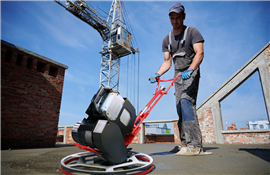 Benefits of battery-electric trowels in sensitive or urban environments include lower noise levels and zero local emissions
Telematics and fleet management systems are giving businesses a clearer picture of how much work machines actually perform and, in many cases, challenging long-held assumptions.
Deubel says, “People can still make assumptions about utilisation rates that are quite a long way from reality.
“If you ask a construction professional how long their compact machines generally operate for, they may say between six and eight hours a day. In many cases, I think that’s a significant overestimate.
“If the machine is continuously in use for that long, the operator would be doing pretty much nothing else that day, and that’s not usually the case.
“Where usage is being tracked – usually on larger machines – the data gives us a much clearer picture. As an example, our research has shown that a one-tonne diesel dumper will only work for an average of around 2.4 hours a day.”
Understanding actual utilisation is important regardless of power source. An engine running for two or three hours a day presents a different lifetime cost profile from one operating continuously through a full shift.
Equally, battery capacity and charging requirements should ideally be calculated against real utilisation rather than how long equipment is present on site.
Not an exact science
Another question mark within TCO is the residual value of small equipment.
“With a petrol-powered unit,” says Deubel, “age and physical condition will influence residual value, but it’s not always easy to determine how much life is left in the engine.
“With a battery, you have a different set of questions. What is its remaining capacity? What is its state of health? How many charging cycles has it completed? These things can all influence residual value.”
The power source question can still be harder to answer for small equipment than for heavier machines.
“For larger engine-powered equipment where there is data tracking on usage – for example a five- or ten-tonne loader – businesses generally have a much better understanding of real-life utilisation,” Deubel says.
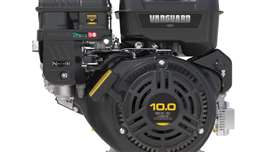 The Vanguard 300 engine incorporates the fuel valve into the on/off switch, negating issues that can lead to equipment downtime
“For smaller ICE [internal combustion engine]-powered equipment without integrated tracking, it’s harder to retrieve accurate figures. Just because a machine is constantly on site for a week or a month doesn’t mean it has worked for that period.”
Looking beyond the power source
Understanding utilisation is just one part of a much larger equation.
Powertrain choice is also becoming less binary. Alongside conventional petrol and diesel engines and battery-electric systems, businesses may increasingly encounter HVO, hybrid powertrains and, in some applications, emerging hydrogen solutions.
Each brings a different combination of acquisition cost, fuel or energy requirements, maintenance demands and supporting infrastructure.
Modern engine technology can also influence fuel consumption, starting performance, maintenance requirements and machine availability. Small operational differences multiplied across a large fleet and several years of use can translate into significant costs.
Deubel places equipment downtime and labour costs high on the TCO calculation list.
“Labour is extremely costly, so whenever a fitter needs to go to site or spend time fixing a machine, that is another cost on top of the revenue being lost while the equipment is unavailable.”
Technologies such as electronic fuel injection or electronic throttle control, designed to simplify operation and improve engine management, can therefore have a financial value that is not necessarily obvious on the original purchase invoice.
The infrastructure equation
The same principle becomes particularly important when considering new and alternative powertrains.
With battery-electric equipment, it is not sufficient simply to compare its purchase price with an engine-powered equivalent and subtract the expected fuel savings.
The infrastructure required to keep that equipment productive also needs to be considered.
For a contractor operating a handful of compact machines, that could mean access to chargers and an appropriate electrical supply.
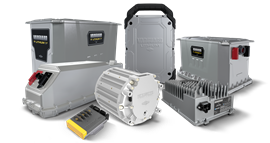 Vanguard’s family of battery-electric products
A rental business introducing battery equipment across multiple depots may face a more complex calculation involving charging capacity, electrical upgrades and energy management.
Site logistics add another variable. Batteries and chargers may need to be transported, stored and managed, while sufficient batteries must be available to maintain productivity without unnecessarily increasing capital expenditure.
Battery standardisation can potentially influence TCO here.
Briggs & Stratton’s Vanguard commercial battery portfolio includes fixed and swappable configurations, with the latter allowing a common battery to be used across different equipment. In addition, the company provides chargers that are precisely matched to the battery range.
The economics of a powertrain therefore increasingly depend not just on the machine, but on the infrastructure and support system around it.
Supporting a changing fleet
Battery technology can offer advantages in terms of ease of operation, noise and zero emissions at the point of use. But these benefits can also create business value.
Reduced noise may make equipment more suitable for sensitive urban environments, while zero tailpipe emissions can allow battery-powered machines to work in enclosed or poorly ventilated areas.
 Philipp Deubel, Senior Director Sales EMEA at Briggs & Stratton
Power availability, grid capacity, fuel supply and site infrastructure will also influence which technology delivers the strongest business case – and these factors can look very different in a European city compared with a remote project in the Middle East or Africa.
Powertrain changes can also alter the maintenance infrastructure required to support equipment.
An engine-powered machine requires established servicing processes, consumables, diagnostic expertise and replacement parts. Battery-powered equipment removes some traditional engine maintenance requirements but introduces different considerations around battery diagnostics, charging systems and electrical safety.
For fleet owners and rental businesses, skills and training consequently become part of TCO.
The support ecosystem – including parts availability, technician training, diagnostic capability and technical support – can therefore have a direct bearing on uptime and lifetime cost, particularly where machines operate significant distances from a specialist service facility.
Upfront cost is still key
From the perspective of rental companies, while TCO is an important discussion point, the real challenge is often still the upfront cost.
“This is a challenge for rental businesses,” says Deubel, “if they don’t feel they can charge enough for battery-powered equipment to balance the initial payback calculation.”
Fleet transition may also require chargers, depot electrical upgrades, additional batteries, workshop changes, technician training and new fleet management processes.
Conversely, remaining with engine-powered equipment carries lifetime costs through fuel, servicing, maintenance and downtime.
The more complete the calculation becomes, the less meaningful a simple comparison of purchase prices becomes.
Avoid cutting corners
Deubel insists that, whichever power technology buyers choose, quality, performance and safety should remain fundamental considerations.
“Safety has to come first,” he says. “Then you can focus on reducing the overall cost. Standardising systems and maximising utilisation across different applications can be an important part of doing that.”
Ultimately, calculating TCO is becoming less about choosing one power source over another and more about understanding the complete system required to keep equipment productive.
Better utilisation data, more varied powertrain choices and the growing importance of infrastructure and support are making that calculation more complex – but potentially more accurate.
--------
This article was produced by KHL Content Studio, in collaboration with experts from Briggs & Stratton
--------
All images courtesy of Briggs & Stratton
--------