


Read this article in 中文 Français Deutsch Italiano Português Español
What’s in a name? Why Hitachi’s move to Landcros goes beyond branding

17 August 2026
For a company whose reputation has been carefully built over decades, changing the name on the side of the machine is no small matter.
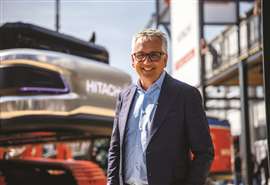 Francesco Quaranta, president and CEO of HCME. Image: Hitachi
Hitachi Construction Machinery (HCM) is preparing for the transition to Landcros, a change that will see one of the best-known names in construction equipment replaced by a new global corporate brand, effective April 2027. The change is happening because HCM is no longer part of Hitachi Ltd in the same way as it was previously.
For Francesco Quaranta, president and CEO of HCME, the shift carries obvious risk. However, in a wide-ranging video interview where he is refreshingly honest and talkative, he contends that it is also an opportunity.
“For us, technically, it doesn’t change anything,” he says. “We’re still the same company. We are still the same equipment, the same quality, the same people.”
In Europe, Quaranta wants the new name to be attached to a sharper commercial strategy. He describes the Landcros transition as a chance to reposition the business around factory-integrated technology, increased customer choice and stronger dealer support.
“There is always a sense of fear when you change,” he says. “But people do not buy the name. People buy what that means; behind every name is a substance. That’s what we are counting on.”
A forced opportunity
Italian-born Quaranta joined HCME two years ago and says he found “the biggest uncut diamond”, alluding to the vast potential of the company. He suggests that the impending move away from the Hitachi name forced the company to develop itself in a way it might not otherwise have done.
“If we were not naturally pushed by this fear [of the change], maybe we would not have challenged ourselves the way we are,” he says.
That is why, for Quaranta, Landcros is not simply a new name. It is also a change in how they operate as the company starts to position itself around more technology, services, data and lifecycle support.
Choosing where to compete
Quaranta is clear that he does not intend to chase every part of the European construction equipment market.
He divides the customer base into different groups, including contractors, rental companies, waste and recycling, and landscaping. But he is focused on professional contractors, OEM and dealer-led rental, mid-sized contractors and key accounts – customers who, he argues, understand total cost of ownership, uptime, residual value and the importance of technology.
At the other end of the market are lower-utilisation customers, for whom the upfront purchase price is the main consideration.
“That’s a typical target customer for Chinese manufacturers,” he says. “I have no intention to go after that.”
It is a notable comment at a time when Chinese OEMs are expanding into Europe, often with attractive pricing and an expanding product range. Quaranta’s answer is not to compete just on upfront cost, but to make the machine part of a wider package.
He argues that the excavator itself risks becoming more of a commodity over time. That makes the surrounding value – technology, support, financing, dealer capability – more important than ever.
“The machine by itself will become a commodity,” he says. “The tagline of Landcros will be ‘solutions beyond machinery’.”
Factory-fit technology
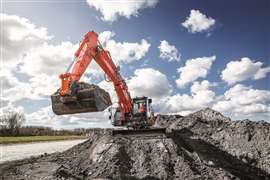 Quaranta says that he wants more technology to be factory-fitted on their equipment in the future. Image: Hitachi
The most concrete expression of that strategy is found in Amsterdam, where HCME is turning its operation into what Quaranta calls a “European customisation centre”.
The idea is to allow customers to order machines already fitted with the technology they want, from the providers they want, rather than relying on dealers to install systems after delivery.
“What happens today is that our dealers are almost in the Harley-Davidson business,” he says, smiling – a reference to the way machines are customised after purchase. “They buy a machine and then have to add expensive technology themselves as dealers.”
Under the new approach, HCME will factory-fit technology packages including quick couplers, tiltrotators, 2D and 3D machine control systems, safety systems and, in time, autonomous capabilities.
To facilitate this, HCME has signed Strategic Partnership Agreements with several technology providers, including Trimble, Leica, Rototilt and Engcon.
That matters, he argues, because customer preferences vary by country and application. One system may be strong in France, another in Scandinavia. Rather than forcing a single technology ecosystem onto the customer, the plan is to keep the platform open.
“I don’t want to tell the customer, ‘you need to like this’, because they will have a very strong opinion on which one they like,” he says. “I’m making this factory flexible enough to be able to fit all of them.”
The first prototypes have already been delivered to dealers, with start of production planned from October.
Construction’s adoption of technology is faster than many give it credit for, while also being slower than its advocates would like. Quaranta says the market for advanced assistance systems remains relatively small and is concentrated in countries such as Denmark, UK, Sweden, Finland and Germany. The barriers, he argues, are not only technical.
Construction is still a largely conservative industry and Quaranta says that customers are concerned about whether they have enough skilled operators to use advanced systems, whether the technology will be supported properly if something breaks, and if the return justifies the (often considerable) investment.
HCME’s answer is to reduce these barriers. Quaranta says that technology could be built into financing packages, with customers paying later once they have seen the benefits. Machines could also be sold with operator training included, while HCME would act as the single point of contact.
“The package is one package,” he says. “You talk to us and we deal with everybody else.”
On autonomy, Quaranta says that he sees strong potential, but mainly in repetitive, defined applications. Quaranta says the company is preparing to ship machines with autonomous technology installed to customers for testing.
When Quaranta joined HCME the company’s machines were already connected and producing data, but the business was not yet doing enough with that information. He was able to hire a whole AI team when another company left Amsterdam – “I was able to go from zero to a big team in no time. Those things happen once in your lifetime; sometimes you have a jackpot” – and they have developed an internal AI tool.
The first focus, he says, is predictive maintenance, faster support and helping customers understand when and why a machine may fail.
Different name, same substance
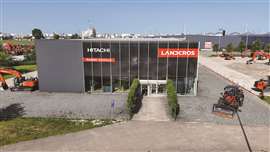 The new Landcros branding will come into effect in April 2027. Image: Hitachi
The name on the machines is going to change and, given that Hitachi is a globally recognised brand, this is not insignificant.
Quaranta’s argument is that the substance behind it is not, but he also knows that ‘same machine, new name’ cannot be the whole story. In a European market facing tougher competition, more demanding customers and faster-moving technology, HCME has to take the opportunity of a new name to also change and modernise the way they operate.
The goal is clearly to have the same reliability with more technology and solutions. There will be factory-integrated technology, open choice of systems, better use of data and increased dealer support.
Regarding the dealers he says, “I will expect my dealers to be able to raise the bar in the future. The most valuable asset that we can bring to the market is the level of support that you can deliver, from product to services to technology. That’s where we need to grow together with our network; we will grow our machines and have our network grow with us.”
It is a big shift to change names, but it seems to have given the company permission to move faster than it might otherwise have done. The future is still orange, but it’s one where the focus is as much on the technology options and solutions as the equipment itself.
STAY CONNECTED



Receive the information you need when you need it through our world-leading magazines, newsletters and daily briefings.
CONNECT WITH THE TEAM