



Read this article in 中文 Français Deutsch Italiano Português Español
Interview: United Rentals on telematics and digital tools

16 March 2026
United Rentals is investing heavily in its digital tools for customers, with recent initiatives including a new AI-powered Equipment Agent and an integration of its telematics data with the Procore Technology construction management platform.
At ConExpo-ConAgg this month, IRN and Rental Briefing met with John Mongan, United Rentals’ vice president - Advanced Solutions, to discuss the Procore agreement as well as its wider strategy on telematics.
Mongan, a former McKinsey consultant who joined United in 2019, was at ConExpo to take part in a panel discussion on the future of automation and the workforce.
IRN: United has just announced an integration with contractor software company Procore. What is the logic of the integration?
John Mongan: It’s two pieces probably. One is owned and rented data side-by-side. Big contractors, they’re going to own some fleet and rent some fleet - so it’s putting that all in one place for them. It’s super important for them to maintain visibility across projects.
And then the other piece of it was really their planning in Procore. That’s where they’re doing project planning, and that’s where the equipment on the job site is going to help connect up the office planning to the actual execution on the job site.
How many of your customers are already using Procore? How well embedded is Procore in the contractor world?
I don’t have an exact number on how many, but when we were talking to Procore, we looked at our top customers and there was almost a one-for-one match in terms of some of our largest customers also being Procure customers. And so it made a lot of sense from that standpoint.
Now, maybe all of them aren’t going to want to pull equipment data in, but we suspect that a large number will.
 John Mongan, vice president - Advanced Solutions, United Rentals, pictured at the ConExpo-Con/Agg show. (Image: KHL Group)
What stage are you at in integrating Procore with your systems?
It’s in its infancy at the moment. We have probably less than a dozen [customers] fully set up. But we only made the announcement two weeks ago now, and it’s been a pretty steady stream of interest since then.
I spent some time on the Procore booth here [at ConExpo], and there seems to be a lot of interest from customers coming by trying to understand what the capabilities are and what they can get out of it. How to set it up, how to make the data flow, and then where that’s going to show up in Procore.
Does Procore have tools that would allow contractors to analyze the data on their fleets? Will it include AI tools?
They’re using AI tools and also just surfacing up utilization information. They’ve got what they call the resource management module, and that’s where the equipment data flows into.
So, if a contractor is managing multiple sites, they will be able to see where the equipment is, if it is being used, and let them see it between owned and rented equipment. They can make informed choices on what they actually need to rent to make sure they’ve got the right equipment on the job.
Maybe less than 50% of your business is pure construction - you’re doing lots of work with petrochemicals, oil and gas, industrial customers. Is Procore just as strong in these sectors?
I believe some of them are Procore customers as well, but the core of it is large construction, general contractors that we’ve seen the interest from.
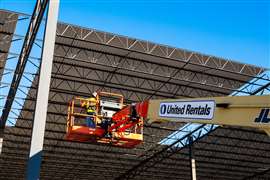 United Rentals’ fleet telematics data will be available in the Procore construction management platform. (Image: United Rentals)
Were your customers asking for this or is it your initiative?
It’s definitely something customers have been asking us for. And I think maybe until recently Procore wasn’t ready and we weren’t ready. But we’ve been hearing from customers about this single pane of glass view, where they can see all their telematics data in one place, for as long as I’ve been in the industry.
Contractors have their own fleet with OEM telematics on it. So, for them to go sign into John Deere, into Komatsu and JCB, and then also United Rentals for Total Control [United’s fleet and worksite management system], and they’re managing the product in Procore, it’s just too many disparate systems. This is about how we make their lives easier by putting it all in one platform where they’re already working.
What was it that made you and Procore ready?
They’ve been expanding their functionality. I think the equipment module inside resource productivity is a relatively new development for them that’s been ready to accept data.
And we’ve certainly been maturing our IT systems to make it easier for us to share via API all of that data with our customers. We’re still building up our Total Control system and all of our digital tools, but we also recognize that customers don’t all want to come to our system to see that. We want to meet them where they’re working, not force them to our systems.
Could you imagine having other partnerships or is the Procore a kind of exclusive partnership in the contractor software world?
At the moment we’re very focused on growing that and scaling it and seeing how it works. But I certainly could envision a future where we have multiple different partnerships.
Like I said, we are open to where our customers want to see that data and trying to be as helpful to them as possible, whether that’s an internal system they’ve built, whether that’s a system like Procore, or another.
Can you talk about the importance of telematics data more generally for United Rentals? I guess a lot of your engine driven equipment is now asset tagged?
Yes, well over 90% of our larger fleet or eligible fleet is telematics equipped. I think it’s been an evolution even since I’ve been here [Mongan joined United in 2019], maybe five to 10 years ago people wanted to see location only or maybe location and run hours. And that’s still the core, but today they’re more interested in advanced capabilities.
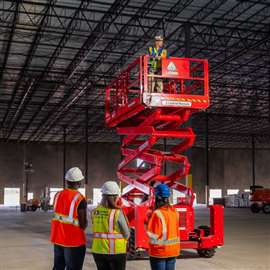 United Rentals is looking at ways to get live telematics data from areas without a cell signal. (Image: United Rentals)
So, we’re doing some things for heating and air conditioning equipment. We’re turning it on and off remotely to help manage fuel costs. For our internal teams showing diagnostic information so we can better maintain the equipment. Those capabilities are starting to be the differentiators in my opinion. How do you make use of that data to help the customer?
And for your non-powered equipment, smaller tools. Any ambition to have that all these assets tagged as well?
Absolutely. We have Bluetooth tags on a number of smaller hand tools or things that can’t support a traditional telematics device. And we’re hearing more and more from customers that knowing the location of those assets or accountability on those is every bit as important as larger equipment. We’ve heard some statistics about 25% plus tool loss on job sites, and that’s obviously painful for our customers.
And so, we’ve come up with telematics tagging, but also a patent pending ‘self-inventorying’ toolbox that basically takes a read of what assets are in it, it understands who opened that toolbox using a keypad or a badge. And so we can say, ‘Murray was responsible for taking out these three assets and only two of them have been returned’. We trying to drive that accountability for smaller assets.
And you would have those on major projects, like data centers.
Exactly. Data centers is a good market where there’s just so many crafts working in one environment, that they’ve really been asking for that type of accountability and transparency.
With all of this telematics data, is there anything that surprised you or made you think you could do more with the data?
I don’t know if I would say it’s unexpected, but certainly the diagnostics [is important]. So, for our internal teams - and it’s not as directly applicable for customers - but for our internal teams, sharing trouble codes on the equipment and using our scale to understand which of those codes actually matter.
There are hundreds of codes and tons of information coming from them. I think some of the secret sauce is how do you filter that down to understand what’s really a problem that needs a technician to address? And that can inform what parts that technician needs to bring out there.
So, they’re not going into the field diagnosing and coming back to the branch or stopping by a store. They can do it all in one visit. I think that’s the future, that’s where it’s going to go. And we’re hopeful that it will make it much easier to maintain fleet.
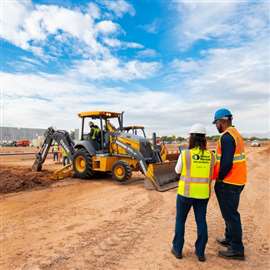 More than 90% of United Rentals’ heavy equipment fleet is equipment with telematics devices. (Image: United Rentals)
Predictive maintenance being the ultimate goal?
It’s still more in the diagnostic phase, I would say. But some of the engine OEMs and other OEMs are starting to get a little bit deeper in translating the codes into predictions of failure.
I think that’s kind of the holy grail for the industry - can we read something off the machine while it’s still in use and send a technician to repair it before the customer even knew that it was done.
One issue with telematics is getting live sight of assets in areas where it is difficult to get a signal. Is that something that you want to be able to offer your customers?
We’ve had success in convincing customers that they can do more with telematics data and visibility and equipment - they’ve adopted that – and so now they expect that anywhere they operate.
And in environments where maybe it’s extremely remote and there’s no cellular connectivity, or maybe they’re indoors in the data hall and there’s no cellular connectivity, they still want those same insights. They might have 80 scissor lifts operating in a hall and if they lose visibility to what’s actually in use, they have a harder time managing their fleet.
So, absolutely, we’re working to identify those connectivity solutions that will help us get that data out. And also help us get data to the machines, like access codes, so we can control who does and does not have access to the machine.
And it’s data centers that has driven that need or is it a more general trend?
I think data centers. It’s more of an acute problem there because of the environment that they’re in and how important that is to the industry right now and construction in general. So much of the growth is coming from the data center market.
How significant would it be to have a solution to that visibility problem? Would it be a game changer?
I don’t know if I would say game changer quite yet. But we are true believers that this data is important to managing fleet and equipment on a job site. So, if you lose visibility in a portion of that, it’s hard to have that comprehensive view.
When do you think there’s going to be a solution?
It’s hard for me to say. I think I would expect significant developments over the next two years in this space. We’re actively working on that.
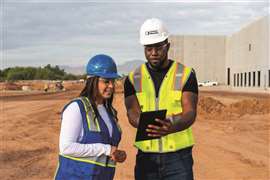 United Rentals said many of its bigger customers are using the Procore platform. (Photo: United Rentals)
You are also investing in what you call Worksite Performance Solutions. Can you explain what that is?
It’s been a push over the last few years. We’re trying to connect up the equipment data that for a long time has been the foundation of what we offer, but extending that into how does it connect with people on a job site? How does it connect with materials or consumables on the job site?
We saw that data is just becoming more and more important, and transparency into who was using that equipment, who checked that tool out, who took those materials out of a Conex box [container] on the job site. This is helping provide safety, productivity, and sustainability benefits to customers. So, it’s a series of solutions that try to connect those three parts for safer and more productive job sites.
For example, I mentioned earlier the remote on-off for heating and cooling equipment on a job site. We have a power and HVAC division that rents generators and climate control equipment. Well, sensors can help us monitor the conditions on the work site and automatically turn on or off the heating and cooling equipment. And we’ve seen really significant fuel savings. So that has a sustainability benefit, and obviously a productivity or economic benefit to the customer as well.
It’s things like that, capitalising on the technology we have, but using data to augment the equipment we rent to our customers.
Any other services that you’re planning to offer through that service?
Yes, absolutely. We’ve got a suite of technologies on demand for tools and small assets, as well as larger equipment, trying to make it easier for customers to rent.
I talked about our self-inventory toolbox, we have larger supplies trailers that have a frictionless shopping experience: somebody swipes their badge to go in, takes whatever they need - whether it’s personal protective gear or consumables on a job site - and walk out. We know exactly who took that and we’re able to bill them appropriately.
How significant a part of the business is this? Is it a differentiator from other suppliers, is that the key?
It’s a differentiator - I think that’s right. I mean, given the scale of United, these solutions still represent a small percentage of what we do. Our bread and butter is still renting equipment.
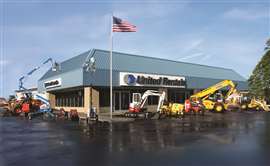 A United Rentals depot. (Image: United Rentals)
But for more advanced job sites, for the larger job sites like data centers, we’re seeing this as an important differentiator.
Because customers don’t just want to rent equipment - they’re really concerned with how they drive more sustainability or productivity or safety on that site. And these solutions help bring that to them.
STAY CONNECTED



Receive the information you need when you need it through our world-leading magazines, newsletters and daily briefings.

CONNECT WITH THE TEAM