



Read this article in 中文 Français Deutsch Italiano Português Español
Interview: Brad Boehler explains Manitou’s new growth goal for North America

20 April 2026
Former Skyjack boss Brad Boehler has joined Manitou Group as its president for North America with the aim of growing the company’s presence the region, including a plan to increase production in the US and sales to the rental sector.
Brad Boehler is a well-known figure in the access and material handling industry, having served much of his career at Skyjack, where he ultimately took up the role as president of the Canada-based company.

Now, following a few years exploring other avenues, Boehler is back in the sector as President of North America for Manitou Group. The newly created role is part of a global restructure by the French company carried out in the fourth quarter of last year, resulting in three distinct geographical divisions; those being Europe, LAPAM (Latin America, Pacific, Asia, Middle East, Africa,) and North America – each led by a recently appointed president.
Speaking about his new role, Boehler comments, “It is absolutely wonderful to come back - I’ve missed being in the access and material handling industry.
“The fact that Manitou Group was looking for someone in this position was a real plus as they’ve got a very good reputation and very good product.”
Since Boehler left Skyjack in September 2019, he has been president and CEO of forestry equipment producer Morbark and led the North American operations of the Australian Makinex group at a time of major growth for the company.
He will now be key to Manitou Group’s growth plans. The company has committed itself to significant expansion, having posted a group net revenue of $3 billion in 2025 and aims to increase that to $4.5 billion by 2030.
North America accounts for 18% of total revenue and Boehler believes the percentage can be much higher. “We have underperformed a little bit in North America. And I think that Manitou Group understood that and the impetus to change the organisational structure was to deal with that.
“I think it was appreciated that they needed someone who understood the market here and was given the authority and the ability to meet that market.”
A North American approach
Part of the appeal for Boehler is Manitou Group’s similarities to Skyjack and its parent company Linamar. “It’s a lot like where I was at Skyjack in that it’s a publicly traded company, but it’s still family held.
“Manitou Group is committed to their customers and their employees and environmental considerations. It is a very forward-looking company and hopefully I can help them be very successful here in North America.”
Commenting on the benefits of the new group management restructure, Boehler adds, “Businesses is done one way in Europe, and it’s done in another way here in North America, along with customer expectations.
“It can be as simple as what products and features are available and how they’re configured. All of these things vary region to region, and I think that perhaps it was a bit more European-centric in the past. People want to understand that you’re meeting their needs.
“People in the US like to move quickly. Even if you have to tell your customer you can’t do something, they’d rather you tell them ‘no’ on day one, rather than wait to give them bad news. I think that dynamic of more immediacy and urgency is really what the US and Canadian customers are looking for.”
The production landscape
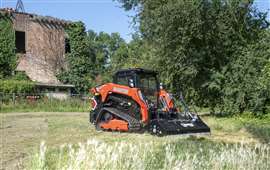
Complementing the restructure has been massive expenditure at Manitou Group’s Yankton and Madison plants in the US, which produce articulated loaders and telehandlers, and skid-steers and track loaders, respectively. There has been an $80 million investment in the two plants, which Boehler says demonstrates the company’s commitment to the market.
“Manitou Group has had the foresight to do that, and I would say has probably increased that capacity for the next five to ten years at least, and now it’s up to me to fill that with work.
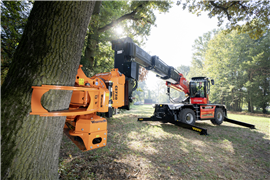 Manitou’s Pruning grapple.
“We have a way to go to get to capacity in those plants from a sales perspective, but the good news is that if we go out aggressively, sell in the marketplace and get those sales, we’ll be able to fulfil them.
“The fact we’re manufacturing here in the US, and also supporting in the US, empowers our team locally to make decisions to help the customers.”
“For me, those things are differentiators - what differentiates you from others is your ability to meet your customers’ expectations.”
Part of that US production is the Gehl brand, which has been a longstanding name in the North American market since it was founded in 1859, and acquired by Manitou Group in 2008. “Gehl has a long tradition and a very American way of doing business. You do have to have good products - after that what sells the products is the long-term relationship and how you deal with your customer base and how responsive you are.
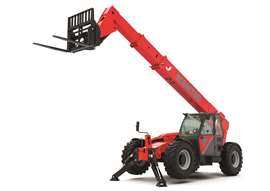
The standard 6,000 – 12,000 lb capacity telehandlers series are designed and built in the US for the North American marketplace. “They have a very American specific design and we’re not exporting those products.”
On the other hand, larger MHT telehandlers and rotating products, produced in Europe, including the new MRT 470 presented at ConExpo, are seeing more demand.
“That’s a global product but it has acceptance here in the US market. People are seeing more and more applications for it. I think they are seeing cost savings on using cranes, as well and crane operators.
Boehler adds, “People are finding applications where with labour shortages they can do more with less with a large rotating telehandler”.
MEWPs are relatively new to the company in terms of its history as a material handling specialist, “so there is a bit of ramp up in terms of building market share there,” says Boehler, “But if you go back to the core products that we are manufacturing here; the construction telehandlers and the skids and track loaders, those are products that we should be able to get to the type of market share as we do around the globe.”
Targeting the rental sector
All this fits in with Manitou Group’s strategic road map which highlights four pillars of leadership in production, innovation in sustainability, focus on customer experience and transformation to meet the modern marketplace.
It is also set to help Manitou Group grow its market share in North America. The company has 270 dealers across the region, which account for 67% of its sales. The remaining 33% of revenue is represented by direct sales to rental companies, including major outfits like United Rentals, Herc Rentals, Sunbelt Rentals and Equipment Share.
The aim is to make rental a larger proportion of its sales. “I think that’s a necessity,” says Boehler,
“We’re two-thirds through dealers and a third through rental. But the marketplace is the other way around. It’s probably two thirds through the rental channel or more and another third that goes through that traditional dealer model, out to end users.”
“I think we should be more representative of the rest of the marketplace where we’re supplying a greater extend into the rental marketplace than we are through dealers.”
Following the dealer model can still lead to substantial success, adds Boehler, but the real potential lies in rental. “We can still be successful with dealers, and we can frankly grow the business that we have today with dealers but the opportunities for large scale growth are really out there in rental.”
This means penetrating the rental market from a regional level to the small ‘mom & pop’ setups.
As Boehler explains, “about 30 years ago here, the likes of United Rentals and the other consolidators decided that they didn’t want dealers - they didn’t want a middleman. So, going direct to rental became their method of going to market and then most of the rental companies followed. The rental companies don’t buy a lot from dealers or distributors.
Having a relationship with the smaller independents is also vital, particularly when the economy gets tough and the large national renters tend to withdraw investment in equipment, says Boehler. “When things are good, the national rental companies are great. But when things are bad, they turn the tap off and your business as an OEM can very much be at risk unless you are with the regional and the smaller rental companies and build the loyalties there.
“They go into a different style of business when economic times get bad and you can still put equipment out through them.”
This is thanks to a different business model, which is focused on local service and relationships. “Generally, they’re not the lowest price providers and so they build their business around service metrics and support metrics and building loyalty and people who are willing to pay a bit more for those types of services. And so, those things tend to do better in poor economic conditions.”
Going forward, how does Boehler see the product landscape in the North America market, taking into consideration Manitou Group’s global aim for 28% of all product sales to be fully electric by 2030?
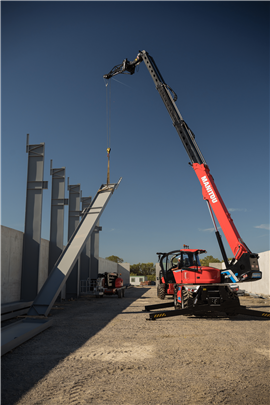 Manitou Jib winch attachment
“Right now, it’s a bit of a hard sell in the US. There are pockets of areas where people are interested in either no noise or particulates emissions but those are few and far between.
“The current administration in the US is certainly not encouraging it anymore and people are happy to stay with their combustion engines and get their work done unless they have a specific need or requirement that requires an electric unit.
“Obviously in the small access environment and people that are working indoors with access equipment, that’s been electrified for quite some time. But there’s not really a lot of direct calls for electrification beyond that.”
When it comes to manufacturing of MEWPs, would Manitou Group consider setting up a factory in the US. “I think we will consider it,” Boehler comments, “Based on the current economic tariff conditions, it’s difficult to import MEWPs and be successful from a competitive nature. I don’t think that it’s the first thing on our list of things to do but it certainly would be considered.”
Contemplating the Tariffs
However, Boehler is not anti-tariffs, as a rule, as long as they are balanced and planned. “I’m all for anything that brings American manufacturing back; we should be manufacturing in North America. We shouldn’t be reliant on bringing products in from other places around the world. Having said that, I would like to see it be a bit more thought out and structured.”
Expanding on the point Boehler says, “We have manufacturing here, we’re going to continue to have manufacturing here. But we’re still bringing components in because they are not readily available for us to buy and source in North America. So, we’re still paying duties on units that we’re building in the US because there are still some portions of those that are subject to these tariffs.”
He adds, “There will always be inflation, but I think between Covid and the supply chain issues we had after Covid and now the tariffs, I think if you went through pricing of the entire industry, it has gone up more than the inflation rate since then. I think we’re all paying more for everything.”
Despite that Boehler sees great opportunity in the years ahead for Manitou in North America, essentially though focusing on the customer. “We’re looking at a customer-centric focus in the North American region and meeting our customers’ needs. Whether that’s local production or sales, support and parts, digital services or attachments, I’d like us to be the best at meeting our customers’ needs.”
STAY CONNECTED



Receive the information you need when you need it through our world-leading magazines, newsletters and daily briefings.


CONNECT WITH THE TEAM