



Read this article in 中文 Français Deutsch Italiano Português Español
Andy Wright: A lack of infrastructure is preventing decarbonisation in the construction industry from charging ahead

16 June 2025
IRN columnist Andy Wright, executive chair of Vital Power Group, argues that setting up the infrastructure to effectively charge large electric construction plant is the main barrier preventing decarbonisation in the construction sector. But persuading rental firms to pay for it in the face of uncertain demand is likely to prove difficult.
 Image: Ideogram (created using AI)
The construction industry is moving at pace to decarbonise the way that it works. There are many aspects to this, such as net zero targets, material supply and embodied carbon, the construction carbon footprint, regulatory and policy uncertainty, skills gap and workforce transition, red diesel phase out and diesel dependency, lack of renewable infrastructure and grid constraints to name but a few.
The transition to the new technology equipment and the infrastructure to power it is also very challenging and these areas in particular are profoundly impacting the rental sector.
The construction site of the future will look very different from the majority of sites today. Diesel will be, and indeed already is, being removed from working sites, and this traditional way of operating construction plant will be replaced by a number of alternative ways to power the equipment that is so critical to being able to create the built environment.
These alternative fuel sources will be driving equipment that is operating on electricity, hydrogen, biofuels, ammonia or other new technologies or approaches still to be invented.
This transition is necessary, but it will not happen quickly. It can’t for a number of reasons.
Barriers to the energy transition
Firstly, the new equipment isn’t available in the quantities required yet, and where it does exist OEMs haven’t built out the full range yet, so equipment availability is a major issue to be overcome.
Also, new fuel technologies and the infrastructure to deliver it is not readily available and in certain cases it is a very expensive option when compared to traditional ways of fuelling the sites.
That said, in some specific cases there is not only an environmental imperative for transitioning towards these new technologies, but there is also a strong commercial argument too, but more about that later.
My recent visit to Bauma confirmed what I was already feeling about the current front-running technology to lead the energy transition.
 Andy Wright, chief executive of Vital Power Group
It was clear walking around the gigantic exhibition in Munich that electric plant appears to be winning the race to replace diesel.
This might change in the future but it’s the case at this precise moment in time.
The number of OEM’s launching or exhibiting a wide range of electric products was impressive and this was very much the key theme of the event.
From small to large scale equipment, it’s clear that electric plant is at the top of most manufacturers’ agendas.
We will also see a wide range of construction equipment available within the next 12 to 18 months, and in fact there is a significant quantity of products available to the market right now.
Feedback on the equipment is good, performing at least as well as the diesel equivalents and delivering a full shift from a single charge.
Charging infrastructure
What was less prevalent at the show, however, is the equipment that will be required to provide the electrical charging environment to make the plant useable at site.
Whilst I know that there are innovative new products available in small quantities now, there needs to be more focus on this area very soon if the whole package is to deliver the full site requirement in the future.
It’s important because the use of large scale electric plant and the subsequent and significant cost savings generated from the displacement of diesel burned by the plant can support the rationale for change too, even after the increased cost of the rental of the electric equipment and the charging infrastructure is accounted for.
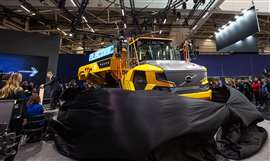 Volvo CE’s stand at Bauma featured only electric machines. Photo: Volvo CE
A cleaner, quieter and more cost-effective solution is within the grasp of the industry, but this will only happen if governments and key stakeholders within the industry recognise what needs to be done and step up to deliver the change.
Net zero commitments for public projects are driving large contractors to challenge the way that they work and consider how to meet these commitments but there is a commercial reality for rental business owners, which is how to meet these challenges in support of these commitments without betting the company.
This is going to take some time, but how will businesses fund the swap out of large diesel fleets for whatever the new technology will be?
And who will fund the infrastructure needed to make the whole thing work?
The last piece of the puzzle
Rental businesses can only do this if they have a reasonable level of certainty as to the economic delivery of the new investments, but how can they know that when the rate of technology transition is uncertain in the first place?
It’s a difficult conundrum that we face. We are progressing well towards having operationally effective electric equipment availability.
The government is beginning to make net zero commitments that will help to force the change. But with the uncertainty of achieving a financial return on their investments, driven primarily because it will take a long time to achieve wide-scale adoption of the change, how will rental companies be able to own the fleet and charging infrastructure in order to stitch the whole thing together?
This the puzzle that we need to solve
Andy Wright is executive chair of Vital Power Group
STAY CONNECTED



Receive the information you need when you need it through our world-leading magazines, newsletters and daily briefings.


CONNECT WITH THE TEAM