



Read this article in 中文 Français Deutsch Italiano Português Español
How to convert a 75m truck mount to hydrogen power

12 October 2026
Netherlands-based rental specialist Siesling has converted a 75m diesel Ruthmann truck mount to be powered by hydrogen fuel-cell technology. Hein Siesling, operations manager, explains the concept and the process.
For Siesling, the development of its 75m working height Ruthmann T 750 HF truck mount began with a simple ambition: to see whether a large truck mounted platform could move to zero-emission power without compromising its usefulness in the real world.
The result is a one of its kind machine powered by fuel-cell technology, with a claimed 450km driving range, 20-minute refuelling time and the ability to carry out high-level access work with diesel-level performance.
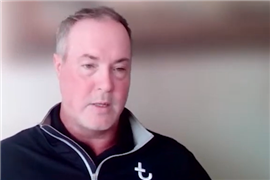
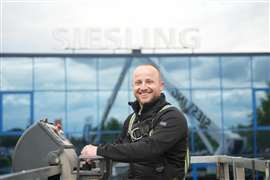 Hein Siesling, operations manager at Siesling. (Image: Siesling).
Siesling is a family business founded in Groningen in 1959 as a window-cleaning company. As Hein Siesling, operations manager at Siesling, explains, it has two distinct activities. Around 70% of the business is dedicated to cleaning, including commercial and industrial work, while around 30% of revenue comes from its younger rental division. It operates eight truck mounted aerial platforms, ranging from 19.5m to 27m and a further nine from 30m working height 7.5 tonne chassis to a pair of 75m units with 33 tonnes GVW.
It is one of those 75m machines that became the basis for the hydrogen project.
Weighing up options
The chosen Ruthmann T 750 HF was acquired by the company in 2019, and was one of the first in the Netherlands. Siesling operated it until early 2024, when it was taken out of service for the conversion.
The idea came from discussions between Siesling’s management and Holthausen, a Dutch hydrogen specialist with experience converting conventional vehicles by replacing combustion engines with fuel-cell systems, including refuse and delivery trucks.
Initially, the plan was to convert a much smaller 30m truck on a 7.5 tonne chassis.
That quickly exposed one of the fundamental challenges of electrifying access equipment: weight.
Removing the diesel engine and fuel tanks creates some capacity, but hydrogen tanks, fuel-cell equipment and batteries literally outweighed that. On a 7.5 tonne chassis, adding enough energy storage to achieve the required range would push the machine beyond its intended weight limit.
This is a factor particularly in the Netherlands, where heavier vehicles can face restrictions in zero-emission city centres, Natura 2000 protected sites, and other locations where only zero-emission operations are permitted, such as Schiphol Amsterdam Airport.
The answer was to go bigger.
The project moved towards a 51m machine before Siesling concluded that the additional space and weight capacity of a 75m chassis provided a better opportunity. It also meant developing something that could extend zero-emission capability into a part of the access market where alternatives were scarce.
The finished truck weighs about 36.5 tonnes fully loaded, compared with 33 tonnes for the original diesel machine.
Weight and range
The T 750 HF conversion carries nine hydrogen tanks, each holding approximately 5kg, giving a total capacity of 45kg. The fuel cell converts the hydrogen into electricity, which is stored in three batteries. That electrical energy then powers both the truck and the aerial platform.
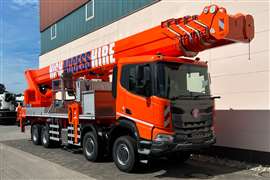 The Siesling T 750 HF converted to be powered by hydrogen fuel cell. (Image: Sielsing).
Siesling says the machine can travel at least 450km on a full hydrogen load. Refuelling takes approximately 20 minutes, a key advantage for Siesling over battery-electric technology.
The company’s truck mounts can start a working day with around 250km of driving before reaching their jobsite. Siesling says that while the project was being developed, a battery-electric truck offering around 250km of range could require six to eight hours to recharge, depending on charging capacity and the available electricity grid.
Therefore, hydrogen offered a way to combine long range with a shorter stop.
Infrastructure remains a limitation, however. Siesling does not currently refuel at its own base, instead uses hydrogen stations operated by Holthausen and other providers, although the network in the Netherlands is developing quickly, with stations now at roughly 75km intervals across the county based at standard petrol stations.
Ruthmann’s role
Ruthmann, the German-based truck mounted platform manufacturer, was involved throughout the process.
Siesling has worked with Ruthmann for around 14 years with a number of the manufacturer’s units in its fleet. Once Holthausen had completed the hydrogen conversion, the truck returned to Ruthmann for extensive testing.
The changed weight and weight distribution had to be assessed against the aerial platform’s working envelope. Ruthmann reweighed the machine, tested its operating characteristics and produced revised working diagrams.
The control system also had to be reprogrammed for the electric powertrain.
The results were better than Siesling expected. In some areas, the revised working envelope gained approximately one metre of range, while the platform’s operating characteristics were recalibrated for the new power source.
The completed machine was also independently examined by Aboma, Siesling’s long-standing inspection partner, which spent several days checking the conversion and identifying further points for adjustment.
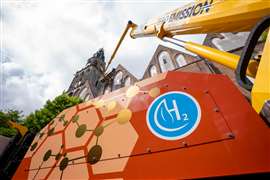 (Image: Siesling).
The Siesling T 750 HF has now moved into real-world operation.
Its early work included inspections and cleaning at the Groningen Forum, renovation work at the Martini Church, and installation work on a building receiving a new steel-panel facade.
Overall Siesling has accumulated approximately eight to 10 weeks of work with the machine.
There were some early issues, including cooling system leaks and programming errors, but the overall performance has been encouraging, says Siesling.
One unexpected result has been its efficiency during working operations. Siesling says its platforms mounted on diesel trucks can typically work for around a week on one tank, while the hydrogen machine has completed around 1.5 weeks without refuelling.
The cost of zero emissions
The technology is not cheap and Siesling puts the current cost of hydrogen at approximately €19.95 per kilogram.
The machine itself was also a major investment. Siesling says that, including the development period when the unit was out of the market, the total cost approached the level of buying roughly two conventional 75m truck mounts.
Financial support from the Province of Groningen, the regional government authority, helped make the project possible through its subsidy support programme.
However, even with that support, the economics remain challenging. Siesling says the T750HF’s rental rate is currently around 30-40% higher than a comparable diesel truck mount.
The difference depends heavily on the job. A machine standing on one site for several weeks can make better use of its range and spread the additional cost. A job involving several locations in one day is more difficult, particularly if the truck has to travel significant distances to refuel.
Proving the market
Siesling sees the machine as particularly relevant to projects where zero-emission equipment is required.
Government and major corporate projects in the Netherlands are increasingly specifying such equipment where suitable machinery is available. Until now, however, that has been much harder to achieve with truck mounted working heights above 50m.
The Siesling T 750 HF is intended to fill that gap, sais Siesling.
Siesling acknowledges that customers remain cautious. Hydrogen is still unfamiliar to many users, while questions around safety, reliability, cost and performance are inevitable with a new technology.
The company is responding with demonstrations, inviting potential customers to see the truck working rather than relying on specifications alone.
For now, the Siesling T 750 HF remains a pioneering and relatively expensive machine. But it demonstrates that a 75m truck mount can operate on hydrogen, travel up to 450km, refuel in around 20 minutes and deliver the high-level access performance expected of a conventional machine.
For Siesling, that is the point of the project, “Not simply to build a one-off machine, but to show that zero-emission technology can reach the top end of the truck mounted access market.”
STAY CONNECTED



Receive the information you need when you need it through our world-leading magazines, newsletters and daily briefings.
CONNECT WITH THE TEAM