



Read this article in 中文 Français Deutsch Italiano Português Español
Interview: Rotair’s true mix of rental products

10 November 2025
Italian manufacturer Rotair produces portable compressors, breaker attachments and mini dumpers, which is a nice product mix for the rental market. Murray Pollok reports.
When you make the kinds of products that Rotair does equipment rental is always going to be a target market, but you still have to produce the right machines. That’s what the company is aiming to do, of course, but in its own way.
“We don’t have a mass production approach, with big numbers of standard units”, said Roberto Gonella, the company’s regional manager for Europe, speaking at a recent event in Italy organised by engine manufacture Rehlko.
“What we try to do is to provide solutions instead of products, to understand what the needs of the customer are, and we have the flexibility to match these needs.”
 Roberto Gonella (left), Rotair’s regional manager for Europe, with marketing manager Jacopo Incrisse. (Image: IRN)
A good example is the latest portable compressors the manufacturer has added to its range.
Jacopo Incrisse, Rotair’s marketing manager, told IRN that the new 5m3 compressor launched last year, for example, has been designed with rental in mind.
“This is exactly for the rental market, because it weighs below 750kg, what gives rental the possibility to rent to more users because you don’t need any specific driving licenses. So, actually, that machine was strategic for that market.”
The same goes for the more recently launched MDVN 30 Eco5, which is a 3m3 unit squarely in rental territory.
“We do expect to have a lot of interest from the rental sector because it’s quite a unique piece. The flow that we give at 7 bar [102psi] is one of the best in class”, said Incrisse.
“In that range, since the Stage V engine regulations came in, we had a gap between the 2.5m3 and our 5m3 compressors, and the new unit has a huge flow at 7 bar compared to what is available in the market.”
The machine, which uses a Rehlko 18.4kW KSD1402NA engine – and was showcased by Rotair at the Rehlko’s demo event at its facility in Reggio Emilia – was launched at Bauma, with the first units delivered in Europe in September.
The unit is designed to be versatile, suitable for general construction, pneumatic tool operations and blasting projects.
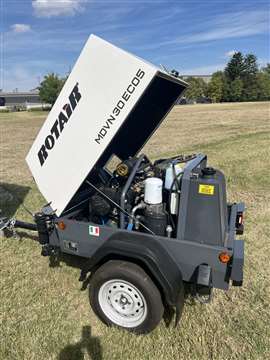 Rotair’s new MDVN 30 Eco5 portable compressor. (Image: IRN)
According to Roberto Gonella, the use of the Rehlko KSD engine was important; “The unit is equipped with this KSD engine because it needed something very compact. And we have quite high expectations for this model because it goes in a segment that actually almost disappeared with the Stage V regulation.”
He said the 3m3 sector of the market needed an engine with DPF (Diesel Particulate Filter), which made it too expensive. The Rehlko unit used on the MDVN 30 does not require DPF.
“We’ve been working a lot on this and we get to this unit that is a 7 bar operating pressure, 2950l/m free air delivery, which I would say is one of the biggest in the segment now.”
The company has other new compressor products in the pipeline. One will be a unit powered from a tractor’s PTO, and there will also be a large 25m3 compressor for blasting or drilling work.
Mini dumpers and breakers
Although best known for its compressors, which it has been making in Italy since the 70s, Rotair has also been producing breaker attachments and mini dumpers for more than 30 years. (In 2012 Rotair became part of the larger ELGI Group, the Italian industrial compressor manufacturer.)
The company’s mini dumpers are sold to end users as well as rental companies. Jacopo Incrisse said these machines are used a lot in construction; “particularly on sites that are very narrow or where they are renovating a place, where the machine has to pass through doors”.
He said the company is adding engine options to its dumpers, and said the battery powered units are not likely in the short term.
With its hydraulic breakers, meanwhile, the focus has been on its light range, which are mounted on smaller excavators.
The company is adapting its breakers to the increased hydraulic flow that is available with modern excavators; “Nowadays the hydraulic flow pressure increasing significantly, so we have to keep on adapting to follow the improvement in flow, because every time there is more oil pressure”, said Incrisse.
“Recently, at the bottom of the range, we presented the new OLS 70, which is replacing the OLS 50.”
Incrisse said these breakers incorporate pads to reduce noise and also vibration going back to the carrier machine.
The OLS 70 is described as “mechanically more robust [than the OLS 50], with a full working weight including bracket of 75kg, versus 60kg for the previous model, providing greater strength and stability during operation.”
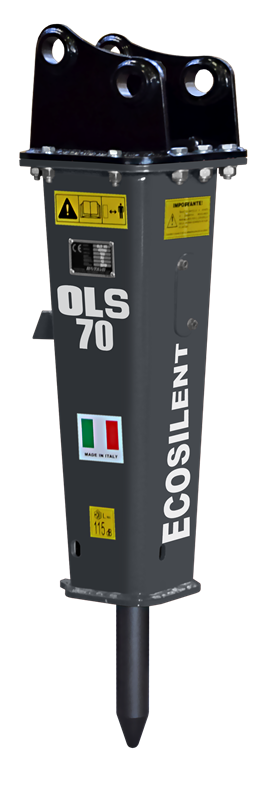 Rotair’s new OLS 70 breaker, for use with micro and mini excavators. (Image: Rotair)
The working cycle has been optimised to offer a wider operating range - hydraulic oil flows from 16 to 28l/min - and higher impact energy, between 120 and 200J. It will be compatible with mini excavators weighing between 0.8 and 1.5t.
The breaker’s monobloc housing, which contains the dampers, serves a dual purpose of centering the breaker body and protecting it from impact, and simultaneously reducing vibrations during operation.
Tariffs causing uncertainty
Rotair, like other manufacturing businesses in Europe, is monitoring the US tariff situation very closely. Our interview took place before the US government announced the tariffs of steel and aluminium, but Jacopo Incrisse said it creates uncertainty; “At this point tariffs are definitely not helping the market situation.
“It’s not exactly what we would want, but we are also lucky that we sell to many different countries and we can work in Europe, but also the Middle East, so these things help to compensate. Maybe a tariff can make things a little harder for us, but we can open other opportunities in the Middle East or Europe.
“And the other important thing on compressors is that we have so many different applications. For example, now the fibre optic market in Germany is super important and maybe compensating for construction in the last year.”
The company will also assess the tariff situation before it makes any decision on expanding its production facilities at its based in Caraglio, near Cuneo in north west Italy. The company is currently using all its existing production space.
“We have planned investment,” said Incrisse, “We already own the land next to us, but we are going to take it step by step. But yes, we do have in strong project for the future.”

CONNECT WITH THE TEAM