



Read this article in 中文 Français Deutsch Italiano Português Español
Why bigger is not always better in construction equipment
01 May 2026
 Image: thanarak via AdobeStock
In mature industries, scale is expected to deliver better margins, faster growth and greater stability. Yet, as fresh analysis from abcg consultant Alan Berger suggests, when it comes to construction equipment, those assumptions do not hold – raising doubts about whether a major consolidation wave is really on the horizon.
On paper, the construction equipment sector should be consolidating. It is a mature-but-growing industry, shaped by the sort of commercial and technological pressures that typically reward scale and gradually narrow the field. Yet the reality is more complicated. For all the headline deals, strategic repositioning and product evolution of the past 15 years, the industry remains fragmented – almost three times more so than agricultural equipment.
Plus ça change
There has been no shortage of visible change: Chinese OEMs have entered the top ranks of KHL’s Yellow Table, alternative powertrains have advanced and connected products have become a baseline expectation. But beneath that movement, the underlying structure has been unusually stable. The combined share of the top 10 OEMs has sat at just over 60% for more than a decade. It is this contrast between visible momentum and structural resilience that gives renewed relevance to the latest questions surrounding possible separate sales of Wacker Neuson and Genie. Is this a sign that the industry is entering a new phase of consolidation, or simply a remake of an old story?
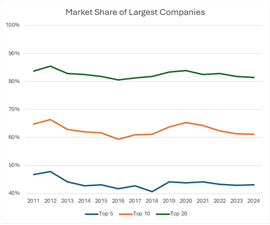 Source: abcg
To move the discussion beyond speculation, abcg initiated a study designed to separate long-term trends from short-term chatter. We combined public financial reporting with KHL’s Yellow Table and Off-Highway Research (OHR) data and assessed what we saw with the judgment of abcg™’s senior team of industry experts. The goal was not to predict the next deal, it was to answer a more strategic question: What, if anything, is likely to make consolidation inevitable?
The promise of scale
Consolidation in this industry takes two forms: companies buy others (e.g. John Deere buys Wirtgen), or they leave the market (e.g.. Volvo shutting down Rokbak). But M&A is not a strategy by itself. It is a big commitment that comes with integration risk, distraction and a multi‑year payback. Whatever the stated strategic rationale, deals are often framed around set value-creation outcomes. These include structurally higher profitability, faster growth and/or lower volatility across the cycle. We tested these ‘promises of scale’ using the available data.
Start with profitability, the most common justification for consolidation in capital‑intensive sectors. The idea is simple: more purchasing power, more leverage in the channel and efficiencies of scale should translate into fatter margins. All good in theory but when we built a 10‑year dataset of operating margins for OEMs with annual revenue of more than $1billion and removed the effects of long‑term industry growth and the business cycle, we found no relationship between company size and operating margin. High margins exist at multiple scales but so do low margins.
If scale doesn’t always buy fatter margins, perhaps it does buy momentum. Bigger companies tend to have wider distribution networks and stronger balance sheets. (Advantages that should translate into faster growth.) Yet, using business cycle adjusted measures for both unit volumes and revenue, we again found no meaningful statistical connection between size and growth rate. We also tested the argument that the larger the OEM is the less exposed it is to cycle swings. (Thanks to a bigger installed base and therefore more aftermarket revenue.) Here too, size did not predict more stable margins.
What’s really driving performance
The one relationship that did stand out is that faster growth tends to come with greater volatility. Put differently, growth is often a choice and choices involve tradeoffs. It is often the dynamism of the ‘C-Suite’ that drives growth, profitability, and stability more than a company’s size. That’s encouraging, because it suggests more OEMs can create value through focused execution and portfolio choices not only through the riskier path of major M&A.
Of course, there will still be some M&A activity. OEMs pursue acquisitions to close product gaps or add capabilities for clear strategic reasons, and family owners will continue to exit when succession, capital needs or risk appetite changes. And sometimes just because a not-to-be missed bargain presents itself. But what our analysis does not support is the idea of a rapid shift toward a concentrated industry simply because ‘scale wins’. For leaders, that focuses the agenda. The decisive question is less ‘who should we buy?’ and more ‘what would make us perform better regardless of size?” In a sector who’s make up has been largely static, gaining a durable advantage comes – rather boringly it seems – from getting the basics right – mundane as disciplined strategy and operational execution. Construction equipment is therefore likely to remain fragmented for years to come, even as the occasional ‘A Co. buys B Co.!’ headlines continue.
Alan Berger is managing partner of off-highway consultancy abcg.
STAY CONNECTED



Receive the information you need when you need it through our world-leading magazines, newsletters and daily briefings.


CONNECT WITH THE TEAM