


Read this article in 中文 Français Deutsch Italiano Português Español
Uperio: developing the tower crane business

28 September 2026
What does the new CEO at one of the world’s largest tower crane rental companies make of the market and what does he see ahead? Alex Dahm reports.
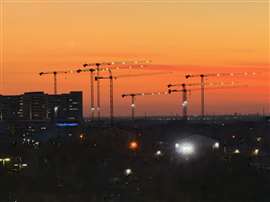 Uperio’s Zoomlion T8030S flat top towers helping construct the PHMS Pediatric Children’s Hospital in Frisco, Texas, USA. They are operating at different heights within airport proximity regulations. Photo: Uperio
International tower crane rental and manufacturing business Uperio’s new chief executive officer offers Crane and Transport Briefing a clear take on the market and a refreshing outlook.
Rémy Breton moved to the CEO position in 2026 after being Uperio Group’s chief financial officer for four years. In the last twenty years he held senior finance and operational leadership positions in international industrial companies, including Cromology and Consolis in the construction materials sector.
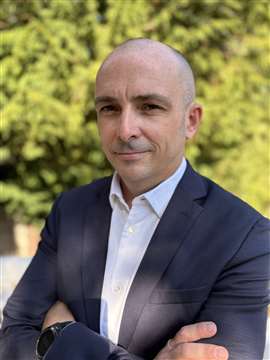 Rémy Breton, Uperio Group chief executive officer. Photo: Uperio
His experience spans finance, operations and business transformation across several European countries.
He now leads one of the world’s largest independent tower crane rental companies, with a fleet of around 1,800 cranes operating across Europe and the United States. I asked him about his impressions of the industry, the opportunities and his plans.
Alex Dahm: What surprised you most about the tower crane business, and what did you initially want to change?
Rémy Breton: Coming from other parts of construction, I understood how essential lifting equipment is. What surprised me was the contrast between the strategic importance of tower cranes and the economics of our industry.
A tower crane represents only a small proportion of a building’s cost, yet if it stops, the whole project can stop. Cranes have become safer, more reliable, connected and sophisticated over the last 20 years but, in many markets, rental prices have not kept pace.
The biggest challenge is therefore economics, not technology. Customers rightly expect safer, greener and smarter cranes and better service but someone has to finance that progress. We need to restore sustainable value creation if manufacturers and rental companies are to keep investing.
The other thing that struck me was the expertise in this relatively small, specialized industry. With around 1,800 tower cranes, Uperio is one of the world’s leading independent rental specialists but we compete alongside many excellent local and regional businesses.
Our future lies in combining that experience with people from adjacent industries who bring fresh perspectives. I have also benefited greatly from Philippe Cohet’s experience; he remains on our Board.
AD: How is demand changing, and where do you see the strongest opportunities?
RB: Europe has experienced an unprecedented downturn in residential construction. Around 60 per cent of tower crane demand is linked to new residential projects and housing starts have fallen to levels not seen for 30 or 40 years in several countries. We are seeing signs of stabilisation but recovery will take time because financing remains challenging and political uncertainty is delaying investment.
Non-residential construction has been more resilient, supported by industrial projects, logistics, infrastructure and data centres. These should remain important long-term drivers, although the outlook for 2026 and 2027 is more uncertain than it appeared a year ago.
I remain optimistic about Europe because housing needs remain significant. Projects are being postponed rather than cancelled.
The USA is different because construction activity varies considerably between states. We are well positioned in growth markets such as Texas and Arizona and in Virginia, where data-centre investment is generating demand. More broadly, North America has considerable long-term potential: tower crane penetration remains well below European levels, while projects are becoming larger, denser and more technically demanding.
Is the shift from crane ownership to rental continuing?
I believe the long-term trend towards rental will continue. Construction companies increasingly want to own projects rather than cranes. Their capital is better invested in developing projects than financing equipment fleets. Renting gives customers flexibility, lower capital intensity and access to specialized technical expertise.
Current conditions reinforce that trend: crane acquisition costs and financing costs have increased while rental prices have remained under pressure. Large contractors with high utilisation can still have good reasons to own, but rental is attractive for many others.
Manufacturers entering rental can capture more value across a crane’s lifecycle but rental companies also finance assets, manage utilisation through market cycles, maintain equipment, provide engineering support and carry customer credit risk. Manufacturing and rental are complementary but involve different capabilities and risk profiles.
Will Uperio continue to expand through acquisitions and sale-and-rent-back?
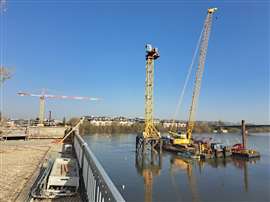 Unusual installation of Potain MDT389 and MD509 tower cranes for the construction of a pedestrian bridge across the River Seine in France. Photo: Uperio
The international rental market remains highly fragmented and I expect further consolidation. But our ambition is not simply to become bigger. Acquisitions must strengthen our geographical footprint, technical capabilities and-or customer offering.
We have also completed several sale-and-rent-back transactions. They allow contractors to release capital while transferring the management of specialized assets to rental experts. Following the Group’s refinancing last year, backed by our shareholders, Uperio has a stronger financial foundation. Our immediate priority is improving the existing business but we intend to participate in consolidation when opportunities fit our strategy.
Which new technologies are delivering the most value?
The crane of the future does not necessarily need more technology; it needs better technology. Customers ultimately judge it by whether it makes projects safer, easier or more productive.
Energy management is important as sites face limitations on available electrical power. Systems that optimise consumption while maintaining lifting capacity can avoid additional infrastructure investment.
The operator’s environment is another priority. Operators now manage collision avoidance systems, cameras, lifting instructions, digital interfaces and increasingly complex projects. Technology should simplify their work, not add complexity. Improving the human-machine interface may create more value than simply adding features.
Digital diagnostics and predictive maintenance are also significant because they can identify potential issues remotely, support technicians and reduce unplanned downtime. They have a direct impact on crane availability.
Which digital technologies are genuinely useful?
The construction industry does not need more dashboards; it needs better decisions. We recently completed a major transformation of our information systems across Europe, improving visibility of fleet utilisation, maintenance planning, logistics and operational performance.
The next step is turning that information into practical improvements: better maintenance planning, higher availability, optimised logistics and greater transparency for customers. AI has significant potential in maintenance planning, engineering support, fleet management and customer service, but the value comes from solving operational problems, not adopting AI for its own sake.
How will the balance between new and used cranes change?
The economics are challenging. Over the last six years manufacturers have increased prices because of inflation, production costs and investment in technology, while rental prices have remained under pressure, decreasing by 5 to 10 % across much of Europe. Our operating costs have increased by 25 to 30 %. Under current conditions, a new tower crane financed through leasing may take 12 to 14 years to generate a return.
Fleet management will therefore become more selective. New cranes remain essential for demanding projects but extending the life of existing assets through refurbishment, modernisation and excellent maintenance will become increasingly important. The second-hand market will continue to give high-quality equipment a second or third life.
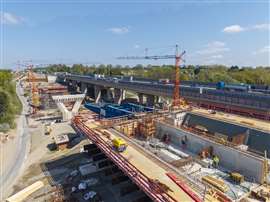 Arcomet builds its own self erecting tower cranes seen here on a job in Germany to replace an A1 motorway bridge. On this job were Arcomet A42, A45 and A47 models plus a Potain MDT219. Photo: Uperio
Does Uperio still manufacture cranes?
We continue to manufacture Arcomet self erecting cranes, particularly for Belgium and Germany. We operate almost 300 in our own rental fleet, while around 2,500 remain in operation across Europe.
Their longevity demonstrates their value for residential and smaller projects, where self erectors remain competitive. Our Belgian engineering and manufacturing teams are finalising the compliance programme so the cranes will meet all applicable requirements by 1 January 2027.
Being both manufacturer and rental company means we operate our own products every day. Feedback from technicians and customers goes directly into product development, improving reliability, maintainability and ease of operation.
What are the main things that will improve tower crane safety?
Safety has become my number one priority. Every company says safety comes first. The real question is whether your decisions prove it every day, especially when safety and productivity appear to conflict.
The first requirement is leadership. Safety starts at the top: the standards we set, the behaviours we reward and the example we give every day.
The second priority is competence. Tower cranes are among the most sophisticated pieces of equipment used on construction sites and operating them safely requires highly skilled people. Training, mentoring and sharing experience remain essential.
At the same time, experience alone is not enough. Sometimes, familiarity creates complacency. We have to keep challenging ourselves and continuously learn from every incident and every near miss. We strongly believe safety is reinforced when knowledge circulates freely throughout the organisation and when teams learn collectively.
Third is equipment condition. Rental companies have a particular responsibility because we own the assets. Preventive maintenance, rigorous inspections and strict technical standards are fundamental. Anti-collision systems, remote diagnostics and connected cranes will help but technology alone will never prevent accidents. People make the difference.
How is Uperio addressing the skills shortage?
We are competing for scarce technical skills but I do not believe young people reject our industry; most simply do not know it. Modern tower cranes involve advanced technology, engineering and significant responsibility. We need to show that these are skilled careers.
We are investing in training, apprenticeships, onboarding and internal career development, while transferring knowledge between experienced employees and younger recruits.
One initiative I am particularly proud of is our contribution in France to the creation of an official qualification for tower crane erectors. It is an important step for the entire industry because it formally recognises the technical expertise required for the profession while helping to attract and train the next generation.
As an international group across Europe and North America, we can offer careers across functions, businesses and countries. Cranes can be purchased; expertise takes years to build.
How important is sustainability?
Sustainability is fully embedded in our strategy. Over the past few years, we have significantly strengthened our ESG governance, working closely with Eric Etchart, who continues to support us and with whom I remain in regular contact.
We have established a dedicated ESG function, implemented a structured ESG roadmap and reinforced the role of our ESG Committee to ensure that sustainability considerations are integrated into decision-making across the group, reflecting both our own ambitions and the expectations of our shareholders.
Sustainability is not limited to environmental topics. It also includes safety, ethics, employee development, responsible sourcing and maintaining strong governance standards. These themes are increasingly embedded in the way we operate and create long-term value.
I believe rental is already one of the most sustainable business models in construction.
The greenest crane is often the one that has already been built. A tower crane is designed to operate for several decades and can contribute to hundreds of construction projects during its lifetime. Our responsibility is to maximise that lifespan through refurbishment, preventive maintenance and continuous technical improvement.
We are also working to optimise transport, improve energy efficiency and reduce our environmental footprint across all our operations.
Sustainability cannot, however, be separated from economic sustainability. Companies must remain profitable if they are to continue investing in safer equipment, lower-emission technologies and modern fleets. Environmental ambition and economic performance are not contradictory, they reinforce each other.
What are customers asking for now but were not asking for five years ago?
Price, technical specifications and availability remain fundamental, but projects are confirmed later and are often shorter. Customers therefore want immediate responsiveness: the right crane at short notice and flexibility when schedules or lifting requirements change.
Projects are also becoming more demanding, with taller buildings, heavier components and more complex lifts. Customers increasingly need higher capacities and expect us to propose the most efficient technical solution, not simply supply the crane originally requested.
Our scale and engineering expertise allow us to offer alternatives when circumstances change and help keep projects on schedule.
Customers are no longer choosing only a crane. They are choosing a partner that can reduce risk, solve problems quickly and contribute to the success of their projects. Our ambition is not simply to operate one of the world’s largest independent rental fleets. It is to be recognised as the partner customers trust with their most critical lifting operations.
Supporting documents
Click links below to download and view individual files.

STAY CONNECTED



Receive the information you need when you need it through our world-leading magazines, newsletters and daily briefings.
CONNECT WITH THE TEAM