


Read this article in 中文 Français Deutsch Italiano Português Español
Inside Fayat’s acquisitions strategy

19 May 2026
One of the biggest trends in the global construction industry is acquisitions – large companies getting even bigger by purchasing other firms. This is a general trend in business, not just in construction, but it does feel that the number and size of acquisitions in the construction industry has increased in recent years.
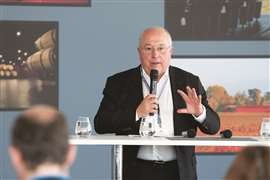 Jean-Claude Fayat is President of the Fayat Group. Image: Fayat Group
In 2025, the Fayat Group was responsible for two of the more notable acquisitions in the industry with the purchases of Mecalac and LeeBoy. Mecalac is a France-based international manufacturer of wheeled excavators, crawler excavators and wheeled loaders and dumpers, while US-based LeeBoy’s products include commercial pavers, compact motor graders, and road maintenance equipment.
The acquisitions significantly expanded Fayat’s presence in both earthmoving in urban jobsites and road equipment, strengthening its position in sectors where global consolidation among manufacturers has been accelerating.
When International Construction meets the president of the group, Jean-Claude Fayat, he is crystal clear on the importance of brands retaining their own identity and culture after they have been purchased.
“We leave to each brand its own autonomy to develop itself and to be agile. Because if you lose agility, you probably lose part of the commitment of the people. Our policy is to leave a large autonomy to the people [running the different brands], to have them to be very committed. It’s important that we keep the DNA of the different brands,” he says.
“But, of course, we’re a group and there are some rules. The most important rule for us is transparency. When you have autonomy, of course you can make mistakes. We all make mistakes. The most important thing when you make mistakes is to talk about it, not to try to hide it.”
Mr Fayat says that the different brands that make up the road equipment division – Bomag, Dynapac, Mecalac, LeeBoy, Marini, Ermont, Secmair, ADM and SAE – share some technical solutions and common platforms but he makes the point that they, “encourage exchanges but don’t force them.”
Looking to the US market
Sitting on a sofa at the company’s stand at ConExpo, Mr Fayat is a genial presence, quick with a smile and giving the impression that there is nowhere else he would rather be than at the Las Vegas trade show. When it comes to acquisitions, he says, “We’re doing both organic growth and external growth. This is the DNA of our group. But we are not growing just to grow – we are trying to build something.”
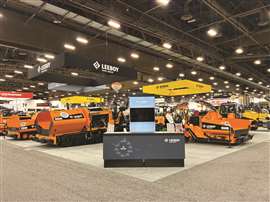 LeeBoy was acquired by the Fayat Group in 2025 to help with their ambitions in the US. Image: Fayat Group
As someone so keen on keeping the autonomy of brands, it is no surprise to hear him say that, “to buy a company is easy. The most difficult thing is to integrate a company and to create value with this company. If you destroy value, then it’s a failure.”
The purpose behind the LeeBoy acquisition was to grow the company but it also played into a key strategy for the company going forwards: targeting expansion in the US.
LeeBoy is an established presence in the US and the acquisition helped the Fayat Group to reinforce its presence in the country, particularly regarding asphalt.
“We have space to grow in North America. We have become a significant player in North America, but there is still a place for us to grow. We can still improve, doing more products locally with a more local vision of our products and improve our sales networks,” he says.
“We will do this with an American team – not European. This is also our culture inside the group; we want to have local teams. Because the culture is different in the US. Even in Europe, the culture in France, in Germany, it’s not the same. You need locals to understand that.”
The US is the largest market in the world for construction equipment sales and one that all major players want to expand in. However, there is a sense that, for the Fayat Group, it is an especially important focus.
“Our intention at our group is to develop our presence in the US. I hope that we’ll be able to do that,” he says.
“In the future, I would like to balance our turnover between Europe and US. I think it’s a good solution. These two markets are very important and, as an international group, to balance our turnover between these two areas of the world is very important.”
Digitalisation and electrification in construction
Despite electric equipment being commercially available for a number of years in the construction industry, take-up has been slow, and much slower than its advocates would have liked. Mr Fayat puts this down to the high initial cost of the equipment, which can be twice as much as their diesel equivalents.
“Electrification in our business is still a small activity for everybody, not only for ourselves. Of course we need to be present there, we need to offer products. The difficulty is the price today. Our customers don’t have a correct ROI (return on investment). That’s why the development is slow. I think that at one moment it’ll come and it’ll be a balance between diesel machines and electric machines.”
Mr Fayat also mentions the difficulties with the global supplier network for electric equipment, pointing out the advantages Chinese companies have due to government electrification policies introduced more than a decade ago, which leads to them being able to offer electric equipment at a cheaper price than European or US-based firms. Despite these challenges, he remains cautiously optimistic regarding electric equipment. “It will come – it’ll take time, but it will come.”
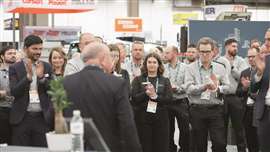 Jean-Claude Fayat believes that individual brands must have autonomy in order to retain the commitment of staff. Image: Fayat Group
The President of Fayat Group is more bullish on the impact of digitalisation on the road equipment segment. Technology is now being built into these machines as standard and, out of the whole suite of equipment that works on a construction site, road equipment arguably makes the most sense to be automated. Whereas, in the past, the biggest changes were to the equipment itself or mechanical, the biggest changes are now digital.
“We are working a lot on digitalisation. This is probably the biggest evolution that we’ll see on the machines, on the equipment, in the next months and years. The next big evolution of the machine will be digitalisation. It is already here, and I’m sure that we are not at the end.”
Regarding automation, he says that it will depend on the job site – on bigger sites with fewer people and more space it makes more sense compared to smaller and urban sites where there may be more people and the issue of safety is more complex.
He also makes the point that it is a question of culture and people getting used to seeing something new – he says, partly in jest and partly seriously, that aeroplanes are now mostly flown by a computer, but he wouldn’t get into a plane if it didn’t have a pilot. Regarding autonomous rollers, the technology is there but there are legal and cultural barriers to be overcome.
Mr Fayat clearly takes a keen interest in new technology and says that he enjoys speaking to the research and development teams from the company’s various brands. However, given his views on brand autonomy, it is no surprise when he says, “Of course, I enjoy being informed and if I have an idea I will give it. But it works without me. It has to work without me. They have the freedom to move and not to wait for me.”
As consolidation continues across the construction equipment sector, Fayat’s approach of combining acquisitions with strong brand autonomy stands out. The group is expanding its footprint in key markets such as the US while allowing its companies to retain their own identities. At the same time, the industry is entering a period of rapid technological change, with digitalisation, automation and electrification altering how equipment is designed and used.
In a sector being reshaped by consolidation and new technologies, that balance between autonomy and integration may prove to be one of the Fayat Group’s most valuable strengths.
STAY CONNECTED



Receive the information you need when you need it through our world-leading magazines, newsletters and daily briefings.

CONNECT WITH THE TEAM