



Read this article in 中文 Français Deutsch Italiano Português Español
From reactive repairs to strategic support
Partner Content produced by KHL Content Studio
02 June 2026
For equipment owners and operators, uptime has always been a priority, but as operational pressures intensify, expectations around aftermarket and customer support are changing.
 How John Deere’s Connected Support system establishes continuous, two-way data sharing between equipment and the local dealer
Increasingly, customers are looking for service relationships that go beyond parts supply and reactive repairs.
Today, support providers are being asked to play a more strategic role – helping customers anticipate issues, plan maintenance and make better operational decisions across the working life of their equipment.
Keeping uptime at the center of operations
According to Jessica Franck, a Territory Customer Support Manager with John Deere Power Systems, that shift is fundamentally driven by the realities customers face every day in the field.
 Chart showing the suite of services offered by John Deere, to help optimise engine performance
“The biggest pressure is just keeping machines up and running,” she says. “When something goes wrong, customers need to diagnose it and get back to revenue-generating work as soon as possible. They work on tight schedules and don’t really have a big buffer for downtime.”
When breakdowns occur, the consequences invariably extend beyond the repair itself. Delays can mean bringing in another machine and interrupting schedules, with potential knock-on effects across a project.
“At the end of the day, it’s about keeping equipment available so customers can stay on plan and protect their bottom line,” Franck explains.
That pressure is changing the role of aftermarket support providers, particularly those supporting OEMs, with access to deeper technical expertise, telematics and connected service ecosystems.
From reactive repairs to proactive support
John Deere Power Systems Territory Customer Support Manager, Kal Airey, says one of the most significant changes in recent years has been the move from reactive service models toward proactive support strategies.
 Jessica Franck, Territory Customer Support Manager, John Deere
“Customers need service providers that aren’t just part sources,” he says. “They’re proactively looking at maintenance plans, stocking parts and helping monitor fleets of machines.”
Part of this evolution is the growing use of technologies like John Deere Connected Support™.
Drawing on telematics systems from agricultural, construction and forestry applications, John Deere Connected Support allows John Deere service experts to maximize the customer experience and support engines remotely utilizing machine health monitoring, predictive alerts and remote diagnostics.
These connected support solutions are now being introduced more broadly across power systems applications.
“The idea is that, with customer consent, they can share data with their service providers in the field,” says Airey. “It enables better support and parts planning and means dealers can monitor equipment health and address issues when they come up.”
 Kal Airey, Territory Customer Support Manager, John Deere
Franck points to a recent example of this involving an OEM customer that retrofitted machines with JDLink™ in order to take advantage of John Deere Connected Support capabilities.
“One of the connected units went down and within minutes the dealer had remotely diagnosed the issue and ordered the part,” she says. “The customer was back up and running the next morning with only one trip to the site. That completely changed their experience.”
Proactive support is not just about accelerating repairs, however. In many cases, it also creates opportunities to improve machine performance over time.
Airey recalls an example in which a John Deere distributor remotely identified a fault code, discussed the issue with the customer and arrived on site with an upgraded component incorporating a design improvement.
“It wasn’t just repair and replace,” he says. “It was repair and improve.”
Why John Deere Connected Support is changing customer expectations
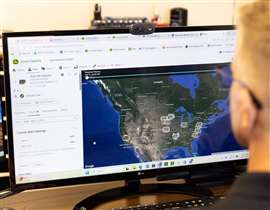 A technician monitors engines across the United States within John Deere’s Connected Support platform
Advances in connectivity and diagnostics have made this sort of proactive support technically possible, but operators are also increasingly expecting higher levels of visibility and close collaboration from service providers.
“I think it’s really a combination of technology, connectivity and rising customer expectations that are pushing support from ‘fix it when it breaks’ to a more proactive relationship,” says Franck.
Rather than waiting for customers to report problems, there is a growing expectation that dealers and support providers will identify issues early and initiate conversations themselves.
“When the dealer is the one calling the customer and saying, ‘Hey, we saw a code on your engine. Can we remote in and take a look before it becomes a bigger problem?’ that changes the relationship completely,” Franck says.
Trust remains central to making those relationships work. Customers vary widely in how comfortable they are with sharing operational data, and providers must balance proactive support with transparency and customer control.
“Every customer is at a different point in their journey as far as what they’re willing to share,” Airey says. “But over time, trust is built through the local dealer relationship. It’s the local dealership that becomes the face of support.”
Building trust through expertise and collaboration
That trust depends on more than just technology. Things like technical expertise, parts availability and application knowledge are equally important.
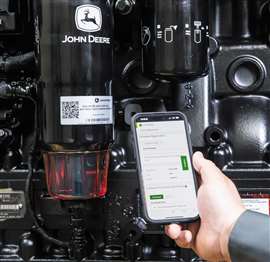 Simple engine registration can unlock the potential of John Deere’s Lifecycle Service Solution
“Technology like John Deere Connected Support is not much use if you can identify an issue but can’t support the customer,” Airey said. “There are still a lot of things dealers do that are critically important.”
Franck agrees. “Fair pricing, quality workmanship and real technical know-how are huge parts of building trust,” she says. “If you have to go back four times to diagnose the same issue, the trust in that dealership probably isn’t going to be top notch.”
Increasingly, those relationships also involve helping customers make better operational decisions.
Maintenance planning has become one area where support providers can add value. Even machines with identical engines may require very different maintenance strategies, depending on how they are used.
“A standby generator versus a street sweeper working day in and day out will have very different maintenance schedules,” Airey explains. “That’s where dealers can work with factory maintenance plans and then customize them for the application.”
Connected systems also allow operators to plan maintenance, budget for downtime and develop a better understanding of operating costs.
“The maintenance tools allow customers to estimate labor, understand parts requirements and even calculate costs before the work happens,” says Franck.
Connected data is also beginning to inform decisions around fuel usage, fleet utilization and future equipment selection.
“There are opportunities for fleet managers to observe how their machines are actually being used,” Airey explains. “Maybe a machine has excessive idle time, or maybe they realize they don’t need as much engine capacity as they originally thought. Those are insights that can improve efficiency across the operation.”
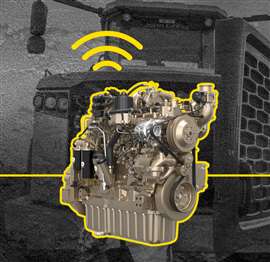 John Deere offers remote monitoring and diagnostic services through John Deere Connected Support
In terms of speed of adoption, both Franck and Airey say once operators experience the benefits firsthand, uptake tends to accelerate.
“Change is hard,” says Franck. “Technology can feel intimidating at first. But once customers actually see these tools working and see the value, the feedback is overwhelmingly positive.”
“In fact,” says Airey, “if they get a taste of what technologies like John Deere Connected Support can offer, they start asking about retrofits for the rest of their fleet.”
The rise of predictive, data-driven service
Looking ahead, both believe aftermarket support will continue evolving toward more predictive, data-driven service models.
Franck highlights technologies such as Expert Alerts from John Deere, saying, “It tells you something is starting to happen that could eventually lead to failure. That allows you to address it before it becomes a major issue.”
She also believes support will become more fleet-focused, with dealers acting more like lifecycle advisors, looking at maintenance planning, warranty coverage, uptime and long-term durability.
As more operational data becomes available, analytics and artificial intelligence are expected to play a growing role in identifying patterns and insight.
“We already have a huge amount of data,” Airey says. “Right now, we’re looking at it with today’s technology. In five or ten years, we’ll probably be looking at that data very differently.”
Franck agrees, saying, “We’ll have data backing more of the decisions and clearer insights into what’s happening inside the engine.”
For customers, the outcome should certainly be faster repairs and easier access to parts, but also a shift to long-term relationships, with service providers increasingly becoming an integral part of successful operations.
--------
This article was produced by KHL Content Studio, in collaboration with experts from John Deere Power Systems
--------
All images courtesy of John Deere Power Systems
--------