



Read this article in 中文 Français Deutsch Italiano Português Español
Deutsche Bank analyst hails European rental opportunity
09 June 2026
Deutsche Bank analyst Ammar Altaf argued at the ERA Convention in Maastricht that Europe’s equipment rental sector is perfectly placed to benefit from increasing market interest in ‘heavy asset, low obsolescence’ businesses – so-called HALO companies.
Speaking to convention delegates, Altaf, who is managing director, EMEA Business Services at Deutsche Bank, said HALO businesses were a dominant investment theme in 2026.
“The context is post-financial crisis of 2009, in a period which combined zero interest rates and abundant liquidity”, said Altaf, who has 16 years of investment banking experience and has advised on multiple rental M&A deals.
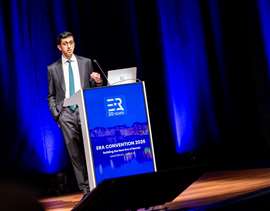 Deutsche Bank’s Ammar Altaf speaking to ERA Convention delegates in Maastricht. (Photo: ERA / Maurice Vinken / kleurstof.eu)
“Investors were really focused on high growth, asset light businesses. This is when you had these SaaS companies which grew enormously at huge margins and got to valuations of $50 billion or $100 billion.
“And all of a sudden in 2026, investors realized there’s no longer a moat around these businesses. People can use cloud code to create their own software instead of paying an expensive subscription fee to these companies every month.
“So, there was a major pivot towards capital intensive businesses, or to be more specific, businesses which demonstrated heavy assets. So, business models with substantial physical capital, with high barriers to replication and no obsolescence. Companies whose economic relevance persist through technological cycles.”
Altaf said valuations of capital heavy and capital light businesses had almost converged for the first time in history, with equipment rental at the heart of this shift. In addition, rental is positioned at the intersection of other HALO-friendly sectors.
“Grid construction needs rental, transport infrastructure needs rental, industrial capacity needs rental, energy transition needs rental”, he told ERA delegates.
“Every other HALO end market that investors are buying into depends on what you provide. The people in this room have built the ultimate HALO industry. The next decade is when the rest of the market figures it out.”
Opportunity beyond construction
Altaf said rental growth in the coming decade would come from beyond the construction sector; “We are living through the largest committed European CapEx program since post-war reconstruction. This is very broad-based - grid, rail, water, road programs across Europe - then you layer in investments related to industrial and climate infrastructure.
“It [means] unprecedented capital flowing into European infrastructure, the energy transition, and industrial capacity over the next decade. This is not incremental, this is generational.”
He argued that rental companies providing integrated solutions would be rewarded; “operators who can supply across a major project, not just deliver fleet. They can capture these energy transition investments, renewable installations, EV infrastructure.
“This rewards specialty depth, such as power and climate solutions. Some of the highest margin categories in this industry are exactly where CapEx is going. Strategic industrial capacity – semiconductors, batteries, defense, data centres - reward scale and major account coverage.”
Lessons from past 20 years
Altaf outlined some of the main trends that the equipment rental sector is seeing, highlighting several lessons from the past 20 years.
These include the sector’s continued growth and resilience despite a sluggish construction sector. European rental has seen compound annual growth rates of 2.2% over the past 20 years and 2.8% over the last five, he said.
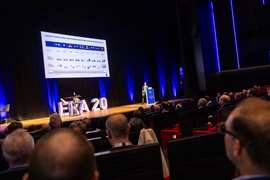 Ammar Altaf has 16 years experience in investment banking. (Photo: ERA / Maurice Vinken / kleurstof.eu)
In contrast, Europe’s construction industry has experienced -0.8% CAGR in the past 20 years, and only 0.2% in the last 5 years.
“This is an industry that has built its own growth through increasing penetration, taking share from customer capex, cycle after cycle.
“The rent versus buy economics have shifted decisively in your favour. And this shift has enabled you to [generate] compound [growth] through the weakest construction backdrop in modern European economic history…The structural penetration increase story is global, but you’ve managed to achieve it in a much tougher market.”
Altaf highlighted equipment rental’s ability to adapt quickly to changing market conditions, with the 2008 financial crisis being an example.
“In ‘06 to ‘08 rental company CapEx was running at over 30% of revenue. The industry was investing aggressively. Then the financial crisis hit and the industry immediately adapted. In fact, 2009 remains the year with the highest free cash flow as a percentage of revenue in the history of this sector. And you saw almost the same trend during COVID in 2020.
“So why does this matter? Because in a downturn, this industry can pivot from investment mode to cash conservation almost immediately. CapEx is discretionary and flexible in a way that it isn’t for really any other asset heavy industry.
“This is structural adaptability and it’s a major theme that investors are looking for today.”
More consolidation to come
He said Europe’s rental industry was also likely to consolidate further in the coming years. He contrasted the degree of consolidation in the US, where the top five represent around 35% of the total market, to the 21% share of Europe’s largest five renters.
“The number one player [in Europe] is now at 7%”, said Altaf, “But important to note, even after substantial consolidation over the last two decades, Europe is still where the US was 15 years ago.
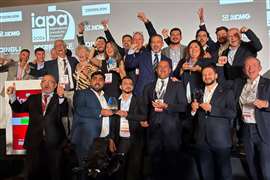
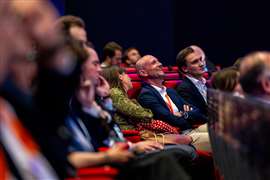 Delegates at the 2026 ERA Convention. (Photo: ERA / Maurice Vinken / kleurstof.eu)
“I know the US is a much more homogeneous market. I know there are pockets in Europe where the consolidation is already comparable to that level, but at the risk of being both provocative and wrong, I believe that’s still more to go.”
He told the ERA Convention that, in addition, the industry has managed to maintain return on capital through economic cycles, exceeding 15% in each of the past 14 years, despite an unsupportive construction market.
“This industry has held onto returns on capital in the 16 to 20% range through Covid, through the inflation shock of ‘22. The slight decline that you see in the last year or two, that’s just the cyclical impact of the current downturn, not a structural decline.
“The industry’s return characteristics remain intact. This is the evidence that this industry isn’t just asset heavy, it’s asset heavy with durable economics.”
The specialty opportunity
A final lesson, said Altaf, was the opportunity presented by specialty rentals – a strategy that is being successfully pursued in the US.
“Specialty rental has emerged as an important structural driver of superior growth and returns. This is partially because it gives exposure to end markets outside of construction with better growth dynamics. It may also involve higher barriers to entry, for example, in larger projects. It also enables cross-selling to the general customer base.
“The US has shown us where this leads. United Rentals took specialty as a percentage of total revenues from 19% to 36%, Sunbelt from 22% to 36%. These are not incremental shifts. This is a strategic repositioning that has helped drive a fundamental increase in returns for these companies over time.”
STAY CONNECTED



Receive the information you need when you need it through our world-leading magazines, newsletters and daily briefings.

CONNECT WITH THE TEAM