


Read this article in 中文 Français Deutsch Italiano Português Español
What we learned from Nishio Rent All’s annual report
24 February 2026
Nishio Rent All is one of the largest rental businesses in Japan and worldwide. Earlier this month it issued its annual report for the year to 30 September 2025 and it contained interesting detail about the rental business in Japan, plans for further rental acquisitions outside Japan, and its approach to sustainability and battery powered equipment.
Here are some key points:
How are current business conditions?
‘Difficult’ is how Nishio’s president, Masashi Nishio, described conditions in the first half of its current financial year, to the end of March.
The president, who has held the position since 1994, said redevelopment work in Tokyo was at a “transitional” phase, but that the overall market would start to recover in the second half of the year to September.
The company plans to significantly increase its fleet spending in the current year, said Nishio, “because we are planning investment to meet robust construction demand from 2027 to 2030.”
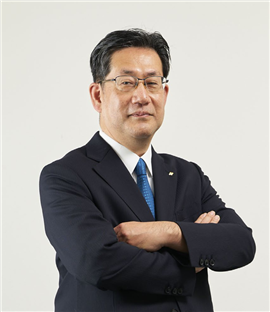 Masashi Nishio, president of Nishio Rent All in Japan. (Image: Nishio Rent All)
The company aims to invest Yen120 billion (€660 million) in its rental fleet over the three years to September 2028. He said the higher budget also incorporated plans to make acquisitions as well as buying land for new depots.
One target area for acquisitions will be event rentals businesses outside Japan in countries where it already has equipment rental operations, in South East Asia and Australia.
The company reported 2025 revenues of Yen215 billion (€1.18 billion), an increase of 8% year-on-year, and EBITDA profits were up 2.8% at Yen58.1 billion (€320 million).
Its outlook for revenues for the full year to September 2026 is Yen220 billion (€1.2 billion), an increase of just 2.3%.
What are its plans in wider Asia?
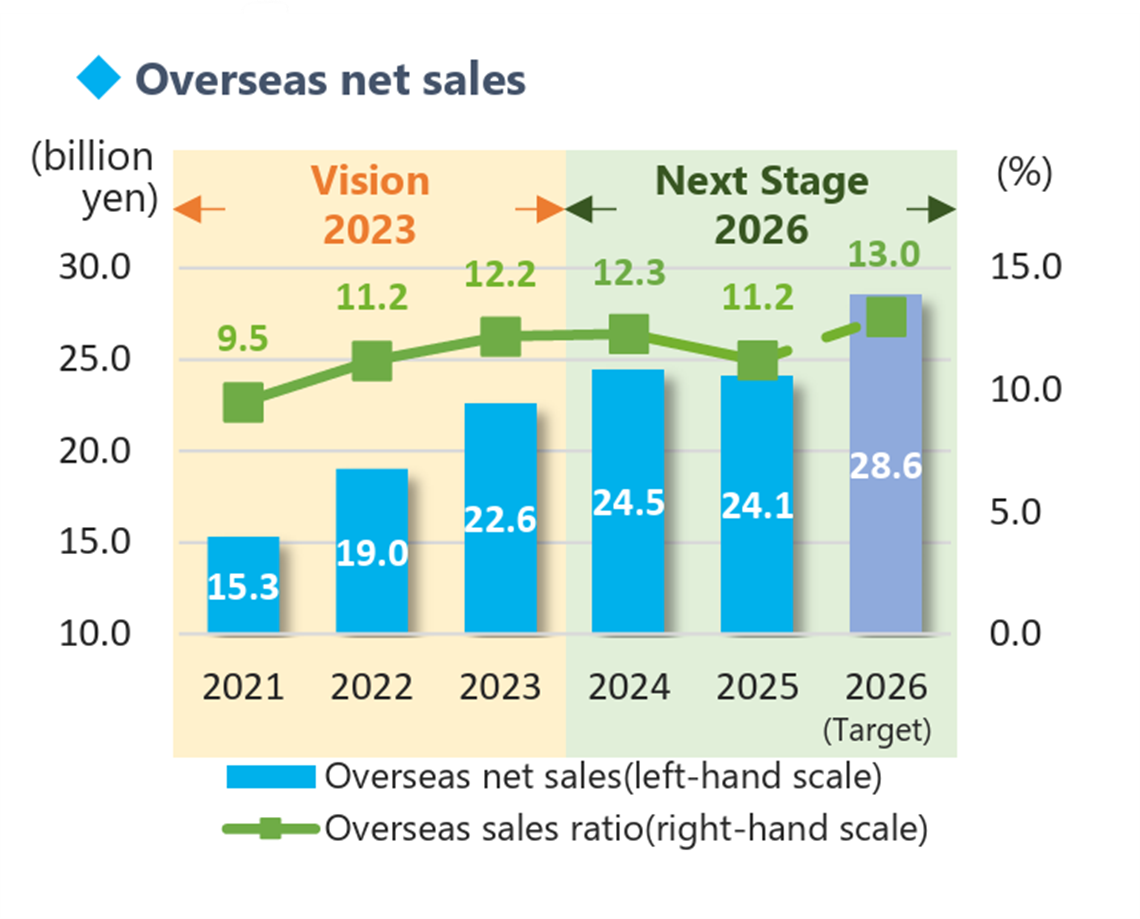
In 2025 rental business outside Japan generated revenues of Yen24.1 billion (€130 million), representing 11.2% of total sales, and Nishio plans to increase that by 19% to Yen28.6 billion (€160 million) this year.
It said it hopes to acquire two overseas companies this year. “We will consider future M&As not only from the perspective of simply expanding our scale, but also from the perspective of whether we can contribute to improving the efficiency of the Group.
The company owns two rental businesses in Australia – aerial platform specialist Skyreach and forklift company Fork Force – and Singapore-based United Power & Resources, which rents generators in Singapore, Malaysia, China, Indonesia and the Philippines.
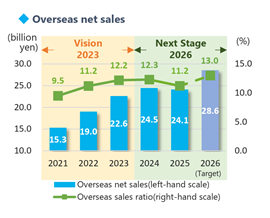 (Source: Nishio Rent All 2025 annual report.)
United Power rents large generators to construction sites, industrial plants and large-scale events, but said “demand for load banks (load testing equipment) and transformers at FPSO (Floating Production, Storage and Offloading) facilities and data centres is tending to increase, and we are working on the expansion of orders while also expanding our bases.”
What are benefits of owning Australian rental businesses?
Nishio first entered Australia in 2016 and said the country had several benefits for the wider business.
According to the Annual Report; “rental prices are higher [in Australia] than in Japan but laws and regulations make it difficult to use some models for a period of 10 years or longer.
“In Japan on the other hand, if maintenance is performed properly, machines which are over 10 years old are allowed to be used. Focusing on this ‘market difference’, our company introduced machinery consisting of new machines at our Australian companies, and after their investment amount is recovered, we relocate them to Japan to operate for another 4 to 5 years.”
This, said the company, made it possible to consistently refresh its fleets in Australia and “enabled the management of fully depreciated assets in Japan, thereby strengthening our price competitiveness.”
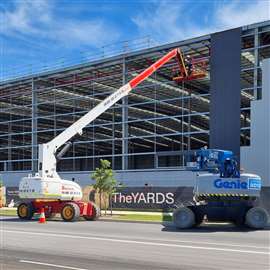 Skyreach in Australia is owned by Nishio Rent All. (Image: Skyreach)
What approach is it taking to sustainability, and electric machines?
Nishio makes the standard point that rental inherently supports sustainability by reducing waste and using equipment “repeatedly and continuously”.
Its focus on decarbonization is on the use of wooden modular buildings and investment in battery powered construction equipment.
The company aims to have 250 battery powered machines in its fleet by the end of its 2028 financial year; “we will work to popularise electric construction machinery by expanding the number of electric machines owned and increasing the number of charging facilities. We will also conduct research on biofuels and other technologies.”
Its current electric fleet includes mini excavators, wheeled loaders and tunnelling equipment. It has also converted several of its rubber tyred rollers – some as old as 20 years - into battery powered machines through conversions carried out by Shin-Tomoe Electric Manufacturing.
In its temporary accommodation business, which includes construction site huts and events-related structures, Nishio is investing in wooden structures which can be dismantled and re-used.
It said as a rental business it was able to help Japan’s wood industry to become more sustainable, because it can increase volumes and introduce standardisation.
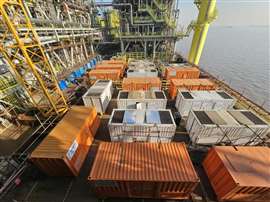 Nishio subsidiary United Power & Resources rented power generators for use on an offshore FPSO. (Image: United Power & Resources)
“Our company has been working to encourage the standardization of wooden materials”, it said, “Together with a company in Akita Prefecture, we have established a wooden materials plant and began executing initiatives in April 2023 for rental of all its buildings and machinery.”
In terms of cutting CO2 emissions, its target is to halve its Scope 1 and 2 emissions by 2035, taking the year to September 2023 as its base year.
That will require a significant shift, given that its Scope 1 & 2 emissions increased by 27% between 2023 and 2025 financial years.
The report makes no mention of Scope 3 emissions, which relate to the use of its rental fleet by customers.
Promoting female participation in the business
Just 5.7% of staff in management positions at Nishio are women. The company said it wants to increase that to 15%, although does not give a timescale for that change.
It said; “we are working on the creation of an environment in which women can play active roles by correcting long work hours, promoting the challenge of examinations for promotion and diversifying forms of employment.
“Also, so that both men and women can be active while balancing their jobs with childcare and nursing care, we are working on the development of a work environment in which employees can work stably for a long time even when life stages change by introducing flexible work styles such as shortened work hours, remote work and flextime systems, as well as providing support for career formation.”
| Note
Nishio Rent All has an English-language website and investor section, where the 2025 annual report and other documents can be found. See here. |
CONNECT WITH THE TEAM