



Read this article in 中文 Français Deutsch Italiano Português Español
Trendlines: Electrification and the conflict effect
05 June 2026
Since the beginning of hostilities in Iran in early March, the price of a barrel of Brent Crude oil has risen from the pre-conflict range of US$70-75 up to US$120 before settling, at the time of writing, to around the US$110 mark, roughly a 50% increase.
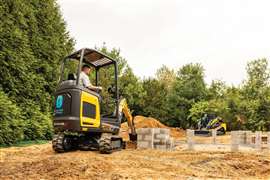 Even with higher fuel costs, charging infrastructure is a key factor for electric machines, such as New Holland’s E25X electric mini excavator, in construction. (Photo: New Holland Construction)
This is already being felt by construction equipment fleet owners and operators due to their heavy dependence on diesel and the large quantities of fuel machines consume.
To take a mild example, a 20-tonne excavator might burn 10 liters (2.64 gal.) of diesel per hour if it is not being used for anything particularly arduous. In a developed market with relatively low utilization, that machine might rack up 1,000 hours per year – a 10,000-liter (2,641.7 gal.) fuel burn. With current elevated fuel prices, diesel costs around 50 cents more per liter, so the annual bill to run that machine would be up by $5,000.
Economics of electric
This is particularly pertinent in the mining sector. Mines in remote locations have always had to generate their own electricity, and while this would most commonly be done using diesel gen-sets, mine mouth coal-fired power plants are common at coal mines, with solar, wind power and even energy recovery systems becoming popular in the general mining sector.
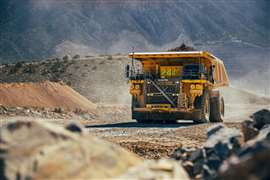 Fuel costs in mining operations can help drive interest in machines like Komatsu’s autonomous 930E-5AT ultra-class electric drive truck. (Photo: Komatsu)
Considering that large excavators, loaders and haul trucks might be running 24/7, the diesel bill for a reasonably sized mining operation is millions of dollars per year. A 30%, 40% or 50% increase in fuel costs adds up to a staggering amount of money.
Anecdotal evidence suggests this is increasing the interest and inquiries in electric equipment. In China, where a high proportion of loaders and dump trucks are already electrified, mine owners are asking OEMs about tethered (plug-in) electric excavators for face work. Tethering is preferred since crawler excavators are not as mobile as trucks and loaders, which can drive to charging points.
For other applications, such as construction, things are not as clear cut. Higher oil prices certainly help the economic argument for electric equipment, but there are other barriers to adoption in construction. Chief among these is where to charge machines. Remote sites and greenfield projects are an obvious problem, but even in urban environments with an electric grid, charging infrastructure is still needed.
Such problems are not insurmountable, and solutions like mobile charging services or on-site power banks are already available. Changes to project timelines could also be significant if a grid connection and charging points can be set up early on.
While it will take time for this electric ecosystem and new mindset to develop, ongoing conflict might spur it on.
Energy security
 Chris Sleight is the managing director of Off-Highway Research, a market research and forecasting business specializing in analysis of the global construction and agricultural equipment markets. Formed in 1981 as part of The Economist Intelligence Unit (EIU), it is now the largest consultancy of its kind in the world, with offices in Chile, China, Germany, Japan, India, the U.K. and the U.S. OHR is part of the KHL Group. www.offhighwayresearch.com
The current conflict highlights the problem of energy security around oil. There have been plenty of wars and political events in the major oil exporting countries that have sent the oil price spiraling over the decades, and the conflict in Iran will probably not be the last to do so.
Again, this sharpens the focus (perhaps in a more strategic sense) on electric equipment where there is arguably greater energy security due to the variety of sources. There is also greater national control over electricity prices, as opposed to the global nature of oil prices.
Owners of large fleets may well be thinking it is time to step away from diesel for a more reliable energy source and more predictable long-term costs.
That said, it is unlikely that the Iran conflict will prove to be a sudden tipping point in the electrification of construction equipment. Such a change takes time, and it is not just economics influencing electrification – on-site logistics and acceptance of the products are also factors.
However, faced with skyrocketing diesel bills, fleet operators will doubtless be nudged to look at alternative fuels.

CONNECT WITH THE TEAM