



Read this article in 中文 Français Deutsch Italiano Português Español
Why Samoter wants to be more than an Italian equipment show

17 June 2026
For Matteo Pasinato, event manager of Samoter, the measure of the 2026 show is not simply the number of machines on display.
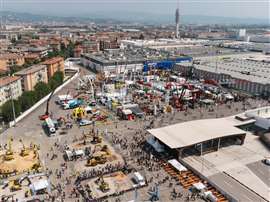 The show saw 42,000 visitors from 78 countries coming through the gates at the Veronafiere exhibition centre. Image: Samoter
The Verona-based construction equipment exhibition has traditionally been associated with earthmoving, but Pasinato is clear that its ambitions are broader than that. He says Samoter 2026 was built around three main aims: attracting leading international brands, creating a platform for industry discussion, and accelerating innovation across the construction equipment supply chain.
The first of those aims was partly about presence. Major OEMs including Volvo Construction Equipment, Case Construction Equipment and Caterpillar all had a role at this year’s event, something Pasinato sees as important, not just for the show itself, but for the wider supply chain.
“When you have the leading brands, the great companies, international companies, all the other supply chain in the construction equipment come,” he says.
That matters because Samoter is trying to position itself as more than a domestic equipment exhibition. Pasinato points to the breadth of sectors represented at the show, including earthmoving, lifting, concrete, quarrying, site vehicles and road construction.
The aim, he says, is to bring different parts of the market into the same place, allowing manufacturers, contractors, rental companies, professional associations, startups and universities to discuss the challenges facing the industry.
“Here we have on board all stakeholders, not only from Italy, but also abroad,” he says. “They can discuss not only the troubles of the sector or the main supply chain, but also to find solutions.”
The show saw 42,000 visitors from 78 countries coming through the gates at the Veronafiere exhibition centre and featured 526 exhibitors, including 124 international companies from 22 countries.
A stronger Italian market
The show also took place against a relatively positive backdrop for the Italian construction equipment market.
 Samoter event manager Matteo Pasinato. Image: Samoter
Pasinato says data presented at the event by Italian construction equipment association Unacea and European research body CECE showed Italy in a stronger position than some other major European markets, including France, Germany and the UK.
He says the market is expected to maintain its position in 2026, with the possibility of renewed growth in 2027.
Italy’s wider infrastructure needs are also part of the picture. Pasinato describes the country as “beautiful but fragile”, pointing to the impact of weather-related events and the need for machinery, technology and engineering solutions to help prevent or respond to damage.
That gives Samoter a domestic market with real demand behind it. But Pasinato is also looking beyond Italy.
This year’s show included 124 exhibitors from outside Italy, with companies from China and northern Europe among those taking space. He says Chinese manufacturers in particular are looking at Samoter as a route into Europe, not only into Italy.
“The Chinese are buying, without problems, many square metres,” he says. “They are looking to the European market, not only Italy. So Samoter is a window for them.”
International ambitions
Pasinato wants that international element to grow further.
Samoter 2026 occupied six halls and two large outdoor areas, but he says there is room to expand. The Verona exhibition centre has additional pavilion space available, and Pasinato says discussions have already taken place with Turkish and Spanish construction equipment associations about a larger presence in 2029.
“I spoke with the Turkish association of construction equipment, also Spanish, and they wanted to come with great numbers in 2029,” he says with a smile.
For Samoter, that points to the next stage of development: increasing the number of international exhibitors while also broadening the sectors represented.
Pasinato identifies lifting, drilling, roads and logistics as areas where the show wants to grow, alongside a stronger academic and scientific presence.
AI, skills and innovation
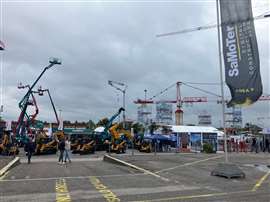 The event started off with overcast weather, but the sun soon came out to shine on the visitors and exhibitors. Image: KHL
Technology was another recurring theme at the event. Pasinato says artificial intelligence was already a major topic of conversation during the show.
“The first challenge for sure is artificial intelligence,” he says. “That is coming fast.”
Samoter has tried to address that through its Samoter Lab and Samoter Arena areas, as well as a programme of around 60 congresses and workshops across the show. Pasinato says the aim is to give professionals, companies and the next generation of workers the tools and skills needed to deal with new technologies.
That skills point is important. Like much of Europe, Italy’s construction sector needs more qualified operators and technically capable workers. Pasinato sees the show as one place where manufacturers, contractors, associations and universities can connect around those issues.
“The future [of technology] is now,” he says. “All of them know this obvious fact.”
He also expects Samoter to remain active between editions, with initiatives and roadshows planned in the Italian market before the next full show in 2029.
Why physical shows still matter
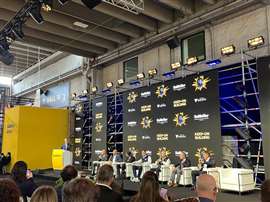 The event featured many discussions on the hottest topics in construction, such as AI and the worker shortage. Image: KHL
That might sound old-fashioned in an increasingly digital market, but Pasinato argues that physical trade shows still play a role that cannot easily be replicated online.
For him, exhibitions are not only about seeing machines. They are also about understanding how the market is moving, what competitors are doing and where investment is going.
“If I have a construction company, I could touch with my hand a Volvo, Case or Caterpillar,” he says. “I also want to know what my competitor is doing, how he is spending his money.”
That, he argues, is one of the reasons people still want to meet face to face. A trade show allows companies to compare technology, but also to test whether their own investment decisions are aligned with the direction of the market.
“Every fair is a great platform, a great venue where people speak to each other,” he says. “Not only to compare technology, but to know what my neighbour is doing.”
For Samoter, the challenge now is to convert the energy of 2026 into a larger and more international edition in 2029. Pasinato says the show’s role is to bring different parts of the sector together and create the conditions for new ideas to emerge.
In that sense, the direction of Samoter’s future may depend not only on how many machines it can display, but on whether it can keep convincing the construction equipment industry that Verona is a place where the wider market comes to talk.
STAY CONNECTED



Receive the information you need when you need it through our world-leading magazines, newsletters and daily briefings.
CONNECT WITH THE TEAM