



The way forward for telehandlers

17 August 2026
The latest generation of telehandlers reflects a category that is becoming increasingly diverse. Manufacturers are introducing new machines for high-capacity lifting, compact construction, rental fleets and lower-emission applications, while also adding more digital systems to improve safety and operator awareness.
Higher-capacity machines are being developed for infrastructure, industrial projects and prefabricated construction, while electric models are expanding into applications previously dominated by diesel equipment.
At the same time, manufacturers say customers are looking for machines that are easier to operate, maintain and match to specific tasks rather than a single solution for every jobsite.
Latest equipment
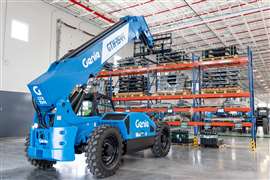 Genie’s new GTH-1544 pick-and-carry model. (Image: Genie).
One of the most notable developments has been the continued expansion of higher-capacity and specialist telehandlers.
Genie has introduced the GTH-1544, a 15,000 lb-capacity pick-and-carry telehandler designed for large, material-intensive projects. The machine extends Genie’s 44 ft telehandler family and is aimed at infrastructure projects, steel erection, energy projects and data centre construction.
Unlike conventional telehandlers that are often used for lifting and placing loads from a stationary position, pick-and-carry machines are designed to transport materials around the jobsite without the need to repeatedly deploy stabilisers.
Kyle Holdridge, global product director, telehandlers at Genie, says the development reflects changes in the way construction projects are being delivered.
“Projects are larger, schedules are compressed and equipment density continues to increase,” he says. “As construction shifts toward larger prefabricated, panelised and modular assemblies, equipment needs are becoming more specialised.”
Holdridge highlights the impact of off-site manufacturing on lifting requirements, with more completed assemblies arriving at jobsites rather than individual components.
“Components that once arrived as individual materials now arrive as completed assemblies that must be unloaded, transported and positioned efficiently.”
Manitou is expanding its rotating telehandler range with the MRT 4080. The model becomes the company’s highest-reaching telehandler, offering an 8-tonne lifting capacity and a maximum lifting height of 40 m. First deliveries are planned in Europe before global availability.
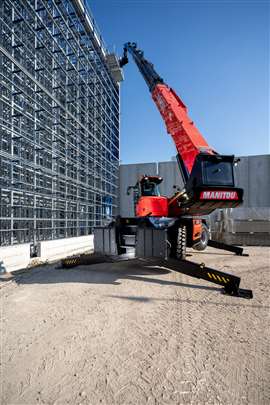 The Manitou MRT 4080 in a construction application. (Image: Manitou).
The MRT 4080 incorporates a new five-section telescopic boom system designed to improve load management and lifting performance. Manitou says the machine automatically adjusts travel speed depending on the attachment and load being handled.
Magni is taking a similar approach with the RTH 8.46 TC rotating telehandler, which introduces a tilting cab designed to improve visibility during high-reach operations. The cab can tilt to help maintain sight lines when handling loads at height, addressing one of the challenges associated with large rotating machines.
The machine is intended for demanding applications including construction, logistics, events and film production, with precise control with specialised attachments.
Alongside the rotating model, Magni is expanding its fixed telehandler offering with the TH 4.15 S/SP and TH 4.19 S/SP. The four-tonne machines are aimed particularly at construction and rental applications, with a simpler configuration focused on lifting performance and ease of use.
The boom has no hydraulic systems at the top, the system operates at 280 bar, and the machine is configured exclusively for lifting tasks, with no provision for an aerial platform.
The introduction reflects a wider trend among manufacturers to offer more specialised machines for different customer groups. While larger rotating telehandlers continue to gain capability, rental-focused fixed machines are increasingly designed around straightforward operation and reduced complexity.
JLG has also continued to broaden its telehandler portfolio. In North America, the company has expanded its rotating range with models including the R1370, R1385 and new R13100, while updating its fixed-boom SkyTrak and the fixed models.
The company has also introduced the redesigned JLG 519 compact telehandler, targeting rental companies, commercial and residential construction and contractors carrying out precision pick-and-place work in restricted areas.
John Boehme, senior product manager at JLG, says the industry is moving towards machines designed more closely around specific applications.
“Telehandlers are supporting a broader range of applications than ever before. They’re used across residential and commercial construction, concrete, steel erection, industrial and infrastructure projects.”
According to Boehme, this wider range of applications is increasing demand for machines with different characteristics, from compact dimensions and manoeuvrability to higher lifting capacity and advanced operator systems.
Wider electric applications
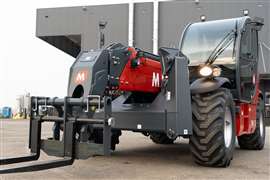 Magni’s 4-tonne TH 4.15 S/SP. (Image: Magni).
Electrification is becoming one of the most significant areas of development in the telehandler sector, with manufacturers moving beyond smaller specialist machines and introducing electric models aimed at mainstream construction applications.
Manitou has been among the companies pushing this development with the MT 1440 e and MT 1840 e electric telehandlers, which entered the European market in the first quarter of 2026. The machines bring battery-powered operation into the 14 m and 18 m lifting classes, traditionally dominated by diesel-powered equipment.
The models are aimed at urban construction, low-emission zones and projects where operators need to work in more environmentally sensitive locations.
The machines are part of Manitou’s wider move towards electric equipment, with the company highlighting the ability to recharge during working periods and maintain productivity across a typical working day.
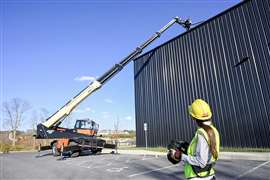 The new R13100 rotating telehandler from JLG. (Image: JLG).
JLG has taken a similar approach with the E313 electric telehandler. The battery-powered machine is designed for evolving jobsite requirements, particularly indoor construction, residential projects, municipal work where reduced noise and zero tailpipe emissions are important.
Sany is also expanding its electric offering with the STH625E, which was shown at the International Rental Exhibition in Maastricht. Based on the company’s conventional STH625 model, the electric version is aimed at lower-capacity applications, providing an option for customers looking to reduce emissions while retaining versatility.
The development of electric telehandlers is not simply about replacing diesel engines with batteries. Manufacturers are targeting specific applications where electric provides a practical benefit, particularly environments with strict requirements.
Advancing safety
Alongside electrification, safety systems are becoming a major focus of telehandler development.
Manitou has developed its SafeAlert pedestrian detection system using artificial intelligence. The system combines an AI camera with an in-cab display to detect pedestrians and provide alerts.
The technology will be available on the company’s MT 1440 e and MT 1840 e electric telehandlers, building on its introduction on the smaller MT 625 e.
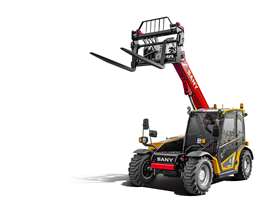 The new electric STH625E from Sany. (Image: Sany).
Manitou is also extending its Operating Safety System, which monitors machine operation, provides warnings when hazards are detected and records safety-related data.
The approach reflects a wider move towards systems that do more than simply display information.
Skyjack has introduced a different solution for its TH Series telehandlers in North America with the Multi-view Camera & Sensor System. The system adds two cameras and a tri-view monitor, allowing operators to view different areas around the machine or display multiple views simultaneously.
The system provides up to 220 degrees of visibility, with rear proximity warnings designed to assist operators when reversing on busy construction sites.
JLG has incorporated a range of similar technologies across its telehandler portfolio, including camera systems, load management technology, attachment recognition and remote boom control on rotating machines.
Boehme says operator support is becoming increasingly important as the industry deals with changing workforce conditions and more complex projects.
“While highly experienced operators remain essential, workforce challenges are driving demand for intuitive machines and technologies that build operator confidence and awareness,” he says.
He adds that technology must be combined with good machine design, including comfortable cabs, intuitive controls and systems that allow operators to remain productive throughout a working shift.
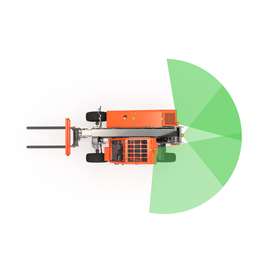 Skyjack’s Multi-view Camera & Sensor System. (Image: Skyjack).
Genie also expects operator-assistance technology to become increasingly common. Holdridge says telehandlers already use technologies such as cameras, load monitoring systems and load moment indicators, but believes future machines will incorporate more advanced sensing systems.
“These technologies have the potential to help operators identify obstacles, improve situational awareness and support safer material handling in increasingly congested jobsites,” he says.
While technology is advancing, rental requirements remain a major influence on telehandler design. Fleet operators typically prioritise reliability, serviceability and ease of use because machines need to perform across multiple customers and applications.
Shaping rental
Sunward Europe is expanding its telehandler range with the rental and construction sectors as a key focus. Following its SWTH 3507 model, the company plans to introduce two further diesel machines in Europe, with 14 m and 18 m lifting heights and four-tonne lifting capacity. Laurent Pons, director of Sunward Europe’s Aerial Work Platforms Business Unit, says the company sees continued demand for straightforward machines with strong standard specifications.
“There’s still demand for machines with more standard options and standard features,” he says.
The company’s approach reflects a wider rental trend towards equipment that is easy to operate and does not require extensive configuration before being sent to customers.
Dieci is also targeting rental applications with its new Pegasus 50.18 rotating telehandler. The machine increases lifting capacity compared with the previous model and is available in a lower-power version designed specifically for rental use.
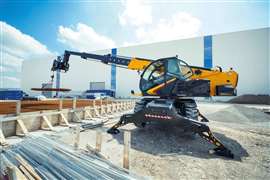 Dieci has been exploring new applications with its Pegasus range. (Image: Dieic).
Alongside the machine, Dieci is expanding its Dieci Telematics System through a mobile application, allowing fleet managers to monitor equipment remotely.
Skyjack’s updated TH Series telehandlers in North America have also focused on durability and ownership costs. Improvements include redesigned components aimed at increasing reliability, simplifying maintenance and extending machine life.
The company says customer feedback has played a key role in shaping the updates, with contractors and rental companies seeking equipment that remains productive throughout its working life.
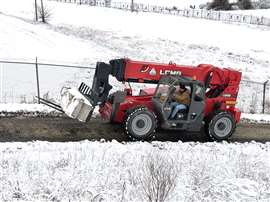 LGMG’s H1256 high-capacity model. (Image: LGMG).
LGMG has entered the higher-capacity telehandler market with the H1256, a rough-terrain model designed for rental fleets and demanding construction environments. With a 12,000 lb lifting capacity, the machine targets projects where heavier loads and faster material movement are increasingly important.
Russell Durand, regional sales manager at LGMG, says the machine was developed around rental fleets. “On large, demanding projects, that additional horsepower translates into faster cycle times, more trips per day and real productivity gains for both operators and fleet owners.”
Expanding portfolio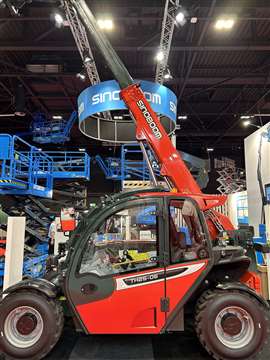 The Sinoboom TH25-06 was at APEX. (Image: Sinoboom). The Sinoboom TH25-06 was at APEX. (Image: Sinoboom).
A key attraction on the Sinoboom stand at APEX, in June, was the TH25-06 telehandler, powered by a Kubota 55kW Stage V engine. Compact, versatile and designed for construction, industrial and rental applications, the machine marks another step in Sinoboom’s expansion of its product offering. Following APEX, the TH25-06 will begin a European demonstration tour to gather customer feedback and real field tests activities to support future product development. |
STAY CONNECTED



Receive the information you need when you need it through our world-leading magazines, newsletters and daily briefings.

CONNECT WITH THE TEAM