



Read this article in 中文 Français Deutsch Italiano Português Español
Smarter by design: How intelligent excavators are delivering better jobsite results
Partner Content produced by KHL Content Studio
29 October 2026
European contractors are being asked to reconcile a difficult set of demands.
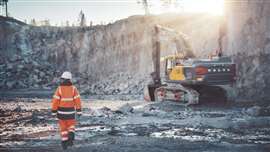 A smart excavator combines a stable, responsive machine platform with digital assistance to help contractors improve accuracy, productivity and control
Projects must be completed faster and more accurately, yet businesses are also under pressure to control fuel, labour and operating costs.
At the same time, many are struggling to recruit the experienced operators needed to maintain productivity on increasingly complex jobsites.
Contractors must also decide which technologies generate real value and which simply add cost or complexity.
This is creating demand for excavators that combine dependable engineering with assistance, automation and connectivity – capable of addressing a wide range of jobsite challenges.
According to Otmar Kirsch, product manager at Volvo Construction Equipment (Volvo CE), this combination is central to the definition of a smart excavator.
 Otmar Kirsch, product manager at Volvo Construction Equipment
“A smart excavator is not simply the machine itself,” he says. “You need a really good base machine and then you add the digital features.
“It is having the right combination of the hardware and digital services that makes the complete product smart.”
More than additional technology
This distinction matters because the usefulness of any assistance system is ultimately determined by the machine carrying it.
A sophisticated control system cannot deliver accurate results if the excavator lacks stability, responsive hydraulics or predictable controllability.
“Smart technologies can only deliver their full value if they are built on a strong machine platform,” says Kirsch. “Even the best system does not help if the base machine has not been developed in the right way.”
When the two elements work together, the benefits extend across trenching, grading, foundations and material handling.
Guidance and control systems can simplify complex work, limit unnecessary movements and help operators maintain accuracy throughout a shift.
The technology may range from relatively straightforward real-time guidance to systems capable of controlling aspects of boom and bucket movement.
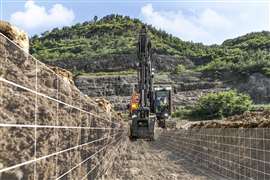 Dig Assist guidance helps operators excavate to the required profile, reducing overdigging and the additional fuel, haulage and material costs associated with rework
Three-dimensional machine control enables an operator to work from a digital site model, reducing reliance on physical setting-out and repeated checks by surveyors.
Onboard weighing can provide load measurements during operation, helping prevent both underloading and overloading of trucks.
Their greater value emerges when they form part of an integrated workflow connecting the design, excavator, operator and other site activities.
Avoiding the cost of rework
Trenching provides a clear illustration. With 3D guidance and semi-automated control, an excavator can dig directly to the specified profile while the system helps prevent overdigging or underdigging.
An error of 100mm may sound modest, but over a road or utilities project it can create substantial extra work. Labour, fuel, haulage and material costs all increase.
“If you overdig, you take more time, transport more material and may then have to refill the trench with more expensive material,” Kirsch explains.
“With 3D guidance and active control, you can reduce that overdigging, work more accurately and avoid paying two or three times for the same mistake.”
Fewer corrective passes reduce machine hours and fuel consumption while removing a potential delay for the teams following the excavation work.
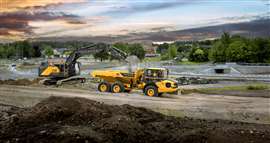 Truck loading links excavator performance to the wider jobsite workflow, with onboard weighing helping operators avoid underloading and overloading
This is especially valuable as the industry contends with a shortage of skilled staff. Assistance systems cannot replace knowledge of the work or sound operating practice, but they can shorten the learning curve and give less experienced operators greater confidence.
Guidance technology and semi-automation can also reduce the mental load of repetitive precision work.
“It is not only a benefit for inexperienced operators,” says Kirsch. “An experienced operator can also work more efficiently, with less fatigue and less need to concentrate on every small movement. These systems benefit both.”
The cab as a working environment
For someone spending an entire shift in an excavator, the cab is the workspace – and its design can affect concentration, safety and wellbeing.
Visibility remains fundamental. Camera systems and object-detection technology can extend awareness around a machine, but direct sightlines are still important because an operator cannot continually divert attention to a display.
Low noise levels, an effective seat and ergonomically positioned controls can also reduce fatigue.
 Clear sightlines from the cab help operators maintain awareness of nearby workers, complementing the additional support provided by cameras and object-detection systems
Moving functions from physical switches onto a central display can simplify the cab, but poorly structured menus may make frequently used controls harder to reach.
Technology intended to support an operator should be intuitive rather than create another distraction.
“The cab is the operator’s office,” Kirsch says. “If the seat, controls, visibility and noise levels are right, the operator is more relaxed and more focused on the work. That affects productivity, and it also helps a business retain people who are increasingly difficult to replace.”
With this in mind, operator comfort has become a commercial consideration, as opposed to a cosmetic feature. It contributes to output alongside cycle times and fuel efficiency.
Turning machine data into decisions
Beyond the cab, connectivity is giving owners greater visibility of how machines are being used.
While an owner-operator may have an immediate understanding of one excavator, data becomes increasingly important as fleets grow and diversify.
Managers may need to compare utilisation, idling and fuel consumption across excavators, trucks and other equipment while coordinating service without disrupting production.
For mixed fleets, information must be easy to access and interpret across machine types and brands.
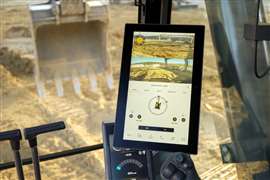 Camera views and boundary information on the in-cab display give operators additional support when monitoring the excavator’s surroundings and working limits
This information can support preventive maintenance and highlight excessive idling, poor machine utilisation or inefficient operating patterns that might not generally be noticed.
The purpose is not simply to generate data but to enable decisions that improve uptime or reduce cost.
Efficiency can also be addressed through the machine’s underlying power systems.
Hydraulic hybrid technology, for example, captures energy as the boom lowers, stores it in an accumulator and uses it to support the hydraulic pumps.
This reduces the demand placed on the combustion engine during the next working cycle.
Application is crucial. Repetitive boom movements in truck or crusher loading create regular opportunities to recover energy, while lighter grading work may offer considerably less benefit.
Kirsch says suitable applications can deliver fuel savings of around 10% to 15%, with the additional investment potentially recovered in as little as two-and-a-half years under typical operating conditions.
Looking beyond purchase price
That calculation illustrates why evaluating a smart excavator solely by its purchase price can be misleading.
The business case may also include higher production, reduced rework, shorter operator training, improved load accuracy, better fuel efficiency, greater uptime and enhanced safety.
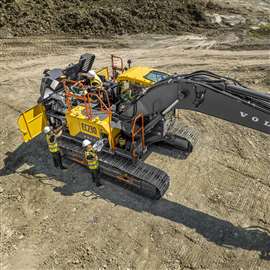 Easy access to service points on the Volvo EC230 supports routine maintenance, helping contractors minimise downtime and keep the excavator productive
Machine condition, specification and reputation may then contribute to residual value when the company chooses to purchase a new excavator.
“It’s important that buyers consider the total value delivered rather than focusing only on purchase price or fuel cost,” says Kirsch. “In many cases, the productivity gains alone can justify the investment.”
Kirsch believes we are now seeing an acceleration in integration between machines and the wider jobsite. An acceleration that, he admits, we should have seen five years ago.
Digital design information, building information modelling, telematics and machine-to-machine communication are likely to form increasingly connected workflows, he says.
Further automation and remote operation could also change the operator’s role from controlling every movement to supervising a broader process.
The speed of adoption will of course vary by country, application and client requirement.
It’s also fair to say that regulation, public procurement and corporate carbon or safety commitments can accelerate change, while skills gaps, along with infrastructure and investment constraints may slow it.
Nevertheless, the direction is clear: excavators will become more connected, assisted and application-aware.
The strongest case for this technology will not be that it makes a machine appear more advanced.
It will simply be that intelligence – built on sound engineering and presented through an operator-friendly interface – will help contractors complete work correctly first time.
--------
This article was produced by KHL Content Studio, in collaboration with experts from Volvo Construction Equipment
--------
All images courtesy of Volvo Construction Equipment
--------
Supporting documents
Click links below to download and view individual files.