



Read this article in 中文 Français Deutsch Italiano Português Español
Perkins expects ‘insatiable’ data centre demand as it unveils 5016 engine

17 September 2026
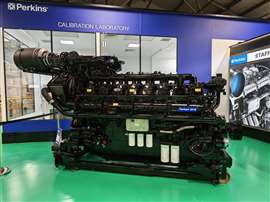 The Perkins 5016 engine at the company’s facility in Stafford, England (Image: KHL Group)
UK-based engine manufacturer Perkins expects “insatiable” demand from data centre projects, as it launched the diesel-powered 5016 engine, which tops its all-electronic 5000 series.
The 5000 series tops the range of Perkins’ engines, with displacement running from 23 litres to 61 litres, and power potential from 750-2500 kVA. It builds on Perkins’ mechanically controlled 4000 series.
The 16-cylinder 5016, which in the configuration showcased to media earlier this week at Perkins’ base in Stafford, England, weighs around six tonnes, is the largest engine in the series.
It’s designed to serve as the heart of generator sets that provide back-up power to mid-size data centres, hospitals, mining and other critical infrastructure in the event of grid outages.
The 5000 series as a whole offers a range of inline six- and eight-cylinder and V12 and V16 cylinder engines (designated as the 5006, 5008, 5012, and 5016).
With optimised turbochargers and custom software, the engines are designed to deliver full power output in under 13 seconds from startup.
The manufacturer also promises long oil service intervals of up to 750 hours or two years, thanks to a redesign of parts including new piston rings liner assembly, electronic fuel system, and fuel filters.
Meanwhile, the 5000 series has been designed to meet EPA Tier 2 emissions standards and the engines are can run with biodiesel of up to B20, or on 100% HVO.
The “long blocks” of the engines are manufactured in Perkins’ factory in Aurangabad, India. There is the option to finish and hot-test the engines in India too (primarily for south and southeast Asian markets). Meanwhile, the Indian factory also ships the long blocks to Perkins in Stafford for finishing and hot-testing in the UK.
Growing demand
The launch comes at a time when supply of large gensets is a constraint on the build-out of new construction projects.
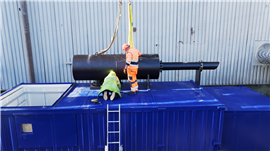 Marapco’s MP1100E 1100 kVA generator, powered by a Perkins 5008 engine, installed at the Royal Victoria Hospital in Belfast (Image courtesy of Perkins)
In its Summer 2026 Construction Market Trends Report, contractor Skanska USA noted that supply of larger gensets is under pressure, with demand for generators of 2 MW and larger absorbing manufacturing capacity.
Meanwhile, it also noted that generator prices across the 100 kW to 4.5 MW range are expected to increase 8-10% in 2026.
James Gardiner, business development manager at Perkins, said demand from data centres was “insatiable”. He also indicated that Perkins has the capacity to keep up with demand for the 5000 series. “The demand of the boom [in data centres] is just unprecedented but we’re confident we know what we need to do and we have the capacity to upscale [production].” However, he noted that the availability of large gensets also depends on the supply of many other components required by genset OEMs, such as alternators and radiators.
He also emphasised the close working relationship that Perkins has with several genset OEMs.
One of those genset OEMs is Marapco. The Perkins 5008 engine has already been pressed into service at the Royal Victoria Hospital in Belfast, Northern Ireland, within one of the company’s generators.
AC Automation, the company in charge of maintaining, repairing, and replacing the hospital’s 16 generators, recently chose to replace a 30-year-old container with the MP1100E 1100 kVA Marapco generator that is powered by the engine.
The engine is ISO 8528-5 G3 compliant, which means it meets the international standard for rapid load acceptance and power quality.
“More and more, we’re seeing consultants asking for G3 governing on generators. There are some projects where G3 governing is mandatory,” said AC Automation director David Callaghan.
“The Perkins 5008 Series engine powers the generator set backing up the centralised boiler house, which maintains heat and power for the site. It also provides standby power for a central decontamination unit, which sterilises all operating instruments for the site, so the generator is critical,” said Jonny Ravey, estates divisional manager for the hospital.
“In the unlikely event of a power failure, power must kick in immediately so there’s no disruption. Lives depend on it.”
STAY CONNECTED



Receive the information you need when you need it through our world-leading magazines, newsletters and daily briefings.


CONNECT WITH THE TEAM