



Read this article in 中文 Français Deutsch Italiano Português Español
Opinion: the UK’s CPA on the net-zero challenge for rental

20 November 2025
Luis Bassett, Decarbonisation and Sustainability Manager at the UK’s Construction Plant-hire Association (CPA), says net-zero aims are important, but the cost and risk implications for rental companies must be addressed.
As the UK pushes forward with its ambitious Net Zero targets, the construction plant-hire sector finds itself at a critical crossroads. The Climate Change Committee suggests that 56% of construction equipment must be powered by non-fossil fuels by 2035 to stay on track.
However, at the Construction Plant-hire Association (CPA) in the UK we have concerns that the economic realities of this transition are being overlooked, and urges that a more measured approach should be adopted.
Many sites have not yet felt the sting of targets for low-emission equipment, but large infrastructure projects are already embedding stringent environmental requirements into contracts, placing pressure on plant-hirers to supply this machinery.
 The author: Luis Bassett, Decarbonisation and Sustainability Manager at the UK’s Construction Plant-hire Association (CPA).
While the environmental intent is commendable, cleaner technologies such as electric and hydrogen-powered equipment come with significantly higher upfront costs, complex infrastructure needs, and difficult resale prospects.
Most machines are financed, and higher purchase prices translate into increased borrowing and elevated hire rates. Infrastructure for greener equipment remains expensive and logistically challenging, with customers often bearing the cost of grid connections, cabling, chargers and fuel. Hydrogen also sees challenges in transport and storage that complicates deployment.
Many low-emission machines currently operate at a loss - a situation which is only manageable in small volumes by large firms.
We think that this model is not scalable, especially for the 95% of CPA members who are SMEs - almost half of whom have annual turnovers below £450,000. Members describe current deployments where they are heavily discounting the rate, but the hire price is still double.
Challenging used equipment market
International resale markets offer little relief. Used low-emission equipment struggles to find buyers as demand for future technologies is limited, especially when it is second-hand.
Without stronger global demand, depreciation remains a major risk, and even if global demand increases, second hand machines from the UK will be competing with brand new machines from international distributors who can manufacture at a relatively low cost.
Hybrid technologies and HVO (Hydrotreated Vegetable Oil) offer more practical solutions. Hybrids are less dependent on novel infrastructure and easier to deploy, while HVO requires minimal operational changes. However, both still carry cost premiums and supply chain concerns, particularly given the UK’s reliance on imported fuels and components.
Total Cost of Ownership models often overlook key considerations for hirers, such as infrastructure costs and the fact that hirers don’t pay for fuel, and sometimes sell it.
Generous subsidies, buy-back schemes, finance offerings and lease arrangements are all measures that could help. However, many of these ‘solutions’ do not eliminate the risk, they only shift the risk to a third party.
While manufacturers and lenders might be in a better position to absorb the risk, it will still need to be addressed and managed. The age profile of fleets may also need to increase, with finance offerings to match and a greater focus on remanufacturing.
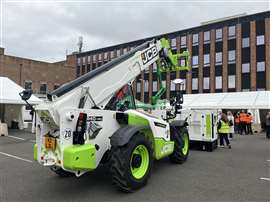 A hydrogen powered JCB telehandler at a recent Sunbelt Rentals UK event. (Image: IRN)
It is unlikely that the public purse would be able to absorb any risk at this time either, and giving subsidies for imported products can be politically and economically unfavourable.
Anything that is more expensive to own and run than diesel creates pressure to increase hire costs, sometimes quite dramatically, and increasing diesel costs deters investment.
No excuse for inaction
These challenges should not be used as an excuse to avoid environmental commitments, but they do highlight the need for hire customers to consider the potential impact of those commitments on their own operating costs, applying caution and balance as appropriate.
We also urge the Government to take a pragmatic approach to tackle emissions from construction equipment.
Ultimately, the CPA calls for a prudent, well-balanced strategy that supports decarbonisation without undermining economic stability, stressing the need for:
- Cost-effective and widely deployable machines
- Consideration of global supply chains and resale dynamics
- Compatibility with the UK’s hire-dominated market
- Consideration of cost implications when scaled
- Consideration of the implications on project costs and construction activity
With the plant-hire sector contributing £14 billion and 191,500 jobs to the UK economy, the stakes are high. The CPA continues to work with government and industry stakeholders to explore viable ways forward that protect both the planet and the prosperity of the sector, acknowledging that this will be a journey of many carefully thought-out steps, not one giant leap of faith.
Find out more about the CPA here.
STAY CONNECTED



Receive the information you need when you need it through our world-leading magazines, newsletters and daily briefings.


CONNECT WITH THE TEAM