



JCB sets out hydrogen case after Hydromax record


02 September 2026
When JCB’s Hydromax car reached 406.320mph at the Bonneville Salt Flats in Utah, it was more than a land speed record. For JCB, it was also a way of demonstrating the potential of hydrogen internal combustion engines for construction equipment.
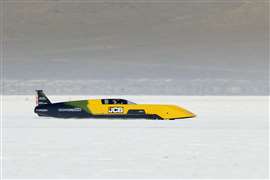 The JCB Hydromax car achieved an average over two measured mile runs of 406.320mph (653.909km/h). Image:
The global equipment market is working hard to clean up its act. Governments and legislators around the world are calling increasingly loudly for zero-emission solutions to power machinery and equipment on site. Yet, while the automotive sector has focused its attention on the possibilities presented by battery-electric powertrains, electricity is struggling to be the perfect solution for much of the construction business.
Battery-electric powertrains do work with smaller machinery, offering quiet, zero-emission operation for urban jobsites, underground and indoor projects. Yet, by its very nature, construction is often an off-grid activity, making the recharging of batteries impractical or impossible for many projects.
UK-based JCB believes that hydrogen provides an answer. The company has invested over £100 million (US$135 million). in the development of zero-emission hydrogen internal combustion engines.
The hydrogen engines develop the same power and torque as their diesel counterparts. By using the same block design, they also fit straight into existing machinery, with none of the additional packaging requirements of a totally new technology. This also means that service and maintenance are easy to carry out, using existing knowledge and tools.
“This technology is based on the machines that we are building today. It proves that we are still designing, still engineering and still prepared to take risks,” said JCB Chairman Lord Bamford.
“The internal combustion engine powered by hydrogen can be one of the important solutions for the future, particularly for the heavy-duty machinery that builds our roads, our homes, our cities and our infrastructure.”
Producing and transporting hydrogen
As with electric drives, the challenges for manufacturers and end users tend to be infrastructure-based. How is the hydrogen produced and how is it transported to remote construction projects? First, not all hydrogen is created equally. Green hydrogen is produced using clean, renewable sources to power water electrolysis. Where fossil fuels power production, the resulting fuel becomes known as grey hydrogen.
Likewise, hydrogen produced using renewable energy can lose some of its carbon advantage if it then has to be transported to site by fossil-fuel-powered tankers. Here too, JCB and Ryze Power have been working on potential solutions. Ryze Power is a European supplier of green hydrogen and this will, in time, be transported to construction sites using trucks powered by electricity or hydrogen.
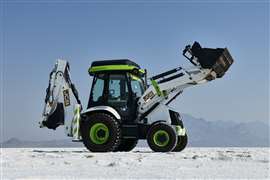 JCB’s hydrogen powered backhoe loader. Image: JCB
One of the other benefits of hydrogen production is that it can be produced locally. You don’t have to drill in the desert in the Middle East and then ship hydrogen around the world. Larger construction projects, with access to local wind turbines or other renewables, could in theory produce their own hydrogen on site, cutting transportation out of the equation completely.
Hydrogen is currently transported to site and stored in bulk cylinders. JCB has developed on-site refuellers, based on its Fastrac tractor line, that can take the fuel to larger pieces of machinery that tend not to return to the site compound. Refuelling takes a matter of minutes, rather than the multiple hours required for battery recharging.
Hydrogen is suitable for a wide range of construction machinery, both static and mobile. JCB’s hydrogen generators, for example, can be twinned with on-site battery packs to provide clean power to a site compound. The 3CX Hydrogen is an ideal first machine to use the fuel and JCB has also developed Loadall telehandlers that can be hydrogen-powered.
As JCB has opted for hydrogen combustion, rather than fuel cell use, in theory any of its machines that are powered by the JCB diesel engine could be hydrogen-fuelled. There would be some work involved in creating storage for the hydrogen on the machine, but the engine and driveline would be virtually unchanged.
Hydrogen at top speed
JCB decided that one way to prove the viability of its hydrogen technology is on the track. Twenty years ago, when JCB started to develop its own diesel engine range, it took the JCB Dieselmax streamliner car to the Bonneville Salt Flats in Utah to record a land speed record for a diesel car, powered by its own diesel engines, of 350.092mph. That is a record that stands to this day.
Keen to repeat this achievement, JCB Chairman Lord Bamford set the team the challenge of a second land speed record, this time powered by hydrogen. On Tuesday, August 11, 2026, the team did just that. The JCB Hydromax car, driven by Wing Commander Andy Green, achieved an average over two measured mile runs of 406.320mph (653.909km/h).
A team of 65 was assembled last year, including 25 of JCB’s own engineers, along with specialists from Prodrive, Ricardo and Ryze Power, the hydrogen provider.
“Ricardo has been a partner of ours going all the way back to the 1960s,” said Lord Bamford. “That relationship has lasted for decades and once again Ricardo’s engineering experience has played an important part in what we have achieved.”
The car arrived in Bonneville in time for the annual Speed Week festival in August, where a wide variety of cars and motorcycles take on the challenge of breaking various speed records. Under the control of the Southern California Timing Association (SCTA), which runs Speed Week, the team achieved an SCTA record of 368.347mph, while running with two engines each developing around 600hp.
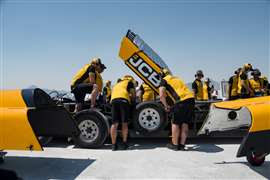 The project has been a way to teach the next generation of engineers. Image: JCB
JCB then swapped them for new checked and sealed units with up to 800hp for the FIA-sanctioned land speed record runs. To achieve a record, the car uses a 10-mile course that has been marked on the compacted salt. It is timed through mile 5.5-6.5 in one direction, turned around, refuelled and readied and then passes through the same measured mile in the opposite direction within one hour.
Every time the car was run above 300mph it was necessary to fit a new set of tyres, while up to 250kg of ice had to be loaded into the cooling system, melting as the car completed each run. As the receiving team was 10 miles from the start line, this involved a certain logistic dexterity.
“This achievement is about more than going fast,” said Lord Bamford. “It is about demonstrating engineering solutions. I believe very strongly that hydrogen must be one of those solutions.”
Teaching the next generation
The project has also been a way to teach the next generation of engineers. Project engineer Erin Murphy has come up through JCB’s graduate engineering apprentice degree scheme. Her day job is a project engineer within the company’s innovation department. Working on a range of new technology developments, including electric and hydrogen-powered machinery, she was a natural fit for the JCB Hydromax team.
“It’s been insane,” she said. “It’s hard to believe that this is a job. We’ve all learnt so much being here. It’s been about how so many different types of experience and expertise can be thrown together and can all pull together.”
Some may see little correlation between a land speed record and a construction machine working on site. However, JCB has shown that hydrogen can be portable, can be delivered to equipment in remote locations, and can provide similar power, torque and performance as diesel while producing zero emissions at the point of use. For many, that will be as important as the record itself.
STAY CONNECTED



Receive the information you need when you need it through our world-leading magazines, newsletters and daily briefings.

CONNECT WITH THE TEAM