



Interview: PowerCell’s Victor Åkerlund on the best applications for hydrogen fuel cells

16 November 2026
Sweden’s PowerCell is a pioneer in the development of hydrogen fuel cells. We asked the company’s Victor Åkerlund about applications, partnerships and its strategy for the construction market.
As chief analytics and sustainability officer at Sweden-based PowerCell, Victor Åkerlund is responsible for identifying the best markets and applications for its fuel cells.
It’s a complicated task because these applications are myriad, from power generation to use with on- and off-road machinery, as well as in sectors like maritime and aviation.
The difficulty is highlighted by the fact that one of the first applications identified by the company, to power in-cab fridges and TVs in long-distance trucks - envisaged when it was owned by Volvo Group before its 2008 spin-off as an independent business – proved to be a false start.
 Victor Åkerlund, chief analytics and sustainability officer at Sweden-based PowerCell. (Image: PowerCell)
“It turned out to be too early for the market”, says Åkerlund, “and then we made a few pivots along the way, and I think where we have our biggest market traction so far is in the aviation and the marine segments.
“Marine is where we have really come the furthest - we have multiple megawatt installations on the seas.”
The second growth pillar has been power generation, from construction site power to construction equipment and, now emerging, for data centres. For these applications PowerCell supplies both fuel cell stacks – the basic building block of a fuel cell power unit – and complete fuel cell systems.
Construction site power
Construction site power is a key target. “We did some work with Hitachi Energy where we provided the fuel cell module and they installed it in a container”, says Åkerlund, “That’s a plug and play solution, and their role is to put it on the market.” That is a 100kW size unit.
In a similar vein, it is working with Norwegian company Enetech, providing its PS190 fuel cell system for Enetech to use in a 190kW mobile power set for construction sites and elsewhere. The first unit was displayed at the Anlegg Norge exhibition in January this year.
“Enetech is very focused on the Norwegian market because Norway, particularly in Oslo and the big cities, are starting to put requirements on zero emission construction sites”, explains Åkerlund.
“The Netherlands is moving in the same direction, and we see in London, for example, there are some tenders where they require zero emission solutions. From our side, Norway, the Netherlands and parts of UK are early markets.”
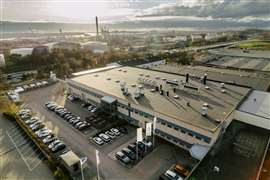 PowerCell’s head office and production facility in Gothenberg, Sweden. (Image: PowerCell)
Åkerlund says PowerCell will approach potential customers in a number of ways; “We are trying to get integrators and OEMs interested and we can support them with what you could call a white label business model, where we put our fuel cell module into their product and it’s their brand.
“But, if we would get, for example, a rental company that wants to buy a larger volume of turnkey containerized solutions and they feel that PowerCell would be a better supplier than the traditional OEMs, because maybe that they don’t offer that, then we can do that as well.”
A complicated mix
Of course, fuel cells are part of a complicated mosaic of possible power technologies, including traditional diesel gensets and hybrid and battery powered units (BESS). Where does Åkerlund see fuel cells fitting in?
“It’s a mix and we’re going from one solution fits all into a more diversified portfolio”, he says, “But if you have access to the grid, it’s sensible to use that - I would never argue that you should use a fuel cell instead of a grid connection.”
Where grid connections are limited, he says, then charging battery units can be difficult; “So, if you need some kind of off-grid solution, today you would have to use a combustion engine, maybe with HVO fuel...if we’re going to decarbonise and also get rid of local pollution, you need to get rid of the combustion solutions and go for something that’s cleaner and doesn’t produce any local emissions, and then hydrogen can be a good choice.”
He thinks fuel cells will complement battery storage; “Batteries are really good at taking short peaks and providing power for short duration and it has a good energy efficiency: you charge it and most of the electricity that you charge it with you can use.
“Hydrogen’s efficiency level is better than diesel, but still not as good as a battery. So, if you need the power for a longer duration or if you have high power demands for days, then a fuel cell is a good complement to a battery. Maybe the fuel cell could charge the battery, or it could be used as a standalone solution.”
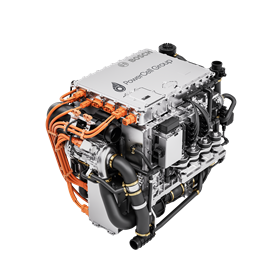 PowerCell’s PS190 fuel cell, jointly developed with Robert Bosch. (Image: PowerCell)
Fuel cell technology is expensive. As Åkerlund says, when it comes to economies of scale combustion engines have a “100-year headstart…But there’s nothing to me that says we can’t catch up. And if you simplify and model the trend curves on the cost per kilowatt, I think sometime in the future - I can’t say when - there’s no reason to believe that it can’t be done.”
He thinks construction site stakeholders should evaluate not just the price per kilowatt, but the cost of not being able to supply zero carbon solutions.
“If we see what Oslo is doing and some tenders in UK, zero emissions is a requirement to operate”, he says, “Either you can participate in a tender because you have a zero emission solution or you can’t, and then the alternative cost is probably higher than the additional cost per kilowatt hour.”
Hydrogen supply infrastructure
For fuel cells, there is also the issue of the availability of hydrogen, which Åkerlund agrees is a bottleneck.
He says hydrogen supply chains are improving; “if you look at the actual numbers, the number of electrolysers going live and the investments into hydrogen and the infrastructure - production is increasing year by year. Maybe not as fast as we had hoped a few years ago, but it is gradually increasing.”
He thinks hydrogen production hubs will be created and business models will evolve in how to supply hydrogen to a site in a cheap way.
He also makes the point that the search for the perfect zero emission solution can be the enemy of progress; “It’s a little difficult or counterintuitive for me as a sustainability manager to say, but maybe we’ve been too focused on green hydrogen solutions.
“If you want to phase out combustion or improve local air pollution, grey hydrogen could do the job as well as green hydrogen. That’s available at a much lower price. You wouldn’t get the climate benefits but compared to some of the coal-heavy grids in some parts of Europe, for example, grey hydrogen wouldn’t be much worse than using the grid.
“It could be a pragmatic way of getting the scale on fuel cell systems, and then you could gradually shift towards greener and more low carbon hydrogen.”
Robert Bosch partnership
In terms of further developments of its fuel cell technology, PowerCell is continuing to work with Robert Bosch in Germany. The two have been cooperating since 2019, when Bosch acquired the licence to manufacture PowerCell’s S3 fuel stack for use in the automotive sector - for cars, trucks and buses.
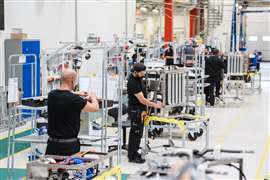 Fuel cell systems in production in Gothenberg. (Image: PowerCell)
In addition, since 2023 Bosch has become a contract manufacturer, producing S3 stacks for Powercell itself, increasing its production capacity.
“And we have also developed with Bosch, based on their truck system, the PS190, which is a 190kW unit, manufactured by Bosch in Germany. Then we bring it to Sweden and work on it to make it fit for our market segment - we install our software, the DMC [distributed master controller].”
PowerCell is also partnering with Bosch for the Chinese market. Initially this focused on automotive applications, but last year the two announced they would also cooperate on non-automotive customers in China, including backup power, construction and industrial mobility.
When it comes to working with construction equipment OEMs, PowerCell has created a modular fuel cell stack providing a wide range of power outputs; “The stack is 100kW. So, anything in multiples of 100kW is a good fit.” Below 80kW would be too small, but it will work in the range of 80 to 400kW.
He says as a medium-sized, agile company, PowerCell can move faster than some of the traditional OEMs and help them accelerate adoption by providing turnkey and modular solutions.
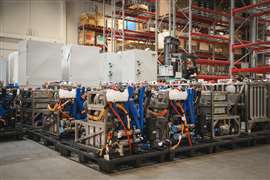 PowerCell fuel cells ready for delivery. (Image: PowerCell)
PowerCell is also working on the European Union H2MAC project, fitting fuel cells into an excavator and a rock crushing machine working in a quarry. The excavator is using a 120kW fuel cell stack while the shredder machine needs a larger 240kW unit. Other partners in that four-year project include Turkey’s Hidromek, Spanish shredder manufacturer ZB and cab filtration specialist Mann + Hummel.
What is the priority?
So, ultimately, what are PowerCell’s priorities when it comes to the construction market: is it power generation for sites or equipment power partnerships with OEMs?
“Short term, I would say that it’s replacing diesel gensets on construction sites that will require zero emissions,” says Åkerlund, “We have construction equipment [partnerships] as an option. I think what we are trying to establish is this genset replacement solution.”
Given its origins as a Volvo Group business, is it discussing its fuel cell technology with Volvo, including Volvo Construction Equipment? In answer to that, Åkerlund points to Volvo’s joint ownership with Daimler and Toyota of Germany-based fuel cell company cellcentric, which is producing the 375kW heavy duty BZA375 fuel cell power plant.
The off-highway sector includes agriculture equipment, so has PowerCell been looking at that? “We’ve made some pilots or demonstrators”, says Åkerlund, “for example putting the fuel cells on a tractor, but right now I don’t think that’s a primary focus for us.”
Data centre opportunity
Perhaps inevitably, it is data centres that are also seen as a big opportunity. In October this year, PowerCell and Bosch announced they were cooperating in the development of a stationary fuel cell system to provide up to 15MW of power, with a target market of data centres and utility companies in North America, Europe and the Middle East.
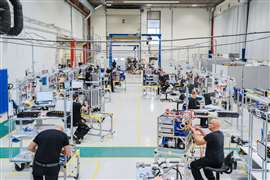 The production line at PowerCell's Gothenburg plant. (Image: PowerCell)
Åkerlund says providing power during the construction phase of a data centre makes sense; “And then the bridge power as well. Many data centres are really searching for ways to get power.
“They want to build them as fast as possible and the grid operators say, ‘Yes, you can connect in maybe seven years’ or ‘you can only get 200MW’, but the data centres want GW scale…so they are looking for off-grid solutions, at turbines, they’re looking at solid oxide fuel cells and even diesel generators for prime power.”
He thinks prime power fuel cells could do an important job as bridge power but also as backup power when the centre is up and running.
“We have a customer actually in California right now that is using our fuel cells for prime power, together with batteries and the grid, in a kind of a hybrid installation.
“We are trying to validate our hypothesis and testing and talking a lot with data centre stakeholders to see where the best product market fits.”
It has a joint venture with Edge Cloud link (ECL), a US data centre developer, to supply 300MW of fuel cell power for an ECL data centre in Santa Clara, California.
 Hitachi has created a containerised power unit using PowerCell fuel cells, pictured here alongside a BESS battery unit and an electric Volvo excavator. (Image: PowerCell)
“I think the data centre market is really interesting because that’s the only market that we really see that’s not subsidy or incentive driven”, he says.
“The business model works without subsidies because the willingness to pay in the data centre industry is way different than it is in other segments.”
And the technology will continue to evolve, alongside the applications.
“Just say 10 years ago or something, we were talking lower digit kilowatt scale”, says Åkerlund, “and then we were talking 100kW scale, and now we’re talking megawatt scale.
“So, it’s evolving quite a lot in terms of power sizes that are applicable and that are being installed on the market. Then also I think a lot is happening on power density, so the systems get smaller and more compact, but can deliver more power output.”
It’s a long way from powering TVs and fridges in a truck cab, but the journey still has a way to go.

CONNECT WITH THE TEAM