


Read this article in 中文 Français Deutsch Italiano Português Español
Interview: Kranpunkten’s market recovery strategy

01 September 2026
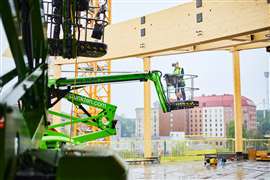 Image: Kranpunkten
Kranpunkten has spent more than three decades building its position as one of Sweden’s leading specialists in access equipment rental. Today, the company is balancing a challenging construction and rental market with continued investment in its fleet, services and sustainability strategy. Rikard Jönsson, purchasing manager at Kranpunkten and Petra Lampa, sustainability manager, explains the way forward.
The company generated approximately SEK 400 million in revenue in 2025 and now operates a rental fleet of around 4,200 machines, with depots stretching from Malmö in the south to Luleå in the north.
The past few years have been difficult for the Swedish rental market, particularly as activity in residential construction has fallen and the number of new construction starts has remained limited. This has contributed to overcapacity in parts of the
At the same time, the cost of new equipment, financing, energy and transport has increased. However, according to Rikard Jönsson, purchasing manager at Kranpunkten, the market is expected to improve slowly, with a more pronounced recovery anticipated in 2027.
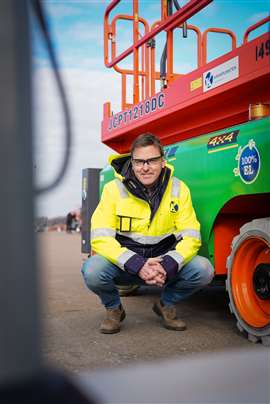 Rikard Jönsson. (Image: Kranpunkten).
Jönsson adds, “We take a long-term approach to investment and continually seek to balance our customers’ future needs against market conditions and the total cost of ownership of the equipment,” says Rikard Jönsson, Purchasing Manager at Kranpunkten.
“In today’s market, it is more important than ever for every investment to provide a clear benefit – such as improved energy efficiency, lower emissions or a feature that makes a real difference to the customer.”
Kranpunkten’s ambition is to grow profitably and sustainably over the long term. Organic growth within its existing segments is the main priority, although the company remains open to acquisitions where there is a clear strategic and commercial rationale.
From a farm to a nationwide operation
Kranpunkten was founded in 1989 at Ängsgården farm in Segelstorp, just outside Förslöv. The need for a MEWP during the construction of a machinery shed provided the starting point for the business.
The company grew rapidly and 1998, the fleet had reached approximately 400 machines and the business was relocated to Förslöv.
Corporate responsibly was a key consideration from the start, with the company gaining quality and environmental certification in 2001, followed by occupational health and safety certification.
The first depot outside Förslöv opened in Uppsala in 2004. Then through continued organic growth and acquisitions, Kranpunkten subsequently established operations in Gothenburg, Malmö and Stockholm.
A depot was opened in Luleå in 2024, strengthening the company’s presence in northern Sweden.
Today, Kranpunkten’s fleet includes scissor lifts, boom lifts, vehicle mounted lifts, telehandlers, forklifts, construction hoists, mast-climbing work platforms and other equipment for materials handling.
The geographical coverage enables the company to serve both local customers and large nationwide construction and industrial projects. It also means logistics are an important consideration for a rental company operating across such a geographically large country.
Market under pressure
The Swedish rental market has faced several challenging years. Low activity, particularly in residential construction, and limited new construction starts have created overcapacity in parts of the rental market and increased pressure on rental rates.
At the same time, equipment prices have risen significantly.
“There is currently a clear gap between the cost of a new machine and the rental rate the market will accept,” says Jönsson.
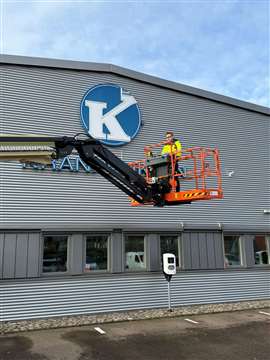 (Image: Kranpunkten).
“This means that we need to be more selective and assess more carefully which machines we invest in, how they will be used and what value they create for our customers.”
This places greater demands on having the right product mix, efficient logistics, high utilisation rates and long equipment service lives. Investments therefore need to be assessed on the basis of total cost of ownership and long-term demand, rather than the purchase price alone.
International developments are also affecting the business through the cost and availability of new equipment, components, transport and energy.
“We have to navigate a significantly more complex procurement market than we did a few years ago,” says Jönsson.
“Price is naturally important, but delivery capability, quality, spare parts, service and long-term support carry at least as much weight when we select suppliers.”
Trade barriers, tariffs and geopolitical uncertainty can make supply chains less predictable and lead to higher investment costs.
Despite the difficult conditions, Kranpunkten is seeing signs that the market is gradually stabilising. Major industrial and infrastructure projects are providing opportunities even while the traditional construction market remains weak.
Continuing to invest
Kranpunkten’s primary focus is to continue developing the segments in which it already has a strong position. This means continued investment in a broad and modern range of access equipment, with particular emphasis on electric and energy-efficient alternatives.
Recent investments have included equipment from manufacturers including JLG, Dingli and Ruthmann.
As a company the ambition is to continue growing organically by developing existing customer relationships, services, training activities and equipment offering,” says Jönsson.
“At the same time, acquisitions have historically played a part in Kranpunkten’s development, including the establishment of operations in Gothenburg and Stockholm. We therefore monitor the market continuously and are open to acquisitions that could strengthen our geographical presence, specialist expertise or market position. However, growth must always be profitable over the long term and aligned with our strategy and culture.”
Electrification at the centre
A significant strategic step came in 2019, when Kranpunkten launched its largest investment programme to date, with the aim of gradually transitioning the fleet to electric and hybrid power.
Since then, electrification, resource efficiency and reduced emissions have been central to the company’s development.
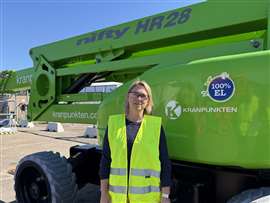 Petra Lampa. (Image: Kranpunkten).
In 2025, 85% of the fleet was fully electric. Where electrification is not yet possible, Kranpunkten makes extensive use of HVO100.
The company is also working across the wider rental value chain. Electric trucks are in operation in Malmö, Gothenburg and the Stockholm–Mälardalen region.
In suitable projects, this means Kranpunkten can offer a fully electrified solution, from customer visits and equipment delivery through to service and return transport.
“For us, sustainability is not about a single machine or a single project,” says Petra Lampa, sustainability manager at Kranpunkten.
“We look at the entire value chain and at how our decisions affect the environment, occupational health and safety, and people. Electrification is an important part of this, but how we manage transport, resource use, safety and our suppliers is equally important.”
Lampa sees a clear structural opportunity in growing sustainability, having invested in electrification for many years, which means it is now able to respond as customers impose stricter requirements for zero-emission equipment and transport.
Developing the wider offer
Lampa also sees growing importance in the services surrounding the equipment itself.
Liftpool and Funktionspool are examples of where the company combines equipment, logistics, expertise and service to make customers’ projects more efficient.
Liftpool is a customised solution ensuring the customer always has the correct equipment on-site when needed, while Funktionspool is a broader management offering that coordinates heavy machinery, logistics, waste management, and support functions.
Training is another important area of growth, says Lampa. Demand for documented performance and safety training is increasing, while regulations are evolving and customers are becoming more aware of the risks associated with working at height.
“We are seeing a clear trend in which safety is increasingly regarded as part of the overall quality of a project, rather than as a separate issue,” says Lampa.
“The right equipment is important, but it must be combined with the right knowledge, the right working methods and an understanding of the risks.”
For Kranpunkten, this means that training is becoming an increasingly important part of its offering.
“By combining equipment rental, training, advice and integrated solutions such as Liftpool and Funktionspool, our role is gradually evolving from equipment supplier to partner for safer, more efficient and more sustainable workplaces,” says Lampa.
Staying close to the core business
Kranpunkten’s focus remains on the segments in which it already has strong expertise and an established market position. The company sees considerable opportunities to grow within its existing areas rather than moving into entirely new lines of business.
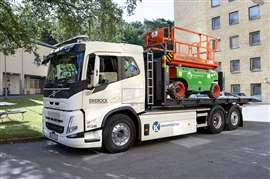 One of Kranpunkten’s delivery vehicles. (Image: Kranpunkten).
At the same time, the customer mix within those segments is changing.
“Industrial projects, infrastructure projects and other major investments can generate significant demand for the same types of access equipment, logistics solutions and expertise that we already provide,” says Jönsson.
“We can therefore follow our customers into new types of projects without moving away from our core business.”
Competition remains intense throughout Sweden. Kranpunkten faces both large nationwide rental companies offering broad ranges of equipment and services and strong regional and local operators.
The weak construction market has contributed to overcapacity and increased pressure on rental rates.
Preparing for the recovery
The most important opportunity for Kranpunkten is a gradual recovery in the construction and industrial sectors, says Lampa.
The company expects some improvement as residential construction begins to pick up again, while major industrial and infrastructure projects continue to provide opportunities.
For now, Kranpunkten is maintaining investment while remaining selective about where capital is deployed. Organic growth remains the priority, although acquisitions remain an option where they fit the company’s strategy and culture.
The long-term approach also applies to sustainability and safety.
“When the market is under pressure, it is easy to focus solely on costs, but we must not compromise on safety or our long-term sustainability work,” says Lampa.
“On the contrary, it becomes even more important to have clear procedures, the right expertise and a safety culture that works every day.”
The next phase is therefore about continuing to develop its fleet, services and expertise while navigating the current Swedish market.
With electrification, resource efficiency, training and safety all becoming increasingly important, the company is continuing to invest while preparing for the recovery it expects in the Swedish construction and rental market.
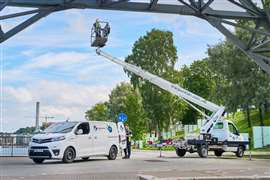 A small part of Kranpunkten’s vehicle mount fleet. (Image: Kranpunkten).
STAY CONNECTED


Receive the information you need when you need it through our world-leading magazines, newsletters and daily briefings.
CONNECT WITH THE TEAM