


Read this article in 中文 Français Deutsch Italiano Português Español
Interview: how to become Southeast Asia’s largest rental company

22 June 2026
Malaysia-based Ban Ngai has expanded its rental fleet quickly in the last two years and now aims to be the largest rental provider in the Southeast Asia region by 2030.
Ban Ngai’s growth rate from 400 units just two years ago to the 3,400 aerial platforms and 400 forklifts now, demonstrates the company’s strong ambitions, following its foundations in manufacturing more than 60 years ago.
“We’ve been very lucky over the last few years. Our markets in Southeast Asia are extremely vibrant and we’re also lucky to have great teams on board across our countries. That’s why we are buying as many machines as we are and trying to scale up as fast as we can,” says the company’s chair of the board Ong Joe-U.
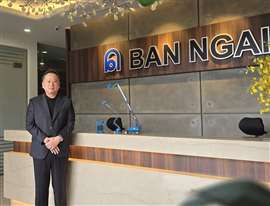 Ong Joe-U, Ban Ngai Rental (NGR). (Image: NGR).
Up until the beginning of the Covid pandemic, the company focused on shopping trolleys and roll cages, and the distribution of forklifts for Chinese producer Noblelift. It remains the largest manufacturer of those products in the region, which has provided it with the necessary capital to meet its ambitious plans for rental.
As Ong explains, the company was founded in 1962 as a manufacturer of automotive parts, before Ong’s father joined in 1965 and then acquired all the shares to become its owner. Ong joined the company at 21 after returning from the UK having completed a law degree in London.
Once Ong’s father had taken control the emphasis shifted to material handling equipment. “And when the Chinese companies started coming to the region with their products, we decided to source a supplier from China that we could represent.”
This led to the partnership with Noblelift,” says Ong. “It was 25 years ago we started the cooperation with them, bringing in their products for us to distribute in Malaysia initially. And then as the customers grew and our product range grew, we expanded into other regions such as Thailand, then followed Indonesia and finally the Philippines.
Then, some six years ago Ban Ngai branched into the rental of forklifts. “We decided to give rental a try as we already have experience with forklifts in the sector and had an established base in the region.”
Alongside that the company has also focused on aerial lifts. “Just before Covid, we decided to do something new. We discovered access equipment and we thought it would be fun to do. So, we went to the UK and got certified by IPAF.”
There the company bought around 100 used units. “Then Covid hit,” says Ong, “and the access side of the business was put on hold until after the pandemic came to an end.
“We were extremely busy with the existing business and only started growing the access side again when a friend came into the company who was an ex-Terex employee.” He helped develop regional teams around the product, resulting in the formation of Ban Ngai Rent, under the wing of parent company Ban Ngai engineering. Within Ban Ngai Rent there are subdivisions, including Ban Ngai Rent Malaysia, Thailand, Indonesia and Philippines.
“It was kind of a startup, because those people are now carrying out the day-to-day operations and have shares in the company,” says Ong, “That’s how we enticed them away from their existing rental companies in the region. And one of the reasons why we are able to scale up so fast.”
He adds, “So we stand apart from many of the traditional rental companies in Southeast Asia, which are old, family-run businesses. The managers they employ don’t normally have stakes in the company. We changed this style of working, so now a lot of the people who really drive the development in our business have stakes in it.”
Growth ambitions
In the last two years the fleet has grown to 3,400, alongside 400 forklifts, and that is increasing by 100 – 200 units each month. And with existing orders, the fleet is expected to grow to over 5,000 aerials by the end of the first quarter of 2027. This, said the company, will place it among the top three rental providers in Southeast Asian markets of Malaysia, Thailand, Indonesia and the Philippines.
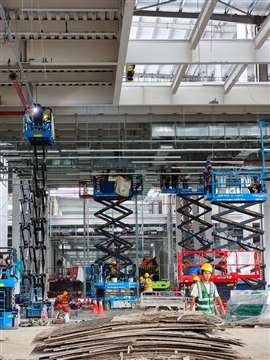
All the products entering the fleet are newly-purchased from the previously mentioned Noblelift, along with Dingli, Zoomlion and Sinoboom and a few LGMG units. “We only buy from these few companies,” confirms Ong.
There are plans to move into Vietnam and Singapore too, but that is on hold for now. “We had some joint venture plans in Vietnam which didn’t go through earlier this year and we’re now re-evaluating our strategy as to the timing of when we enter these markets.”
Ultimately, Ban Ngai Rental aims to grow its regional fleet to more than 8,500 units by 2030, with the ambition of becoming Southeast Asia’s largest rental provider.
Ong explains. “There is a big boom in the rental market and we are actually at a turning point in Southeast Asia where a lot of people are switching to MEWPs, where penetration has been very low.
Ong adds, “Data centres are playing a big part in this boom, which is also reshaping the rental market. And because of the volatility with tariffs, along with globalisation, a lot of major companies are choosing Southeast Asia as their plus one, instead of China and others.”
Of all the region’s MEWP markets, Malaysia is the fastest growing with around 10,000 units operating in the country, with large numbers of contractors adopting aerial platforms onsite.
“In part this is due to growing awareness and education about the products, and is also due to our government regulations, which have tightened considerably over the last two years. On top of that contractors are asking for new machines,” explains Ong.
“The process for getting approvals and licences for MEWPs is increasingly onerous and burdensome. It will take us up to two to three months to get the licence enabling a new machine to be used after it lands on our shores.
“So, other rental companies are either delaying bringing in machines or the older machines they already have are facing long waiting times to get re-certified.”
It means that companies that are not working to these high standards are finding it difficult to operate in many circumstances.
Booming into the foreseeable future
Looking ahead, the future in the country is bright. “We are seeing visibility of that data centre boom until 2030, and there are 50 confirmed projects, with only 15 being executed right now.”
Alongside the many infrastructure, aviation, automotive and energy-related projects in the country it could see the MEWP population doubling to 20,000 in the next five years.
When it comes to Thailand, Indonesia and the Philippines, there are different dynamics. Thailand is a larger market than Malaysia overall, with around 12,000 units, but that may change in the next five years. “We are growing very quickly there because we started from a very low base.”
The company has about 700 machines there now, compared to the 1,900 in Malaysia. “There are still a lot of investments through data centres and investments from China but it is not growing as fast as Malaysia.” In contrast says Ong, “We will grow from 700 units probably to about 2,500 units in the next five years.”
Ban Ngai’s Thailand team comes from major regional rental players like China’s Horizon, along with Aver Asia and Nishio Rent All. “So, we’re probably taking some of their market share, but to be honest, everyone’s doing well in Southeast Asia at the moment because the market is also growing.”
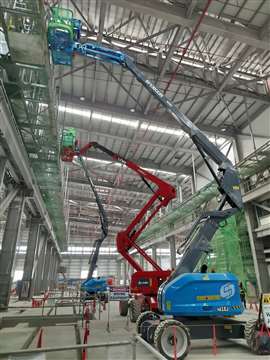
Indonesia is a smaller market, with around 4,000 units, but growing at a faster rate than Thailand, says Ong. “Again, data centres are part of that but there are also large labour-intensive industries from China.”
“It’s a much smaller market than Thailand at this moment, but it will also possibly double in the next five years,” says Ong. The Philippines market is even smaller at some 2,000 units, and says Ong, “the growth will probably be pretty slow in the next five years.”
Again, Ban Ngai aims to outpace both Indonesia’s and the Philippines’ wider MEWP growth rate. It has 700 units in Indonesia but that will increase to 1,200 by early next year. In Philippines there are about 500 in total. “But we’re not going to be growing that too much - probably another 100 units by next year.” He adds, “When you look at those countries Horizon and Aver Asia are still larger than us but by the time we hit 1,200 in Indonesia, we’ll be the largest probably.”
Across the region, with its 3,400 units, Ong believes the company sits firmly in the top five rental players, estimating that Simgapore’s Galmon has around 3,400 units, Aver Asia 7,000 and Horizon likely topping the list.
The latter has been moving fast, having acquired Tong Hing, Malaysia’s largest rental company at the time of sale last year, and increasing operations elsewhere, which Ong believes brings its fleet to anywhere from 8,000 to 10,000 units in the region.
However, while there has been much talk of Horizon’s move into global markets outside China, Ong says their presence is not directly affecting their business. “They do price slightly below us. But we also have the capability to price at their level.
“At least they are not pricing at Chinese rental rate levels. So that’s good for us and we’re happy that they’re doing that.”
Opportunity for further expansion
Beyond that there is space in the market for everyone to grow, at least for now. “And of course, the people are very important. Customers in Southeast Asia are very concerned about service and relationships. We have good relationships and manage the company well and have a good technical team that goes out to site very quickly.
“We also think that’s what’s keeping us ahead as well, in addition to our new machines and our good people.”
The company focuses strongly on service with vehicles, in stock parts, and is working on a new ERP system, including numerous service vehicles and teams.
This is an important focus for such a quickly expanding company, which is opening a new depot almost every quarter to add to the current nine across the region, four of which are in Malaysia, and the others split between the other three nations.
As in most parts of the world, labour is an issue and hiring and retaining its 250-strong staff is a challenge. “We just try to do everything properly. We keep our promises and we pay rates that are slightly higher than the market. We have good retention schemes.”
Utilization is generally high at about 85% in Malaysia and Thailand, slightly less in Indonesia, at 75%, while the Philippines stands at 60% to 65% -but says Ong the rates are high in the Philippines, so the business is still profitable.
“In Malaysia, the machines come in, they get certified, they’re out within a week. And the machines that come back from hire - we clean them up, and then they’re back out within a week,” says Ong.
But it wasn’t always so positive in Malaysia. “Until last September it was challenging. We were still at 70%, and it was basically from the end of last year that a lot of these data centre projects and bigger infrastructure and manufacturing projects started coming on stream, and then we’ve been busy since.”
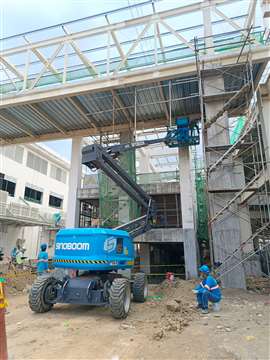
The reason for the turnaround comes down to greater confidence in the market. “All the investments that are underway had been announced early last year. But we had the scenario with the tariffs from late last year that kind of made everybody hesitate a little bit. But then the investors decided to put their money where their mouth is and start the projects that they committed to.”
In addition, there is the potential of snap elections ahead of the planned general election slated for February 2028. “That has possibly hastened the schedule for the start of construction projects in Malaysia, in addition to other factories - before things changed.”
The situation is not the same in nations which do not have as strong safety regulations as Malaysia. “In places like Thailand and Indonesia and the Philippines, the government doesn’t take such an active role. We’re just hoping that they get stronger but it’s not really happening for the certification of MEWPs,” says Ong.
And there are other market variations in each country. “In Thailand MEWPs have been popular for many years, it’s just that a bigger number of projects have now started up that’s driving the demand.
“In Indonesia, the Chinese contractors have come in with investments like [car manufacturer] BYD. They’re known for their speed, and they use MEWPs to help accomplish. These are really driving demand – one site might use up to 1,000 machines.”
Varying markets
Beyond the top five rental companies in the region there are many small domestic outfits. “There are also new companies opening up, but they’re kind of small and dipping their toes into the water. We are also seeing medium-sized companies coming in from China that are linked to manufacturers, but besides that, there are no companies from Europe, the US or Australia.”
For rental companies seeking to start up in rental in Malaysia, there are barriers. “The machines are expensive - you can’t easily buy second-hand machines because you have to import new machines to get government approvals.”
Ong adds, “It is possible to import older machines, but the certification process is even more convoluted. You need third-party approvals and other requirements which could be quite difficult to obtain.
“And that’s why, you know, there is this demand for new equipment. That’s why Zoomlion and the other big manufacturers are doing a decent business in Malaysia.”
When it comes to equipment prices, the situation in Malaysia is also quite different to other parts of the world. “Nobody is dumping prices. In fact, prices have gone up 20% from last year because there are not enough new machines in the market.”
Understandably, this is not uniform across the region. “I’ve seen prices go down as well in other countries. For example, in the Philippines with the recent oil price shocks rental rates tumbled, demand dropped, people get desperate and started lowering prices. Which means we have to follow suit.”
The MEWP market is really very much based on demand and supply, and we have really seen this in Malaysia.”
STAY CONNECTED



Receive the information you need when you need it through our world-leading magazines, newsletters and daily briefings.
CONNECT WITH THE TEAM