



Read this article in 中文 Français Deutsch Italiano Português Español
Can the UK fulfil its ambitious nuclear construction plans?

30 March 2026
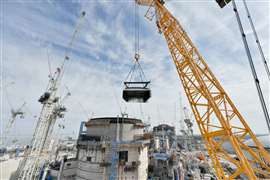 Modulift modular rebar lifting frame at the Hinkley Point C nuclear power station site. Photo: Modulift
The UK’s nuclear construction plans - for both conventional and small modular reactors (SMRs) - are ambitious. Vincent Zabielski, partner, Pillsbury asks if the Office for Nuclear Regulation will be up to the task and argues why international regulators need to aim for more standardisation.
A looming energy crisis and fractious geopolitical headwinds have increased attention on nuclear energy and the critical role it could play in global energy systems.
However, UK projects have struggled to meet budgets and schedules, with many pointing to a complex regulatory system as part of the challenge.
While it is crucial that the UK’s regulatory framework remains rigorous and safety-led, it must continue evolving to support timely project delivery.
Complex but evolving regulatory framework
The Office for Nuclear Regulation (“ONR”) has a strong global reputation for safety, independence and rigour, and plays a critical role in maintaining public confidence in nuclear power.
All of these traits must remain in place without compromise, but processes need to be streamlined and made more efficient.
Global regulatory counterparts such as the United States Nuclear Regulatory Commission (“NRC”) recognise the urgent need for simplification and flexibility – both crucial facets of enabling construction and delivery - but also the need to prioritise and uphold robust safety measures and operational management.
Likewise, the Finnish government have this month put forward proposals for a new Nuclear Energy Act, seeking comprehensive reform to a decades-old legislative text, adapting it in line with societal and technological evolutions.
The European Pressurised Water Reactor (EPR) project being built at Hinkley Point C (“HPC”) is an illustrative example.
The EPR, already one of the safest reactors ever designed when selected for Hinkley, required more than 7,000 design changes to meet the UK requirements.
To be fair, many of these modifications reflect legitimate UK-specific safety expectations and post-Fukushima enhancements, but the scale of divergence indicates that greater international standardisation is needed.
These thousands of changes to the EPR design saw the HPC project increase its steel and concrete use by 35% and 25% respectively, compared to its sister project at Flamanville in France, initially held as a reference point for Hinkley Point C.
These adaptations also contributed to delays, cost escalation, and a revised completion window of 2029 to 2031, compared to an original target of 2027.
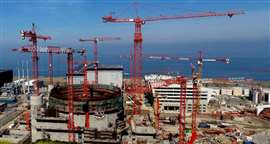 Construction of the EPR nuclear power plant at Flamanville, France (Wikipédia, CC BY 3.0, via Wikimedia Commons)
Much to its credit, the ONR recognises the need for greater efficiency and increasing international cooperation.
In particular, it has been working more closely with the US NRC to explore opportunities for regulatory alignment, particularly for advanced reactor and SMR technologies.
SMRs in particular present an opportunity for regulators to adopt more agile, risk-informed approaches, reflecting their modular design and potential for standardisation across jurisdictions.
Such collaboration could reduce unnecessary duplication, enable shared assessments, and accelerate deployment timelines, all while maintaining high safety standards.
New ‘life-extension’ a necessary ancillary
While progress is made at Sizewell and Hinkley Point to bring new nuclear on-line, the UK still faces a declining nuclear output over the course of the next decade.
As a result, the choice to provide a ‘life-extension’ of the existing Sizewell B nuclear power plant is a logical next step to at least partially stem the decline while the next generation of nuclear power plants are being constructed.
Sizewell B’s design, the only pressurised water reactor (“PWR”) currently operational in the UK, fortunately lends itself perfectly to provide a temporary solution.
The PWR design, which is the most deployed design world-wide, is typically licensed for 40 years. However, the originally-licensed life of the plant and its potentially useful life are two far different concepts.
For a start, the principal constraint of an ageing reactor, neutron embrittlement of the reactor vessel, can be closely predicted and monitored. With the appropriate maintenance, a PWR’s operating license can safely be renewed and the design will safely generate carbon-free power for as much as 60, or even 80, years.
The creation of this significant power for the next 20 years from an existing asset is a relatively easily achievable advantage, given the notable challenges that have plagued new power plant construction. But the UK’s ambitions to be a global leader extend beyond only large-scale nuclear reactors, with the SMR programme also having been identified as a considerable growth area.
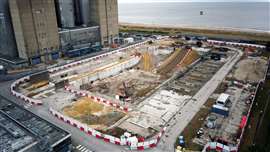 The cleared site of the Sizewell A turbine hall (PHOTO: NRS)
SMRs for new energy demands?
It’s widely documented that AI capacity requires huge levels of energy to function. As a result, the question of how to power AI in a market alongside increasing demand for data centres is a key concern for both international governments and tech giants alike.
Nuclear power is emerging as an obvious front-runner in this pursuit, and international players in the tech sector have been partnering with nuclear energy projects, including those harnessing the power of the SMR.
The UK has also been upping commitments to developing its nuclear capabilities, with a £2.5bn pledge to support the development of SMRs, including proposals centred on sites such as Wylfa in North Wales.
The construction of large-scale reactors can of course be considerably slower. SMRs slot into the equation as a more agile solution to what is a fragile moment for global energy supply.
While a faster pace of SMR development to run in lockstep with demand for data centres makes sense, it will require an equally fast programme of education. The world’s first commercial nuclear power plant, Calder Hall, was British, but nuclear skills have diminished since, so upskilling a workforce to match the scale of deployments will be vital to realising the UK’s nuclear future.
Steps are already being taken, with the government committing to supporting UK workers to access the new job opportunities in the sector, but the success of this training programme will be a key signifier as to whether ambition can be turned into action.
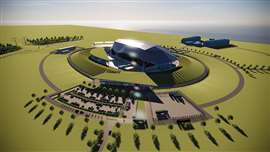 A digital render of a Rolls-Royce small modular nuclear reactor (Image courtesy of Hochtief)
Lessons from the past
There are historical parallels of energy crises prompting greater investment in nuclear energy that serve as a path forward in the current climate.
France in the 1970s responded to the 1973 oil crisis with an unprecedented undertaking within nuclear, under the ‘Messmer plan’. The plan envisaged the construction of roughly 80 reactors by 1985 and up to 170 by 2000, with construction on the first reactors beginning within a year.
While the full programme proved to be perhaps overly ambitious, France still delivered 56 reactors in little more than a decade, fundamentally reshaping its energy system.
The Messmer plan still has far-reaching benefits, with 220,000 people now employed across 2,600 nuclear companies in France’s industry, and a nuclear fleet of 56 reactors within 18 plants.
A significant share of this output - around 12.7 terawatt-hours last year - reaches the UK via subsea interconnectors. This example makes clear that a comprehensive nuclear plan can still yield advantages decades beyond its introduction, and it’s an example the UK would do well to heed to drive the nuclear renaissance further forward.
Where to now?
The good news is that the trajectory is positive.
The UK is keeping nuclear firmly on the agenda, and recent measures such as increased international cooperation and efforts to streamline planning restrictions are steps in the right direction.
With continued efforts to streamline processes, embrace international collaboration, and align regulation with modern construction realities, the UK is well placed to deliver on its nuclear ambitions.
Vincent Zabielski is a partner at law firm Pillsbury.
STAY CONNECTED



Receive the information you need when you need it through our world-leading magazines, newsletters and daily briefings.



CONNECT WITH THE TEAM