



Read this article in 中文 Français Deutsch Italiano Português Español
Onboard generators - meeting the demand for power

04 November 2026
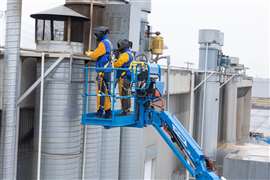 A Genie S-85 XC FE carrying out welding. (Image: Genie).
From powering welding equipment on large boom lifts to providing electricity for everyday tools, onboard generators are becoming an increasingly important part of the MEWP specification as jobsites become larger, taller and more complex.
Onboard generators provide electricity for tools and equipment used by operators working at height, without requiring a separate portable generator or cables running from ground level.
Harrison Hydra-Gen is one of several specialist suppliers serving MEWP manufacturers, with a history in fire and rescue, oil and gas and other mobile equipment applications dating back to 1969.
“We provide mobile power to the job site. That’s the bottom line,” says Jeff Brock, vice president of business development at Harrison Hydra-Gen.
The company’s involvement in the access sector began around 15 years ago, when Genie became its first AWP customer, installing a 12 kW generator on an S-60 boom lift. Harrison Hydra-Gen subsequently expanded its relationships with manufacturers including Skyjack and MEC, among others.
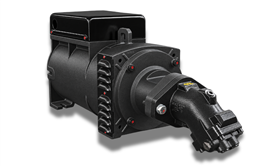 A 7.5kW hydraulic generator from Harrison Hydra-Gen.
Other providers such as Dynaset and Fabco Power also supply generators, while OEMs also have their own solutions, however, the difference with Harrison Hydra-Gen is that it focuses solely on equipment for aerial platform equipment.
Two established approaches
Traditionally, onboard generators have been either hydraulically driven or belt-driven, although electrically driven systems and inverters are also part of today’s equipment offerings.
Hydraulic systems use power from the machine’s hydraulic circuit to drive the generator, while belt-driven versions take mechanical power from the engine through a belt arrangement. Neither requires a separate engine dedicated to generating electricity.
Harrison Hydra-Gen offers both arrangements, with the choice determined partly by available space and engine power. For manufacturers, the decision also involves installation flexibility, efficiency and the interaction between power generation and boom operation.
Gary Crook, vice president of engineering at MEC Aerial Work Platforms, explains, “A belt-driven generator has an efficiency advantage because power is transferred mechanically from the engine. But these units tend to be large and heavy, and they’re mounted directly to the engine, where heat and vibration create challenges.”
Hydraulic systems offer different advantages. “Hydraulic generators give us more flexibility. We can mount them remotely, away from engine heat and vibration, in a location that works better with the machine’s overall design,” says Crook.
“This can have a minor effect on efficiency, because we’re converting mechanical power into hydraulic power and then back into mechanical power to drive the generator. But the generator only needs to spin when electrical power is required.”
Philip DeCorte, vice president of engineering at Harrison Hydra-Gen explains that the level of integration can also vary between manufacturers.
“Some customers may just want a generator with a motor and they’re going to supply the hydraulics to us. Some of them want a complete system where we supply the manifold and everything to be able to drive the generator.”
The electrical installation can also be customised, including the provision and location of electrical boxes.
“We want to make the right generator for the right application,” says DeCorte.
Power requirements
The most common generator outputs discussed by the manufacturers are approximately 3.5 kW, 7.5 kW and 12 kW, with smaller units intended for general electrical tools and larger systems primarily serving welding applications.
Smaller generators are used for tools, lighting and charging equipment, while the 7.5 kW and 12 kW versions are selected according to welding equipment requirements. Plasma cutting is another application for larger systems.
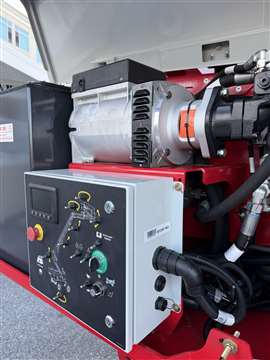 A generator onboard a MEC boom lift. (Image: MEC).
According to DeConte, changes in welding technology is a reason for increased generator outputs. Newer welding equipment from the likes of Miller or Lincoln can provide higher amperages, with customers increasingly requesting larger equipment.
MEC has experienced a similar change in customer specifications.
“For a long time, 7.5 kW represented the upper end of what customers were requesting. While that remains our most commonly specified generator size today, about three years ago, we started seeing demand for 12 kW generators on our largest booms,” says Crook.
“That progression is largely tied to the market demand for steel erection, such as data centre construction, for example. Bigger booms are working on bigger steel structures, where thicker steel joints require larger weld rods and heavier weld beads. Those applications need more power at height.”
MEC offers 3.5 kW, 7.5 kW and 12 kW options, with the greatest demand for its 12 kW generators on the 135-RJ, followed by the 85-J. The option is also available on the 66-RJ.
At the smaller end, Crook identifies grinders, cut-off wheels and rotary hammer drills as typical applications.
“The common advantage across all three sizes is mobility. Operators can move around the jobsite and work at height without being tethered to a ground-level power supply.”
OEM integration
Genie provides generator solutions through its Lift Power system, with different configurations depending on the machine and geographical market.
Nick Tupper, Genie product manager – booms, explains that its current hydraulic generator options are 3 kW for global markets, 7 kW for Australia and 12 kW for North America.
These systems have their own dedicated hydraulic pump, while Genie’s S-85 XC FE hybrid and S-85 XC E electric booms use generators driven by dedicated electric motors. The latter machines can also provide 3 kW of AC power through a DC-to-AC inverter.
Genie’s earliest generator system was a 3 kW belt-driven arrangement powered from the engine crankshaft pulley.
Lift Power is offered as a factory-fit option on selected articulating and telescopic booms, including the Z-45 XC, Z-62, Z-80/60 and ZX-135/70, together with a range of S and SX telescopic models.
“As jobsites become larger, more complex and more vertically oriented, operators spend increasing amounts of time working at height,” says Tupper.
“The ability to access power in the platform saves time because operators aren’t constantly returning to ground level to find a power source for tools.”
Genie’s hydraulic system also has a dedicated pump, which avoids generator spool-up delays when the boom needs to move.
MEC has addressed the same issue through a different operating arrangement.
“On some hydraulically driven systems, operators have to wait for the generator to wind down before moving the boom, then wait for it to spin back up before resuming work,” says Crook.
“That can mean roughly five seconds delay in each direction, or 10 seconds of waiting every time the operator makes a small positioning adjustment, which can be disruptive.”
MEC’s solution allows simultaneous boom movements at reduced speed while the generator is operating.
“For a steel erector moving from one weld joint to the next, that eliminates the repeated waiting associated with generator shutdown and restart. Those small interruptions really add up over a workday.”
Different markets, different specifications
Skyjack offers belt-driven and hydraulic generator systems ranging from 3.5 kW to 12 kW across its larger engine-powered rough terrain scissors, telescopic booms and articulating booms.
In North America, selected Skyjack scissors and booms can be specified with its Welder Ready Package, providing three-phase power to the platform.
According to Skyjack, approximately one in every two of its booms in North America is equipped with the largest generator option and Welder Ready Package, which is particularly popular among steel erectors.
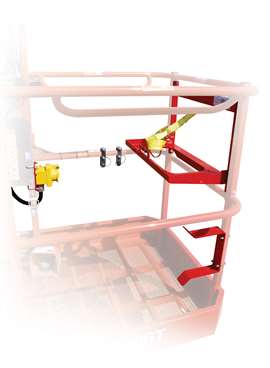 Skyjack’s welder package. (Image: Skyjack).
Generators remain factory-order options on its engine-powered scissors and booms.
Brock identifies North America as the principal market for higher-output generators, estimating that generator fitment on booms has increased from around 50% to approximately 80% over the past 15 years.
“It seems to be coming to standard. The rental companies seem to only want the booms with the generators,” he says.
He associates this demand with welding applications in construction, including data centres, bridges and infrastructure projects.
Outside North America, Brock sees greater demand for smaller generators used to power tools and charge equipment. Harrison Hydra-Gen supplies 50 Hz and 60 Hz systems for different markets, with Brock also highlighting growth in Asia.
MEC reports particularly high generator take-up on its largest machines.
“On our largest booms, we estimate that approximately 90% are ordered with a generator, compared with less than 50% on smaller booms,” says Crook.
MEC’s generators are optional and can be retrofitted, although Crook recommends factory installation.
“When approximately nine out of 10 customers selecting one of our largest booms also specify a generator, it tells us how central onboard power has become to the work those machines perform.”
For Genie, North American demand also reflects requirements around external cables and equipment.
“Across North America, jobsites are increasingly implementing dropped-object and platform fall-prevention requirements, which is increasing demand for integrated power solutions, like Lift Power, that eliminate the need for external power cables,” says Tupper.
Rental requirements
For rental companies, generator output and its effect on machine operation are generally more important than the drive arrangement, according to MEC.
“Rental companies generally come to us with a specific generator output requirement. They’ll ask for a particular kW rating, but they typically aren’t concerned with whether the generator is hydraulically or mechanically driven,” says Crook.
“What matters is that the machine delivers the power their customers need and allows them to work efficiently.”
Genie similarly emphasises immediate power availability.
“Although not all job sites call for MEWPs with power in the platform, when it is needed, rental companies and operators expect generators to produce power at the flip of a switch,” says Tupper.
The electric alternative
Electrification is also influencing how manufacturers provide power at height, with dedicated electric motors and inverters offering alternatives to conventional engine-driven systems.
DeCorte explains that Harrison Hydra-Gen can drive generators using electric motors powered by machine batteries. The company also supplies systems for hybrid equipment, including generators used to recharge batteries.
For MEC, the challenge is delivering sufficient AC power efficiently from an electric machine’s DC electrical system.
“On an electric machine, the goal is to convert the battery’s DC electrical energy into usable AC power with as few conversion losses as possible,” says Crook.
“Solid-state inverter technology offers a potential path, but there are challenges to overcome, especially at the higher power levels required for welding.”
He identifies heat generation, welder duty cycles and cost as particular considerations.
At lower power levels, MEC also sees demand in some regions for compact inverters providing approximately 1 kW of single-phase AC power on indoor battery-powered MEWPs, principally for charging cordless tool batteries.
Skyjack provides power-to-the-platform functionality on its battery-electric scissors and booms, allowing an external supply to be connected at the machine’s base.
Looking ahead, Crook expects onboard power to become increasingly important across different MEWP configurations.
“Every time an operator has to stop work, move the machine unnecessarily, or return to ground level to access power, there’s a productivity cost,” he says.
“It’s MEC’s overall goal to reduce those interruptions in the MEWPs we offer, benefiting both the operators using the machines and the rental companies supplying them.”
CONNECT WITH THE TEAM